Course compass
Guiding question: Why does a rocket nozzle converge and then diverge instead of being a simple pipe?
1 — The physical question
Why does a rocket nozzle converge and then diverge instead of being a simple pipe?
We start from the concrete problem before notation. The goal is to understand what we seek, then why mathematics becomes useful.
2 — How to read the symbols and units
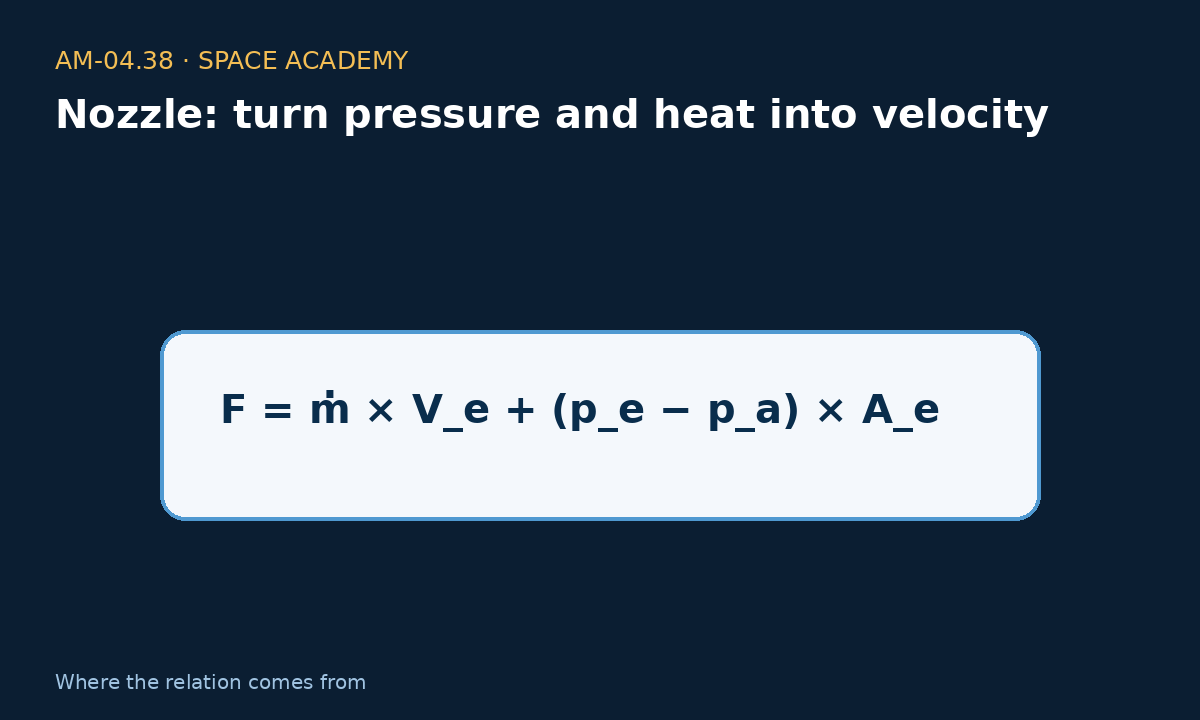
F = ṁ × V_e + (p_e − p_a) × A_e. Read: “F equals m dot times V e, plus p e minus p a, times A e”.
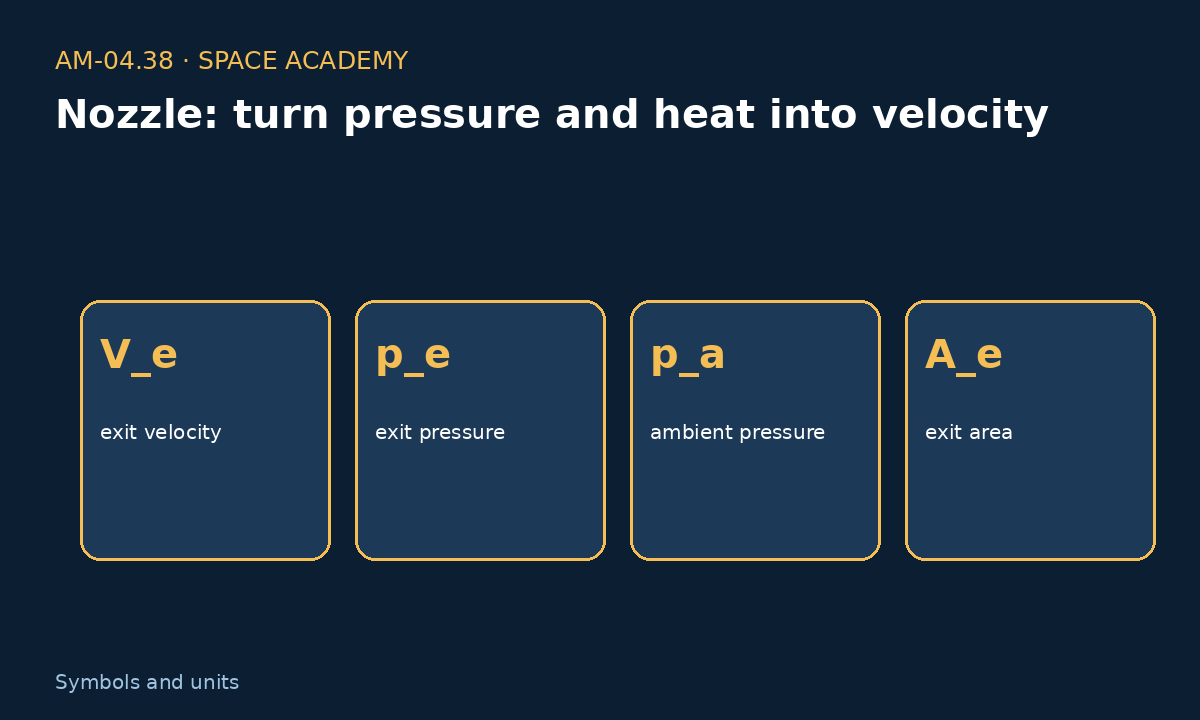
V_e — exit velocity ; p_e — exit pressure ; p_a — ambient pressure ; A_e — exit area
3 — Where does the relation come from?
The nozzle accelerates exhaust. Thrust combines momentum flow ṁVₑ and an exit-pressure contribution. A converging-diverging nozzle lets gas choked at the throat continue expanding in the divergent section.
Every number used below is explicitly treated as data, convention, learning assumption, or calculated result.
4 — A — Momentum term
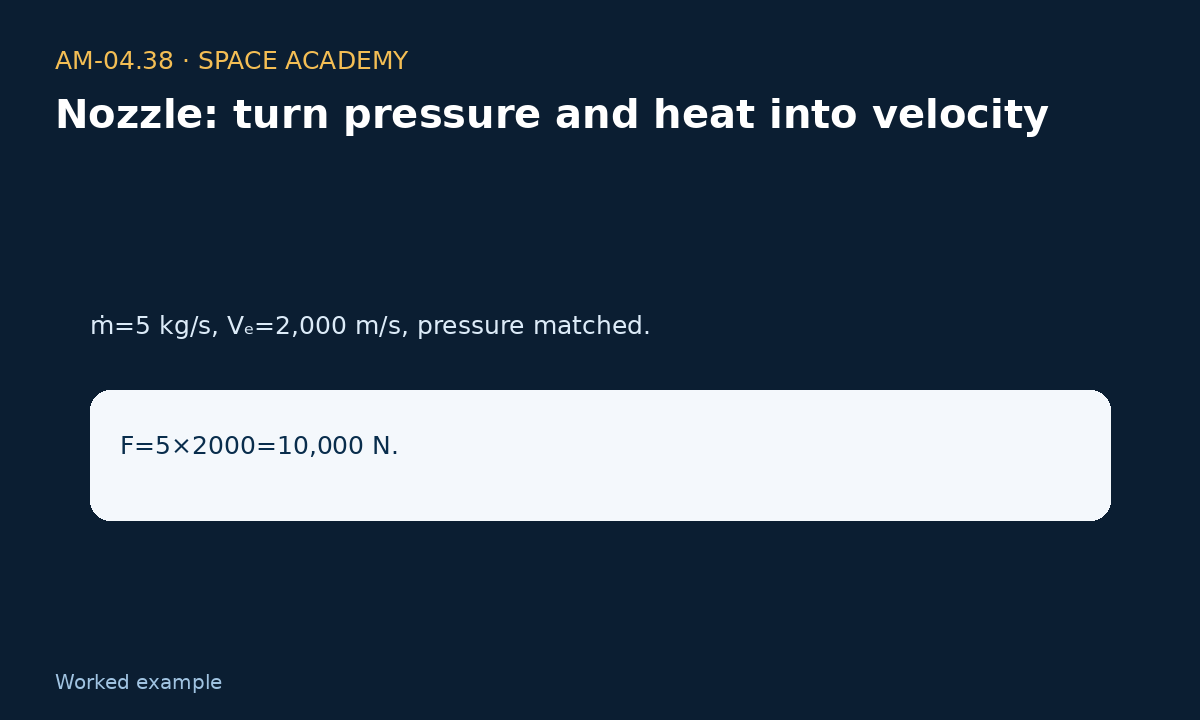
Where do the numbers come from? ṁ=5 kg/s, Vₑ=2,000 m/s, pressure matched.
Step-by-step calculation: F=5×2000=10,000 N.
Pressure term is then about zero.
5 — B — Pressure term
Where do the numbers come from? pₑ−pₐ=20,000 Pa, Aₑ=0.25 m².
Step-by-step calculation: F_p=20,000×0.25=5,000 N.
Pressure difference adds thrust.
6 — C — Different ambient
Where do the numbers come from? Same pₑ, but pₐ decreases with altitude.
Step-by-step calculation: The (pₑ−pₐ) term increases if other quantities stay equal.
This is one reason a nozzle has an optimum operating condition.
7 — Sensitivity, inverse calculation, and sanity check
Change one input, predict the direction of the result, calculate, then check units, sign, order of magnitude, and limits.
Essential limit for Nozzle: turn pressure and heat into velocity: the displayed relation is a learning model. A real system adds detailed geometry, variable properties, sensors, uncertainty, transients, and testing.
8 — Why this matters in a mission
In a space mission, why does a rocket nozzle converge and then diverge instead of being a simple pipe? The useful skill is not reciting the formula but knowing which data are needed, which are measured, and when the model becomes insufficient.
10 — Go deeper: from calculation to physical understanding
A nozzle converts one form of energy into another
Gas in the chamber has high pressure and temperature. The nozzle provides a geometry in which some internal and pressure energy can become kinetic energy of the jet. Saying “the nozzle accelerates the gas” is correct but incomplete: the exit velocity comes from expansion of the gas.
Why a diverging section can accelerate supersonic flow
Our intuition from slow liquid flow can mislead us. For compressible supersonic flow, a diverging area can continue to increase velocity while static pressure and temperature decrease. The behaviour depends on Mach regime, which is exactly why throat choking should be understood before the divergent shape.
Exit pressure must be compared with ambient pressure
The (p_e-p_a)A_e term in the thrust equation reminds us that an engine does not operate in the same environment at sea level and in vacuum. If p_e differs from p_a, pressure contributes to thrust and expansion is not perfectly matched. This explains why a geometry optimised for sea level is not necessarily optimal in vacuum.
A larger nozzle is not automatically a better nozzle
More expansion can improve some vacuum performance, but it also imposes mass, length, structure, cooling, and integration constraints. At sea level, excessive expansion can lead to unfavourable flow behaviour. Real design is therefore a mission compromise, not a search for the largest possible cone.
9 — Exercises and answers
Challenge 1
ṁ=5 kg/s, Vₑ=2,000 m/s, pressure matched.
Challenge 2
pₑ−pₐ=20,000 Pa, Aₑ=0.25 m².
Challenge 3
Same pₑ, but pₐ decreases with altitude.