Course compass
Guiding question: Why can the same force produce very different pressure depending on area?
Markers: 📏 MEASURED · 📐 CONVENTION · 🧮 CALCULATED · 🎓 TEACHING ASSUMPTION · ⚠️ APPROXIMATION
- define pressure
- define density
- read pascal
- understand limits of simple models
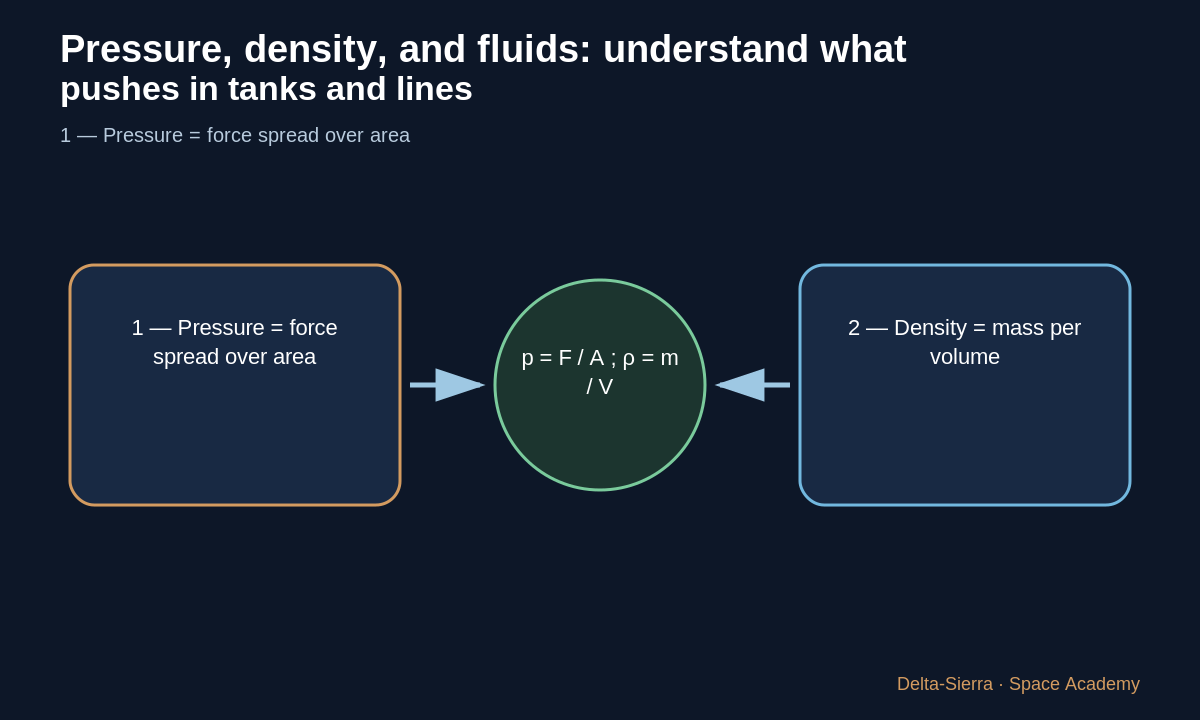
1 — Pressure = force spread over area
The pascal is one newton per square metre. The same force concentrated on less area produces greater pressure.
Pressure is a local fluid quantity, not simply “total force in the tank”.
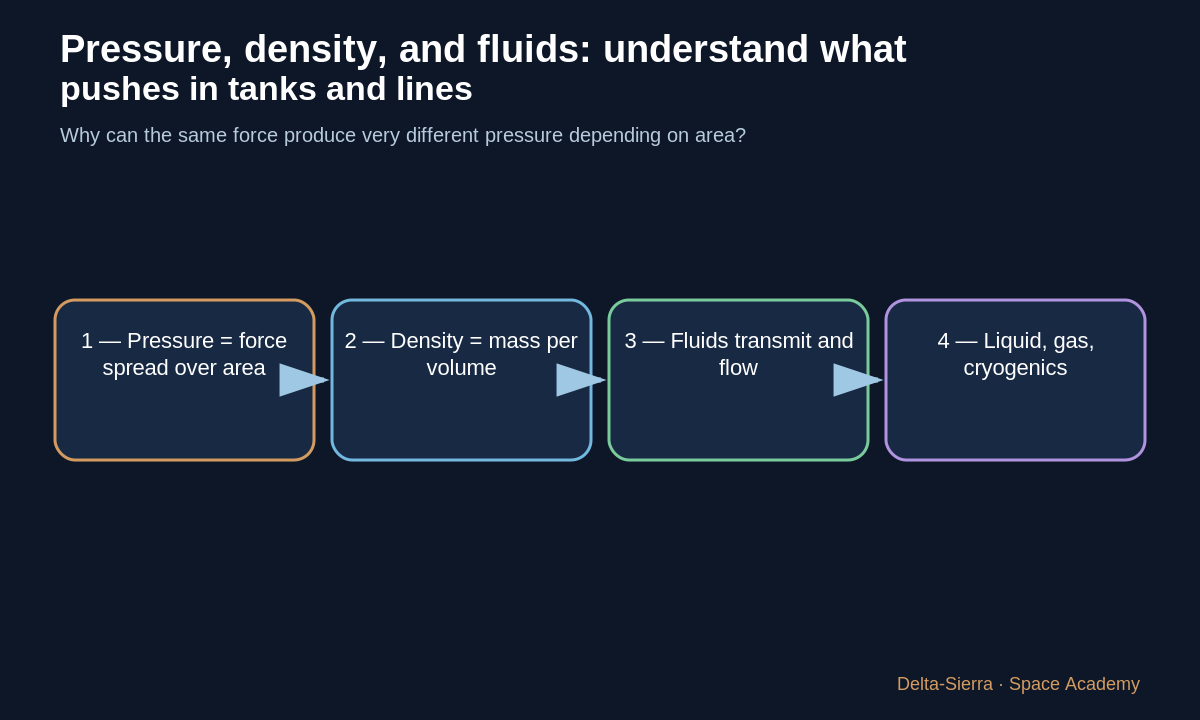
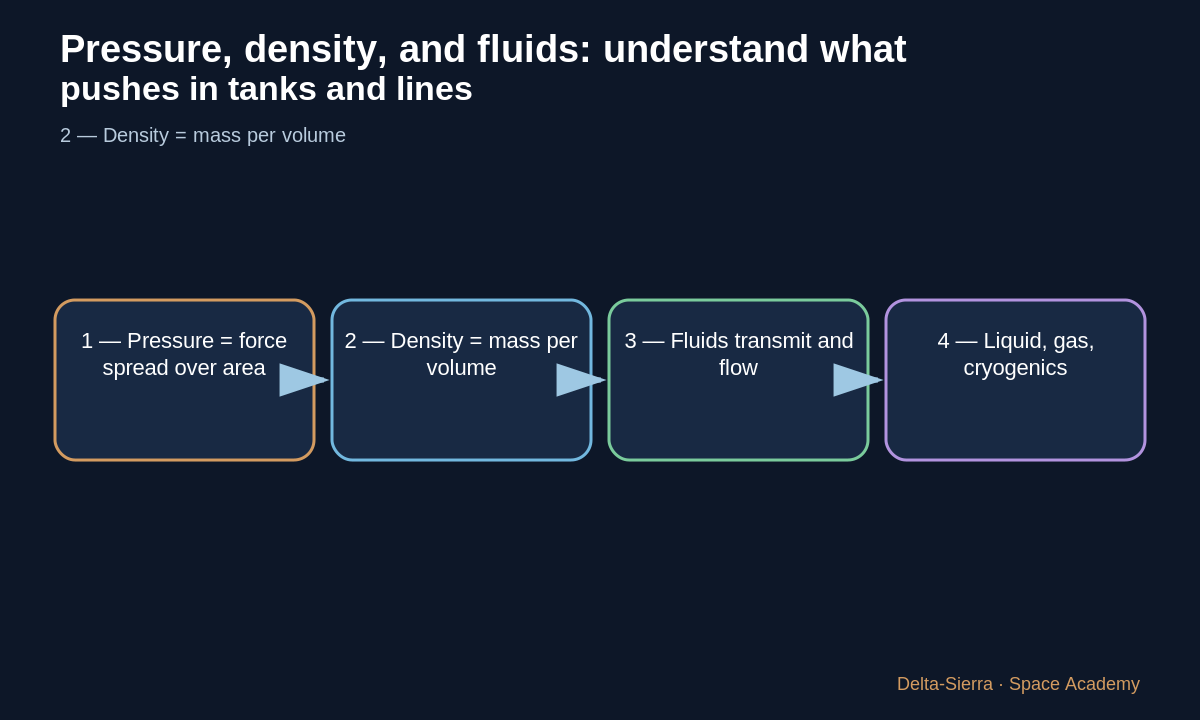
2 — Density = mass per volume
ρ is read “rho” and represents mass density here. Greater density means more mass in the same volume.
Temperature can change fluid density, especially for gases.
3 — Fluids transmit and flow
Pressure differences can drive flow, but real flow also depends on geometry, losses, viscosity, speed of sound, and fluid state.
A simple pressure equation cannot size an engine feed system.
4 — Liquid, gas, cryogenics
Liquid propellants are fluids; storage, pressurization, and pumping depend on properties and temperature.
This lesson stays conceptual; advanced engine lessons explain architecture without becoming a construction procedure.
Three complete examples: change one assumption to understand
Before each calculation, identify where every number comes from and whether it is measured, conventional, assumed, or calculated.
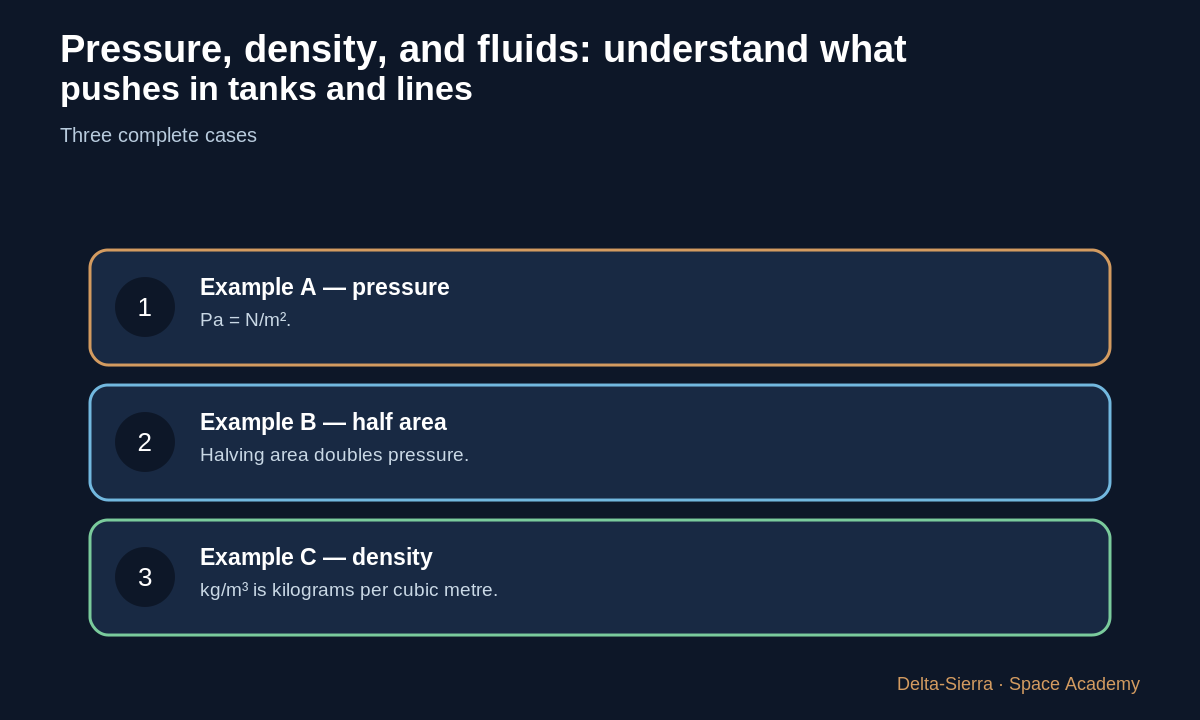
Example A — pressure
F=1,000 N over A=0.5 m²: p=1,000/0.5=2,000 Pa.
Pa = N/m².
Example B — half area
Same force over 0.25 m²: p=4,000 Pa.
Halving area doubles pressure.
Example C — density
m=800 kg in V=1 m³: ρ=800 kg/m³.
kg/m³ is kilograms per cubic metre.
Inverse calculation
If p=2,000 Pa and A=0.5 m², F=pA=1,000 N. If ρ=800 kg/m³ and V=2 m³, m=ρV=1,600 kg.
Common trap and result check
Trap: assuming high pressure automatically means a large total force without knowing the area.
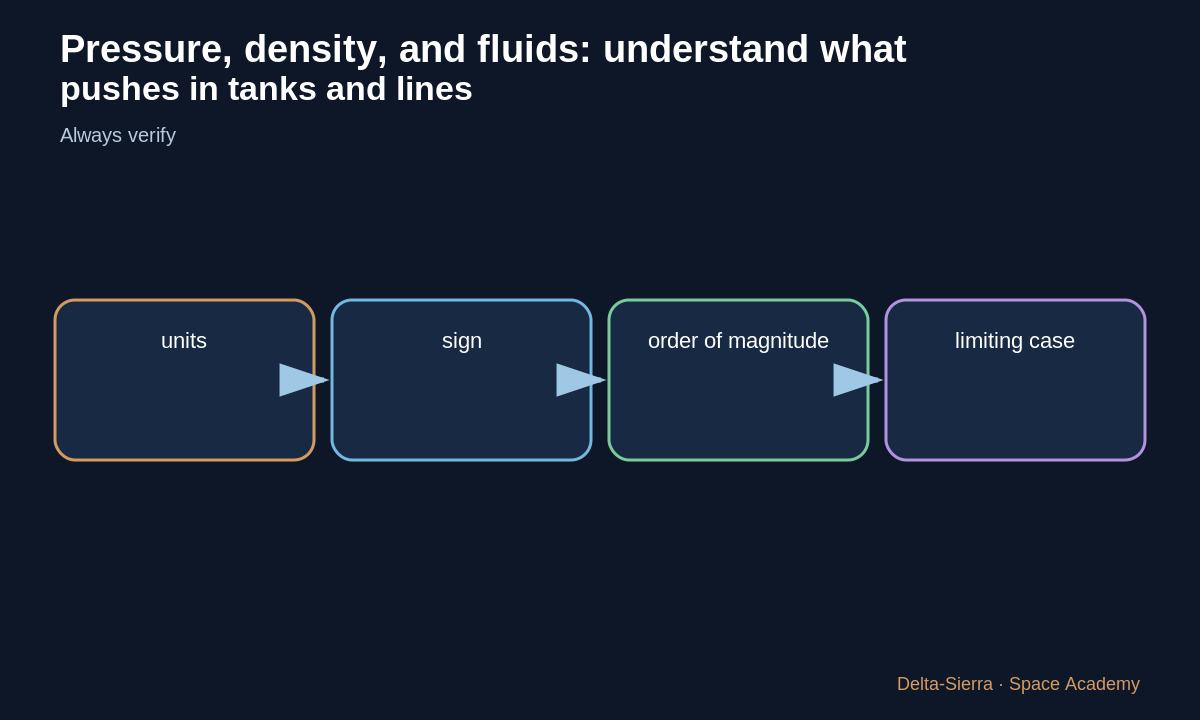
Check units, sign, order of magnitude, and consistency with a limiting case.
Exercises and answers
Restate
Explain in your own words what the equation connects.
Vary
Halve one input and predict the result before calculating.
Check
What independent check can you perform?