Course compass
Guiding question: How can you catch an error by a factor of 10, 1,000, or a million without repeating the entire calculation?
Markers: 📏 MEASURED · 📐 CONVENTION · 🧮 CALCULATED · 🎓 TEACHING ASSUMPTION · ⚠️ APPROXIMATION
- understand the concept
- do a simple calculation
- explain every symbol
- check a result
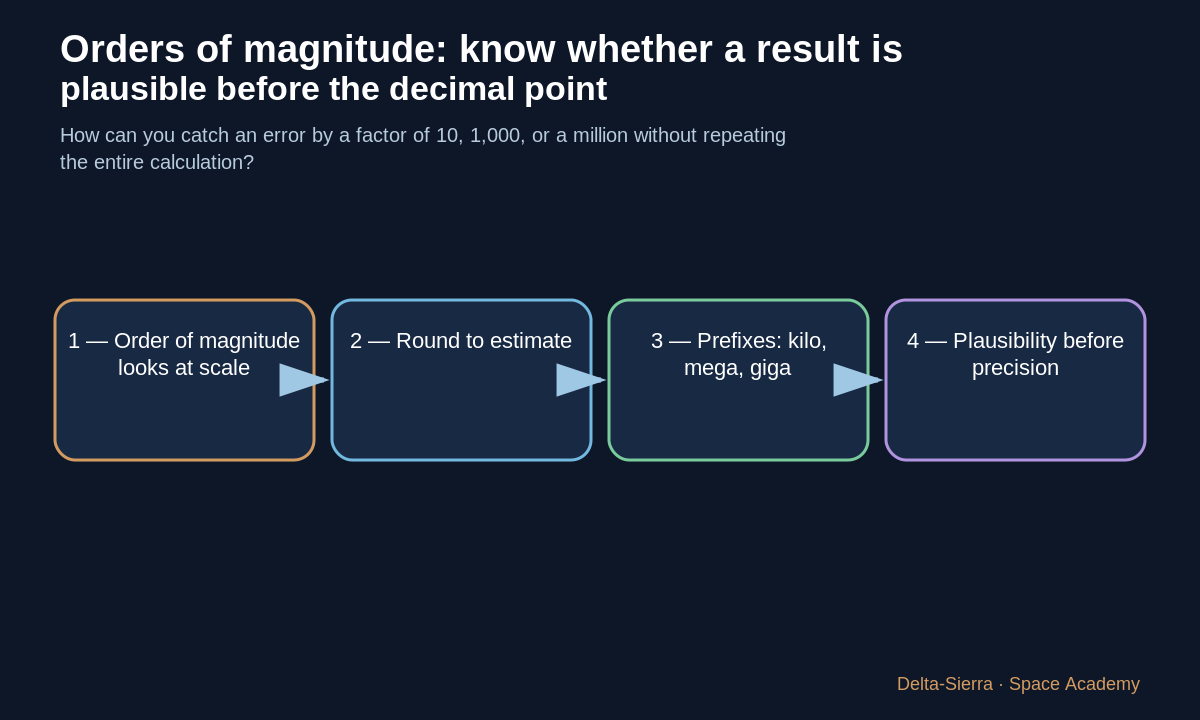
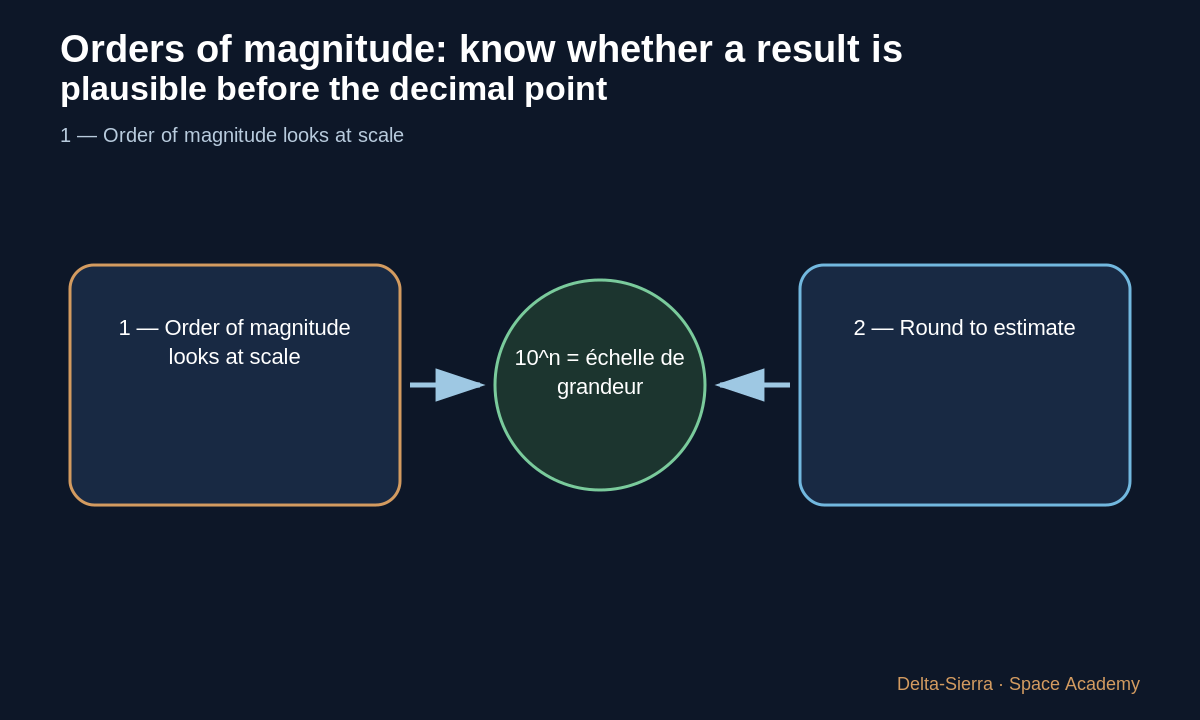
1 — Order of magnitude looks at scale
Between 980 and 1,020 details differ but scale stays near 10³. Between 1,000 and 1,000,000, scale changes by three powers of ten.
Space problems routinely span millimetres to millions of kilometres.
2 — Round to estimate
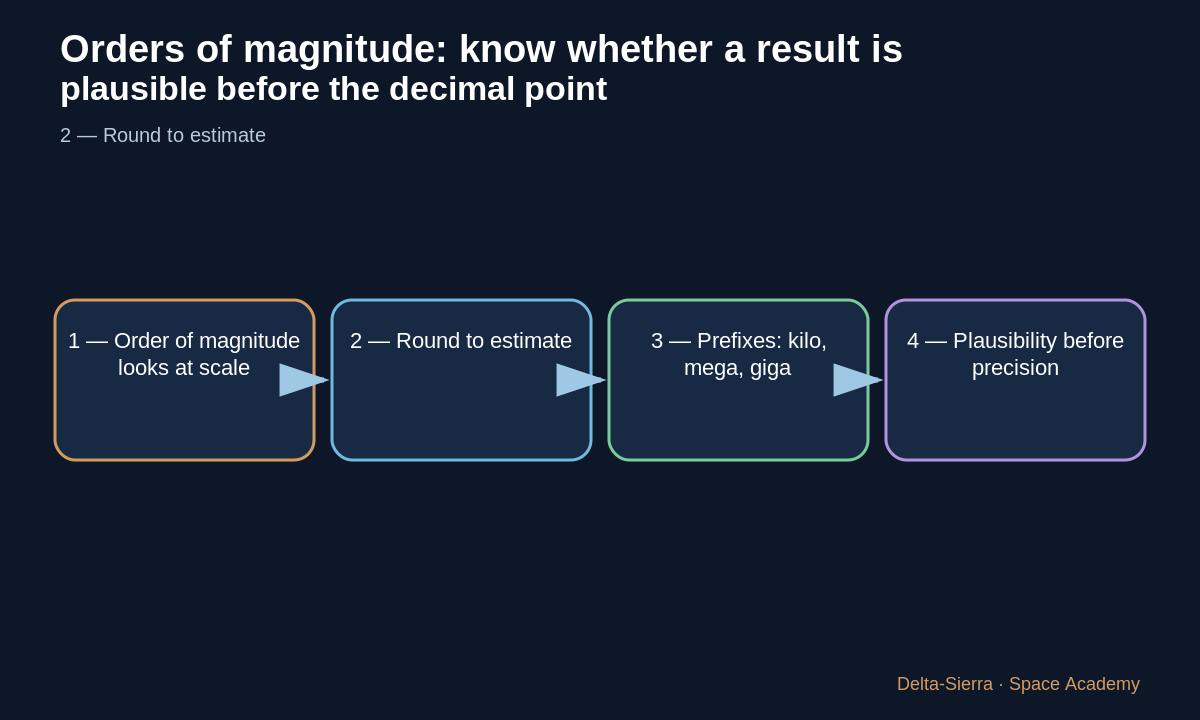
Estimation temporarily replaces awkward values with easy neighbours: 327 becomes about 330 and 9.81 becomes about 10.
The estimate is not the final answer; it is an independent guardrail.
3 — Prefixes: kilo, mega, giga
Kilo means one thousand, mega one million, giga one billion in SI usage. Confusing kN and N creates a factor of 1,000.
Prefixes are part of the quantity, not typography.
4 — Plausibility before precision
An engine producing a few newtons cannot lift a launch vehicle weighing hundreds of tonnes; a few seconds is not an interplanetary transfer time.
Comparing with known cases or physical bounds catches many errors.
Three complete examples: change one assumption to understand
Before each calculation, identify where every number comes from and whether it is measured, conventional, assumed, or calculated.
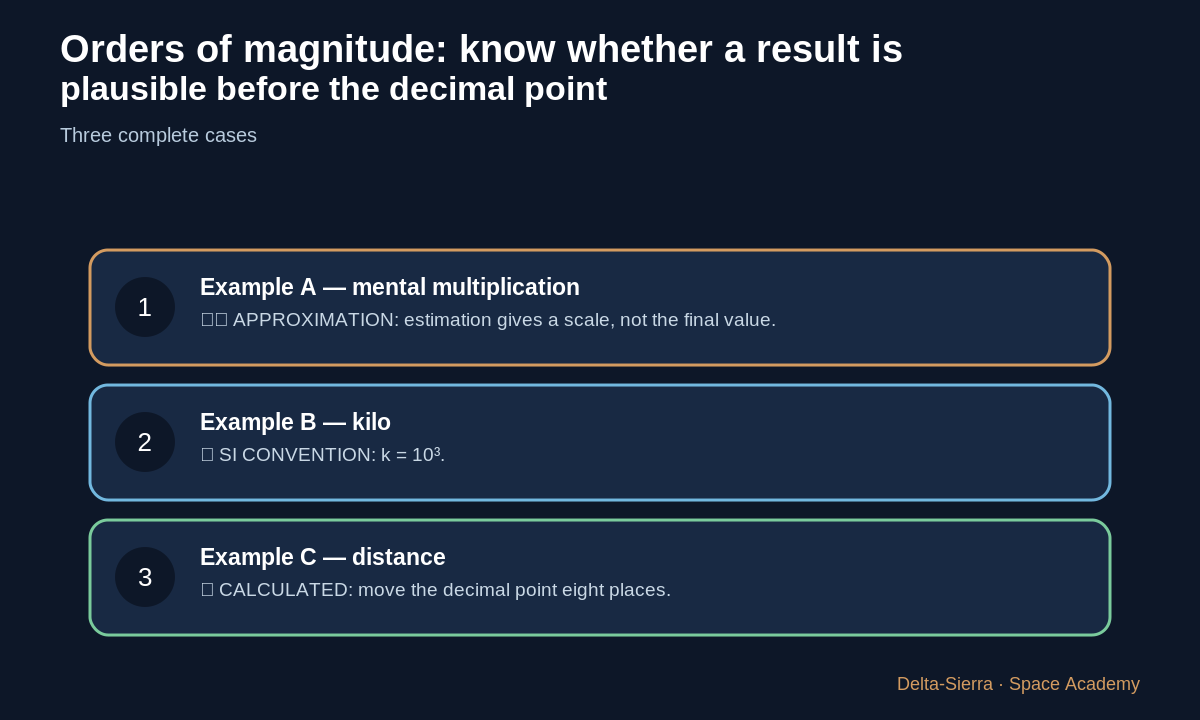
Example A — mental multiplication
327 × 19.8 can be estimated as 330 × 20 = 6,600. The exact result should be near 6.6 × 10³, not 66 or 660,000.
⚠️ APPROXIMATION: estimation gives a scale, not the final value.
Example B — kilo
1,371 kN = 1,371,000 N = 1.371 × 10^6 N.
📐 SI CONVENTION: k = 10³.
Example C — distance
225,000,000 km can be written 2.25 × 10^8 km, making the scale immediately visible.
🧮 CALCULATED: move the decimal point eight places.
Inverse calculation
If a quantity is 3 × 10^7, division by 10^3 gives 3 × 10^4. Exponents subtract because 10^7 ÷ 10^3 = 10^(7−3).
Common trap and result check
Trap: thinking an estimate that is 5% off is useless. To catch a ×1,000 mistake, a 5% estimate is excellent.
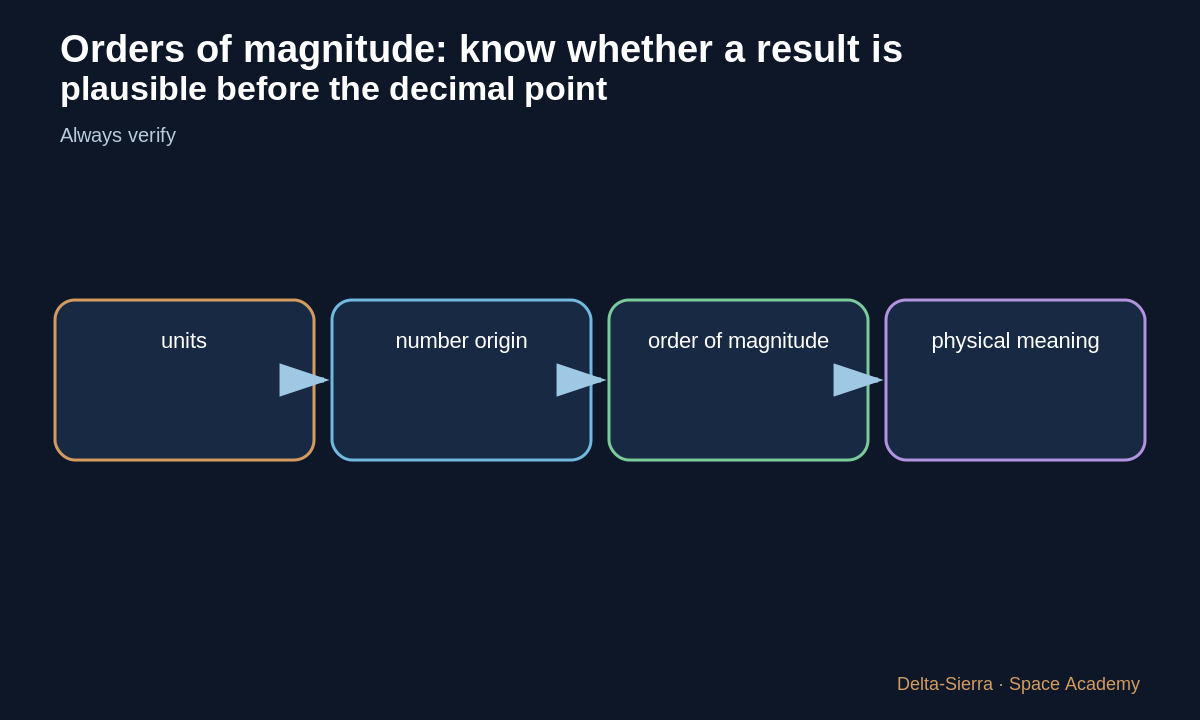
Always check units, order of magnitude, and physical meaning before accepting a result.
Exercises and answers
Understand
Explain the relationship in your own words.
Change an assumption
Modify one input and predict the direction of change before calculating.
Verify
Name two checks after a calculation.