Course compass
Guiding question : Which functions must cooperate to turn a high-speed first stage into a vertically landed vehicle?
Evidence tags : 📏 MEASURED · 📐 CONVENTION · 🧮 CALCULATED · 🎓 LEARNING ASSUMPTION · 🚀 MISSION DATA · 🏭 MANUFACTURER DATA · ⚠️ APPROXIMATION
Objectives :
- describe the return sequence
- understand grid fin purpose
- understand engine relights
- connect navigation and TVC
- separate public facts from proprietary control details
1 — Recovery begins long before touchdown
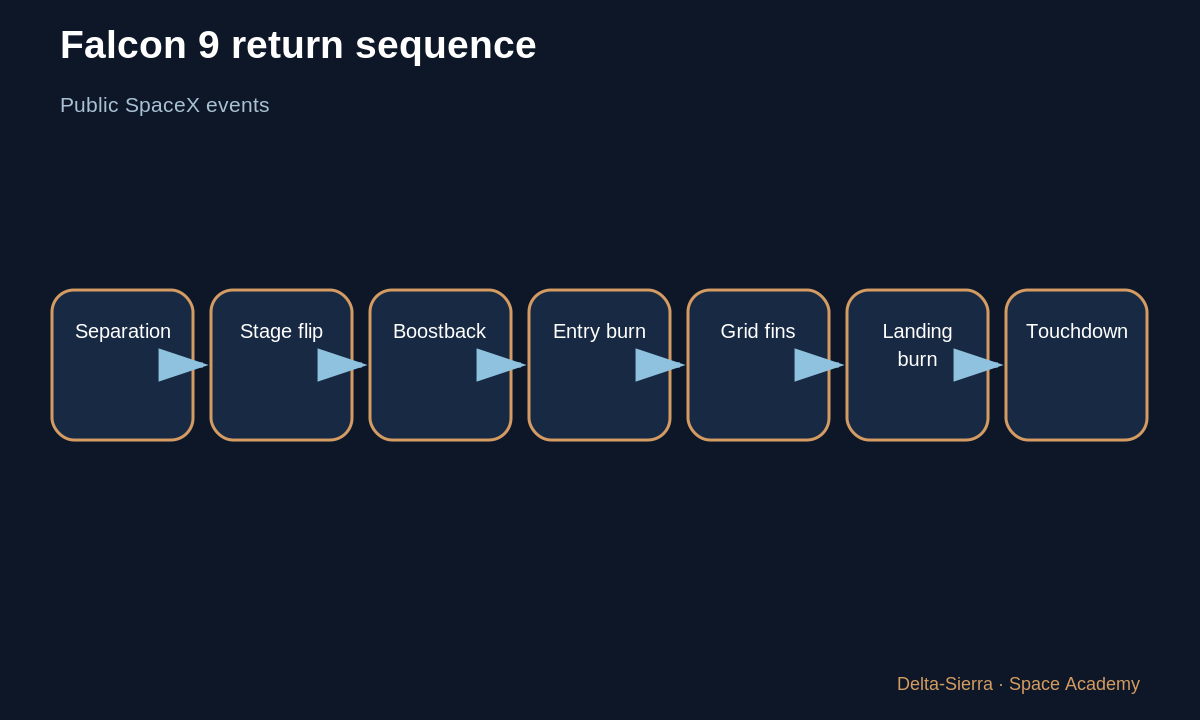
Recovery is not “brake at the last second”. SpaceX publishes sequences where the first stage separates, flips, may perform a boostback burn, then an entry burn, and finally a landing burn.
Each phase reshapes energy, trajectory, and orientation so that the next phase remains feasible.
2 — Why a boostback burn?
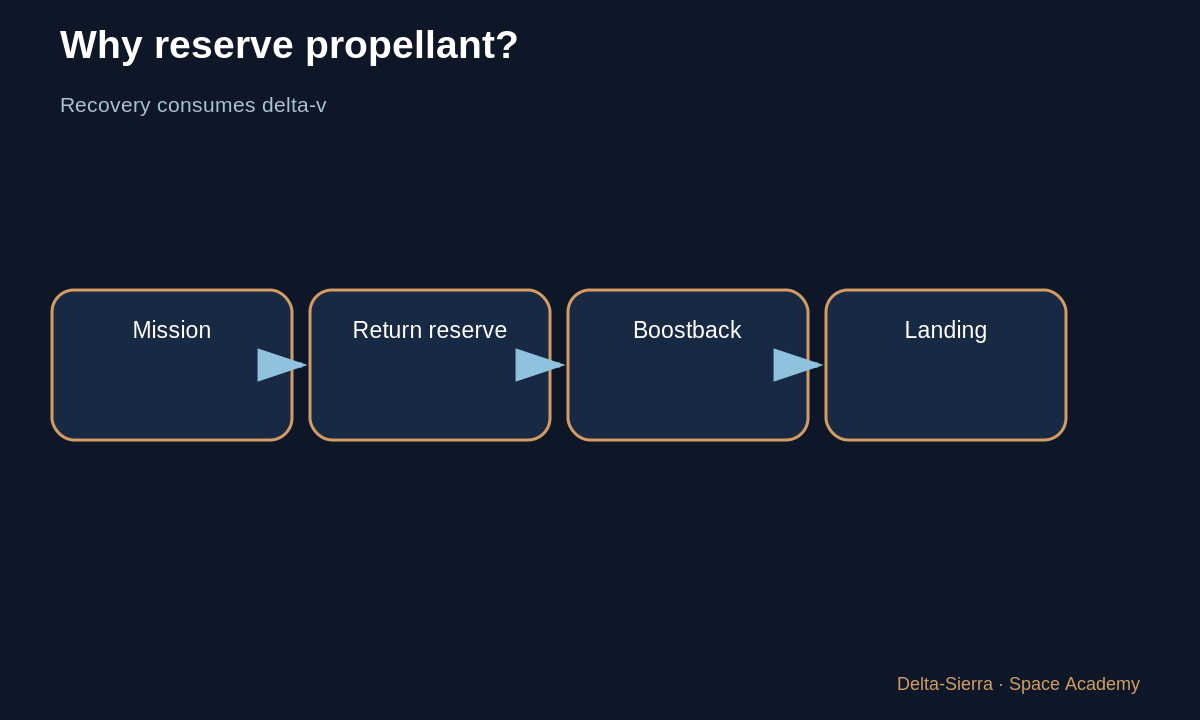
On some missions the first stage must substantially change horizontal trajectory to return toward a landing zone. An engine burn supplies the required delta-v.
There is a tradeoff: propellant saved for return is unavailable for payload acceleration. Reuse therefore has a performance cost built into the architecture.
3 — Entry burn: manage speed and environment
The stage reenters increasingly dense atmosphere. A burn can reduce speed and some thermal/aerodynamic loads before the most demanding portion of entry.
Guidance must account for wind, atmospheric density, and actual vehicle state rather than only an ideal ground-computed path.
4 — Grid fins: use the atmosphere
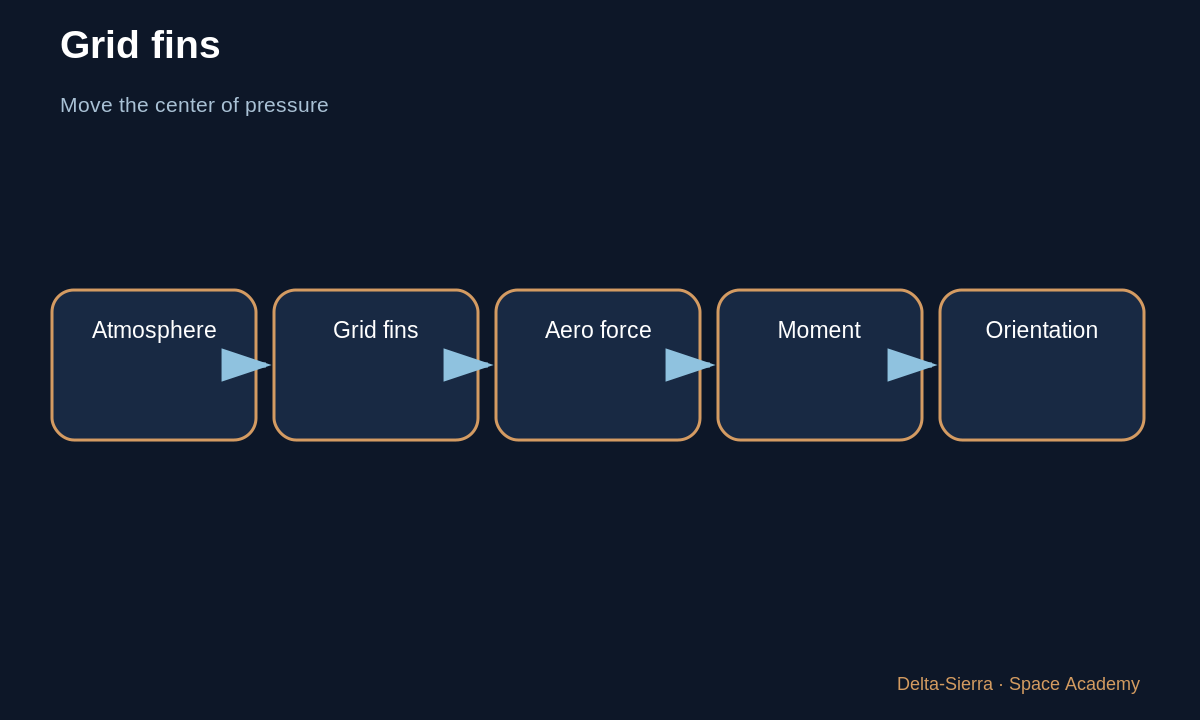
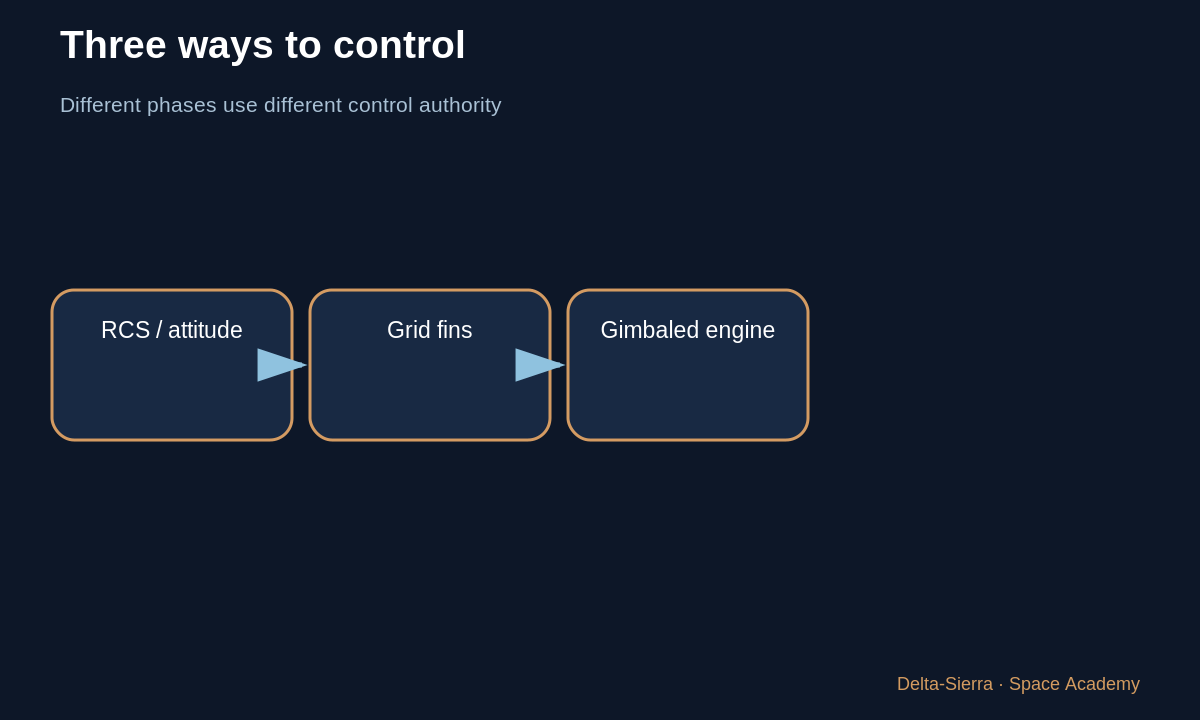
SpaceX states that Falcon 9 carries four hypersonic grid fins that orient the vehicle during reentry by moving the center of pressure.
They do not replace the engine; they provide aerodynamic control when the atmosphere is dense enough. The engine becomes central again for final deceleration.
5 — Landing burn: control vertical speed and position
The goal is to reduce velocity to a touchdown-compatible value at the correct point and attitude. TVC can redirect thrust and the engine can operate within its available throttle range.
Control is automatic: sensors, navigation, and flight computers estimate position, velocity, and attitude, then update commands. A human does not hand-fly the final seconds by sight.
6 — Why do the engines move?
Tilting the thrust axis creates a lateral component and torque, allowing attitude and trajectory correction while decelerating.
The actuator must move and hold the engine under large loads. The problem combines mechanics, hydraulic/electromechanical actuation, sensors, and control — not software alone.
7 — What is not public
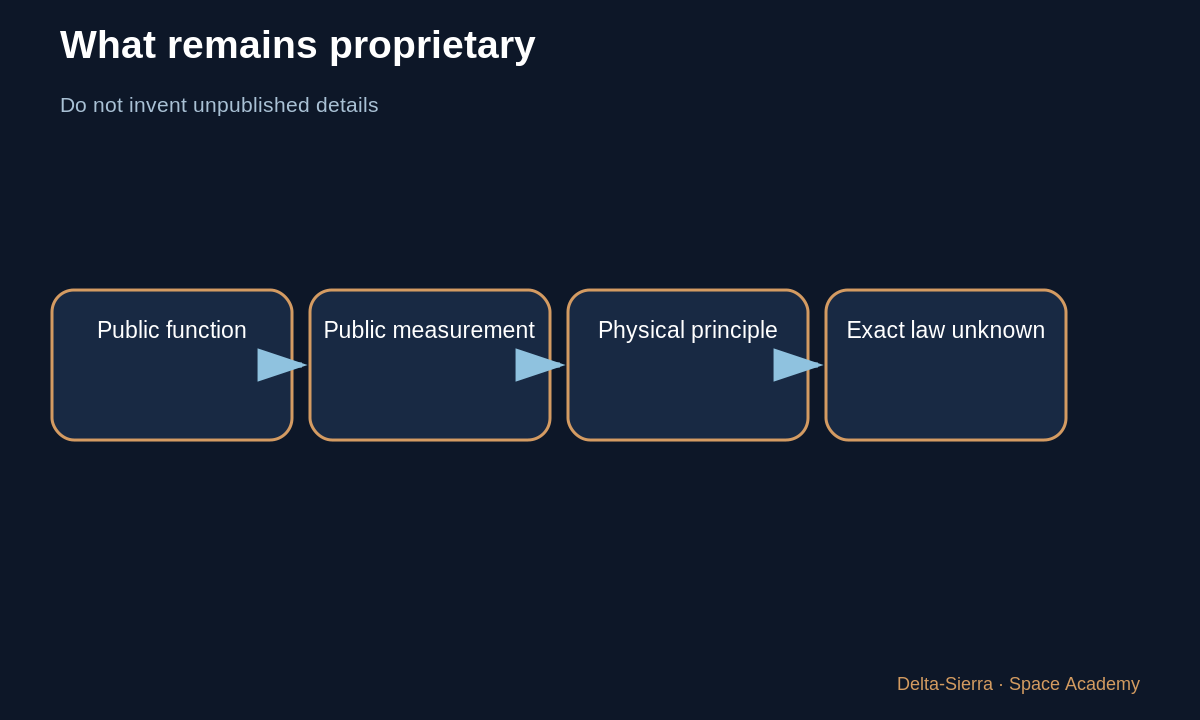
Exact SpaceX guidance laws, gains, filters, tolerances, and optimization details are not fully public. The course therefore explains demonstrated functions and general control principles without inventing a Falcon 9 algorithm.
Separating observable architecture from proprietary detail is a Space Academy method rule.
8 — Landing is mostly about managing remaining energy
After separation the first stage still has velocity, altitude, attitude and limited propellant. Return redistributes that energy across several phases: maneuvering, using the atmosphere where useful, propulsive braking and arriving with vertical speed compatible with touchdown.
This energy view prevents the misconception that the stage simply “aims” at a platform. Navigation estimates state, guidance selects a feasible path and control follows that path while respecting aerodynamic, thermal, structural and propulsion limits.
9 — Why automation is essential
Major return events happen too quickly and demand too many corrections for manual ground piloting. The vehicle therefore carries computers, sensors and software that close the loops locally. Human teams define architecture, verify software, monitor the mission and set rules, while instantaneous correction happens onboard.
Automation does not remove humans; it changes their role. Instead of moving a control in real time, teams design a system that can measure, decide within its limits and act automatically. The same logic applies to lunar and Martian landing systems.
Exercises and answers
Sequence
Order these: landing burn, stage flip, entry burn.
Tradeoff
Why does return propellant reduce mission performance?
Automation
Why not manually command every correction?