Course compass
Guiding question: How do you read 3.2×10⁶ without treating the exponent like a secret code?
Markers: 📏 MEASURED · 📐 CONVENTION · 🧮 CALCULATED · 🎓 TEACHING ASSUMPTION · ⚠️ APPROXIMATION
- understand the concept
- do a simple calculation
- explain every symbol
- check a result
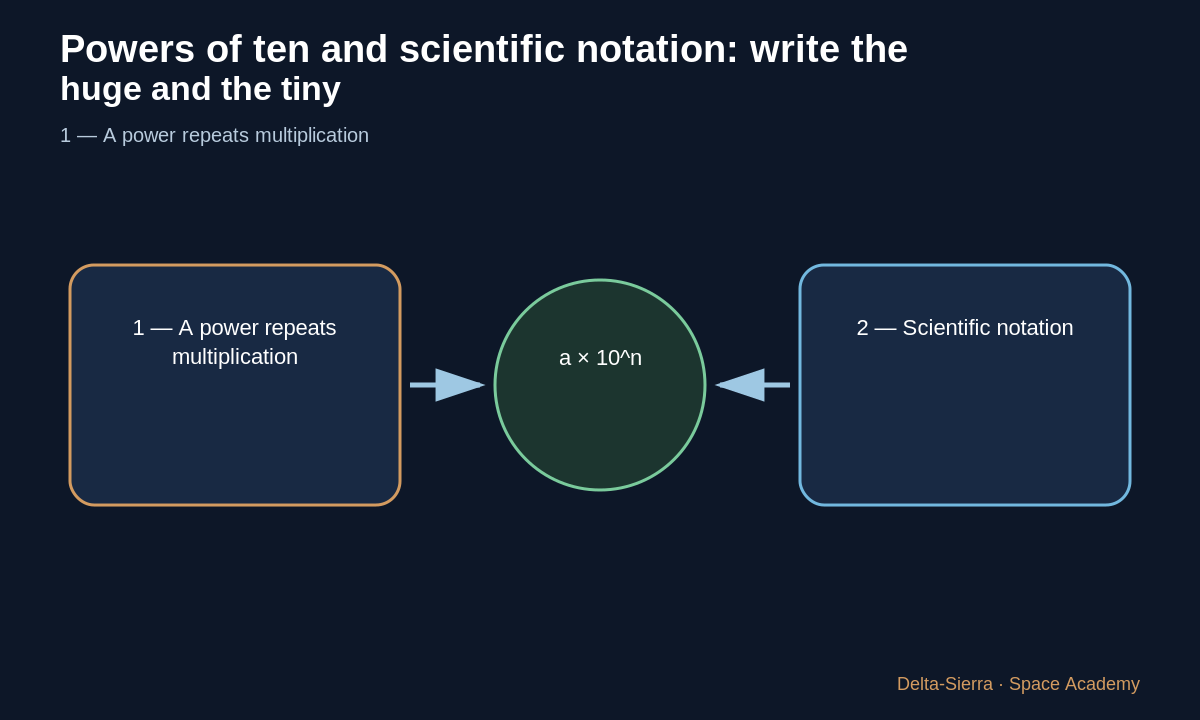
1 — A power repeats multiplication
10³ means 10×10×10 = 1,000. The exponent 3 counts factors of ten.
For a negative exponent, 10⁻³ = 1/10³ = 0.001.
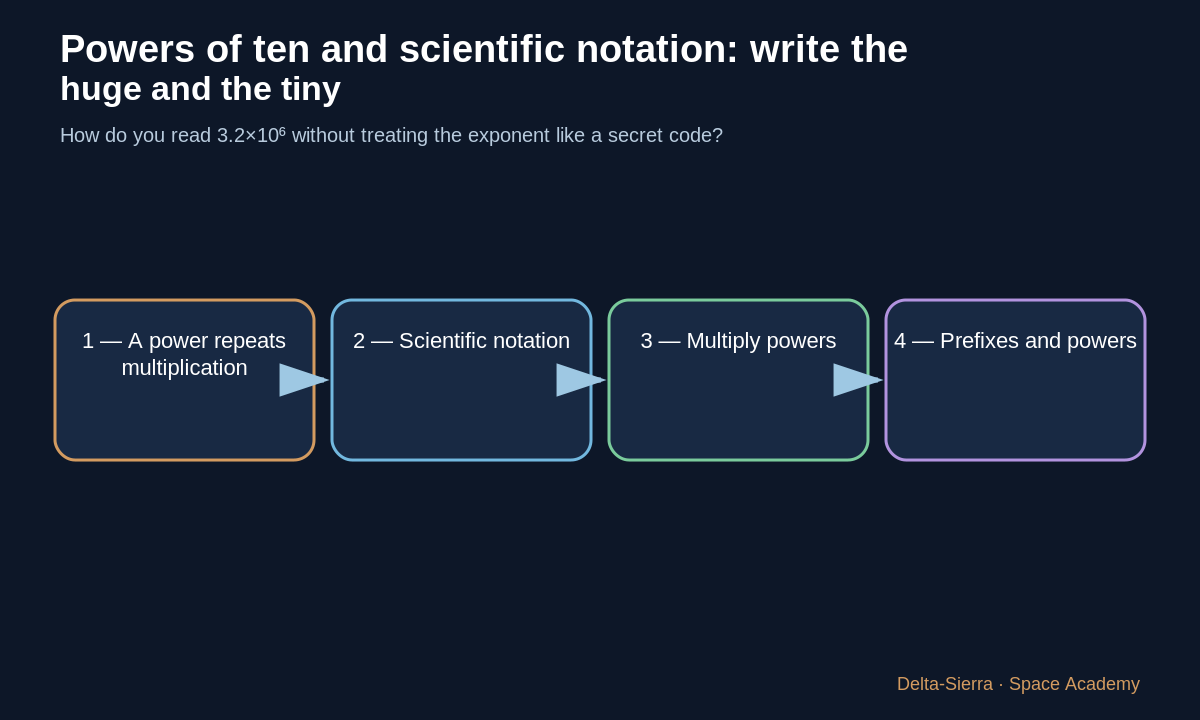
2 — Scientific notation
A number is written a×10ⁿ with a usually between 1 and 10. 320,000 becomes 3.2×10⁵.
The form makes order of magnitude visible.
3 — Multiply powers
10³×10⁴ = 10⁷ because three and four factors of ten are combined. Exponents add.
For division, exponents subtract.
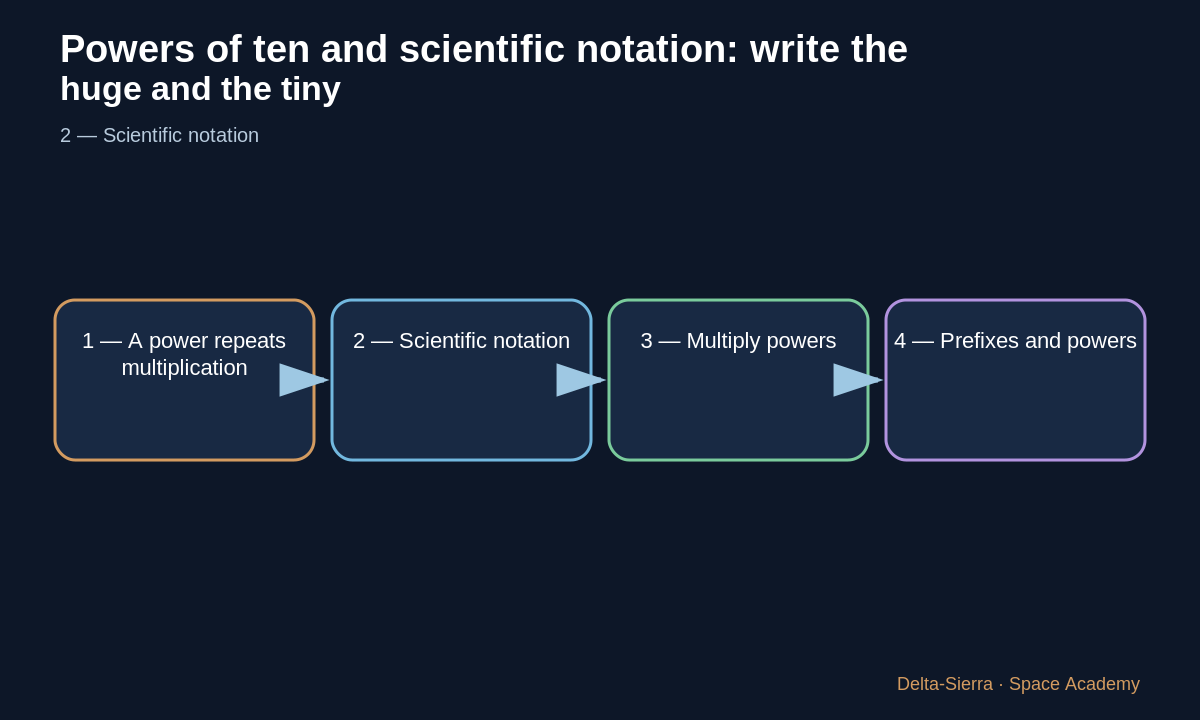
4 — Prefixes and powers
kilo = 10³, mega = 10⁶, giga = 10⁹, milli = 10⁻³. Understanding exponents makes prefix conversion logical.
The prefix is part of the written unit.
Three complete examples: change one assumption to understand
Before each calculation, identify where every number comes from and whether it is measured, conventional, assumed, or calculated.
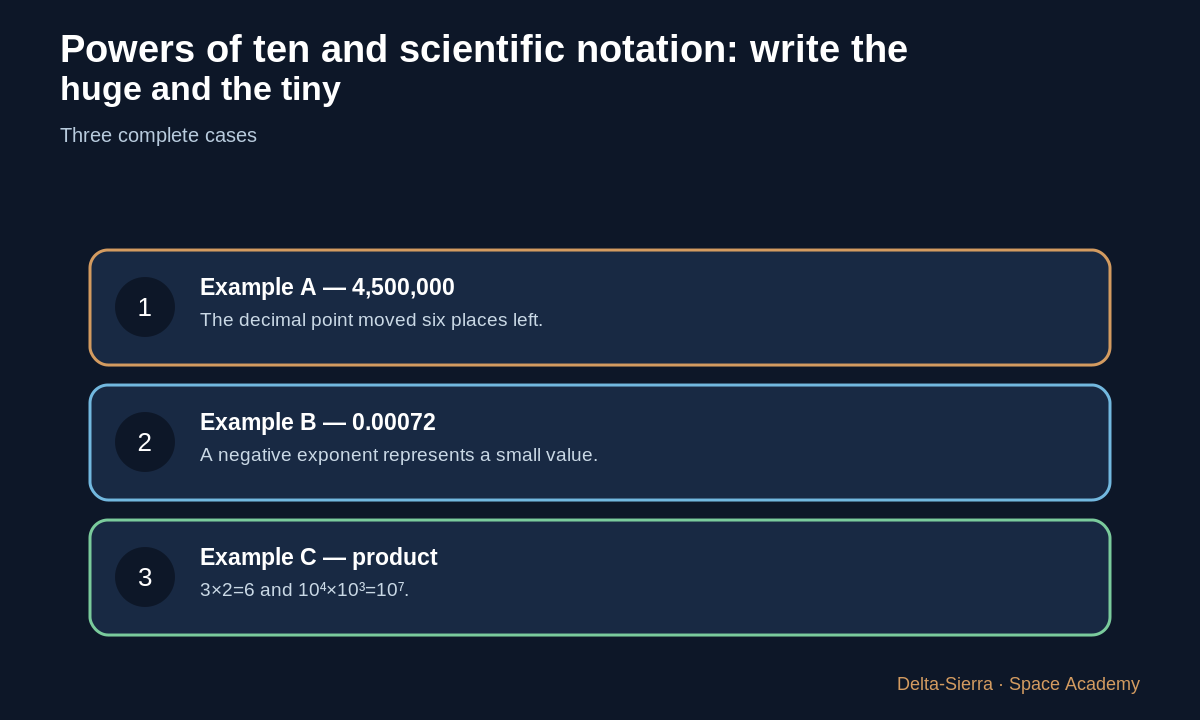
Example A — 4,500,000
4,500,000 = 4.5×10⁶.
The decimal point moved six places left.
Example B — 0.00072
0.00072 = 7.2×10⁻⁴.
A negative exponent represents a small value.
Example C — product
(3×10⁴)(2×10³)=6×10⁷.
3×2=6 and 10⁴×10³=10⁷.
Inverse calculation
If 6×10⁷ = 3×10⁴ × x, then x = (6/3)×10^(7−4) = 2×10³.
Common trap and result check
Trap: confusing 10⁶ with 6×10. 10⁶ is one million.
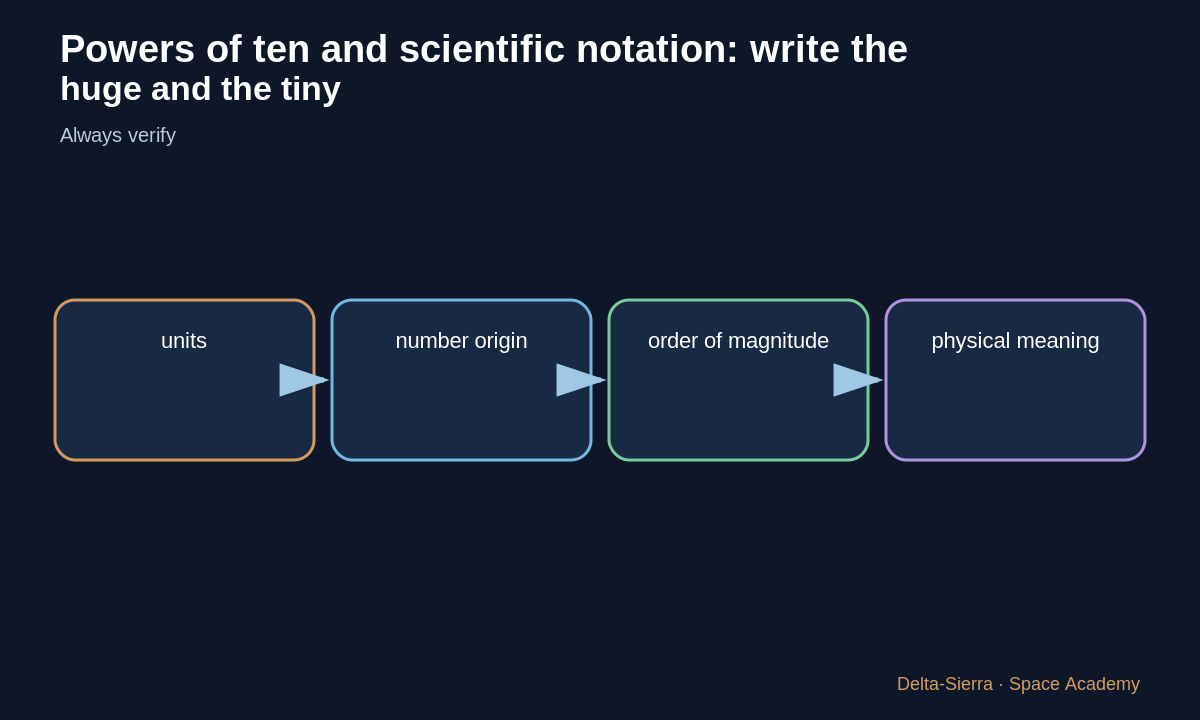
Always check units, order of magnitude, and physical meaning before accepting a result.
Exercises and answers
Understand
Explain the relationship in your own words.
Change an assumption
Modify one input and predict the direction of change before calculating.
Verify
Name two checks after a calculation.