Course compass
Guiding question : What constraints forced engineers to organize the V-2 in this way?
Evidence tags : 📏 MEASURED · 📐 CONVENTION · 🧮 CALCULATED · 🎓 LEARNING ASSUMPTION · 🚀 MISSION DATA · 🏭 MANUFACTURER DATA · ⚠️ APPROXIMATION
Objectives :
- read a launcher as subsystems
- understand structure-versus-mass logic
- follow propellants to the nozzle
- understand gyros and thrust vanes
- identify architecture limits
1 — A vehicle is a set of compromises
Structure must withstand pressure, acceleration, and vibration, yet every kilogram of metal reduces the mass the rocket can accelerate usefully.
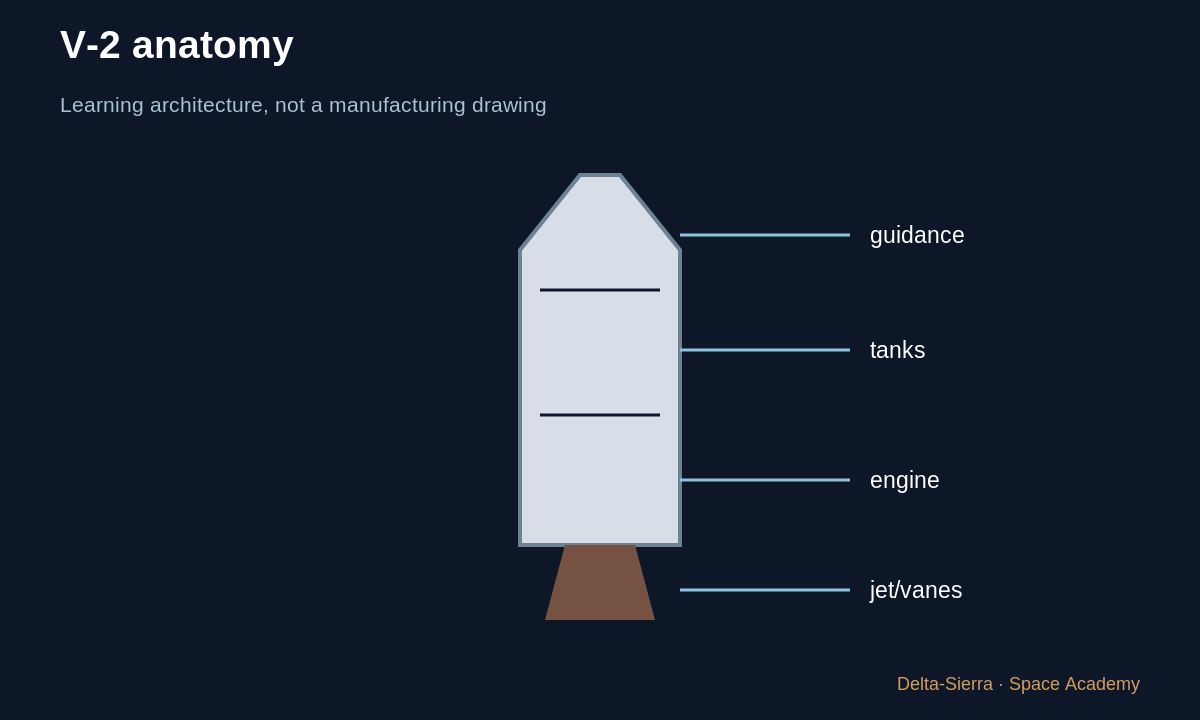
NASA describes the V-2 fuselage as thin metal that could collapse before tanks were filled. The example illustrates a lasting launch-vehicle truth: large structures live near a strength-versus-mass compromise.
2 — Tanks are not ordinary containers
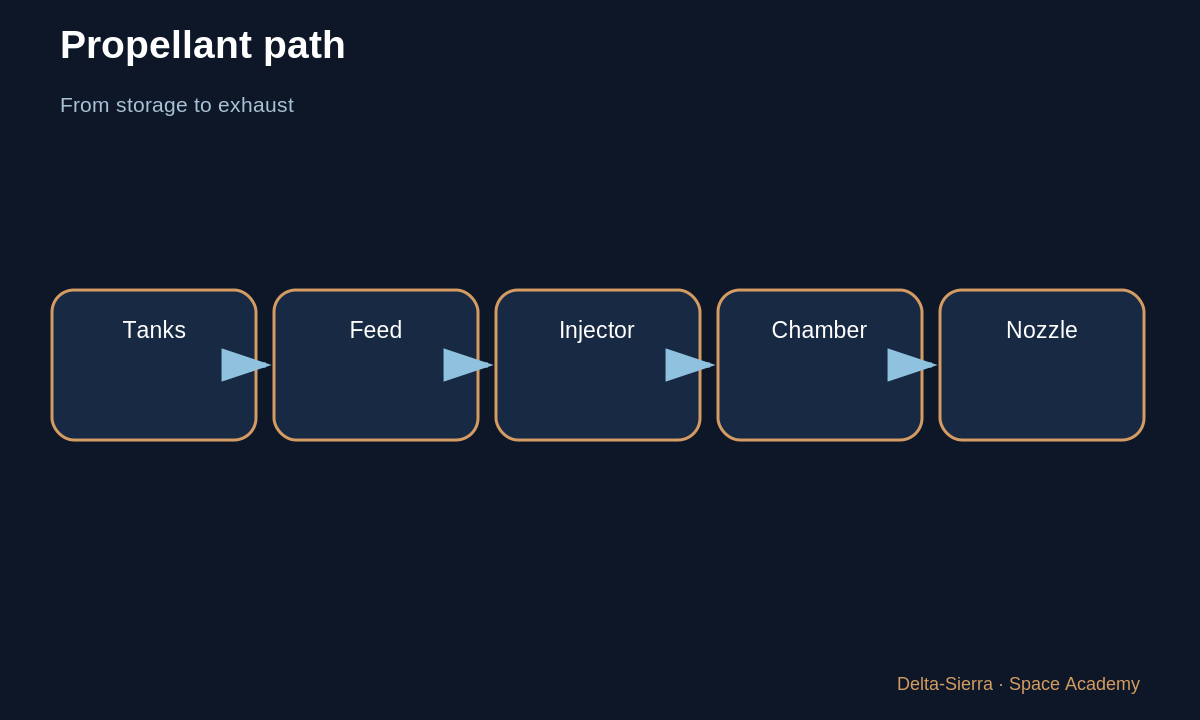
They hold fluids with different temperatures, densities, and chemical compatibility. A cryogenic oxidizer tank must also manage thermal contraction, insulation, and steady engine feed.
Liquid moves under acceleration; tank pressure must remain compatible with pumps and injection. The problem becomes dynamic as soon as the vehicle moves.
3 — Chamber and nozzle turn chemical energy into velocity
Combustion raises temperature and pressure. The nozzle accelerates the gas and directs momentum backward; the rocket receives the reaction forward.
Nozzle shape is not decoration. It trades expansion, ambient pressure, mass, cooling, and length.
4 — Guidance: measure, then correct
Gyroscopes sense vehicle rotation. Control logic converts attitude error into action. On the V-2, vanes inside the jet could deflect thrust, so those vanes endured severe thermal and mechanical conditions.
The essential loop already resembles modern systems: target → measurement → error → actuator → response → new measurement.
5 — Why not make every wall thicker "for safety"?
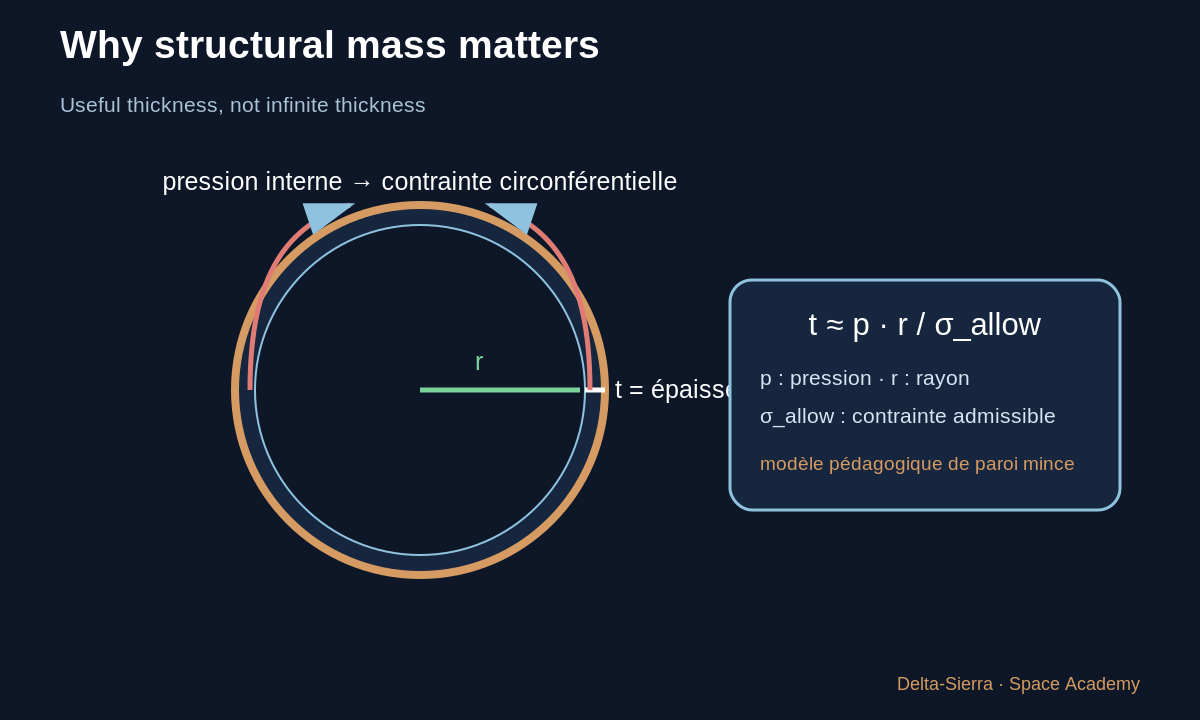
Because a launch vehicle carries its own structure. Arbitrarily doubling wall thickness adds mass, inertia, and propellant demand; it can make the mission impossible.
Engineers design explicit margins. Pressure loads, buckling, fatigue, vibration, manufacturing defects, and temperature determine where material is needed.
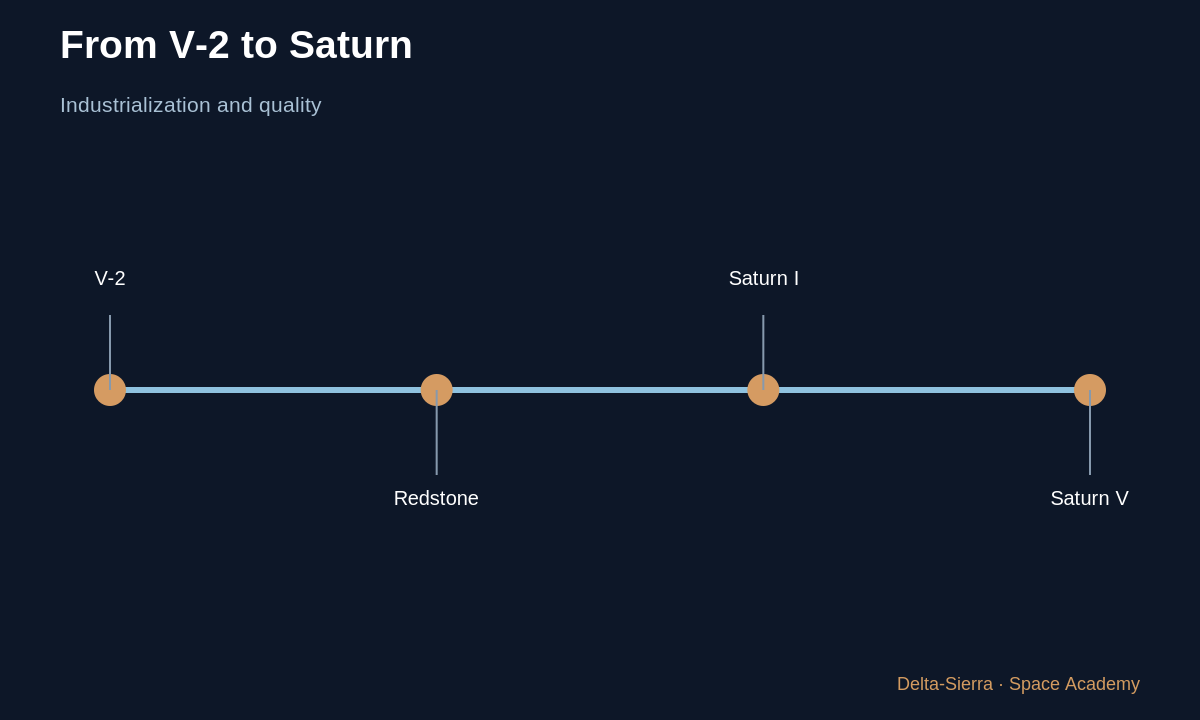
6 — From V-2 to Saturn: manufacturing becomes a science
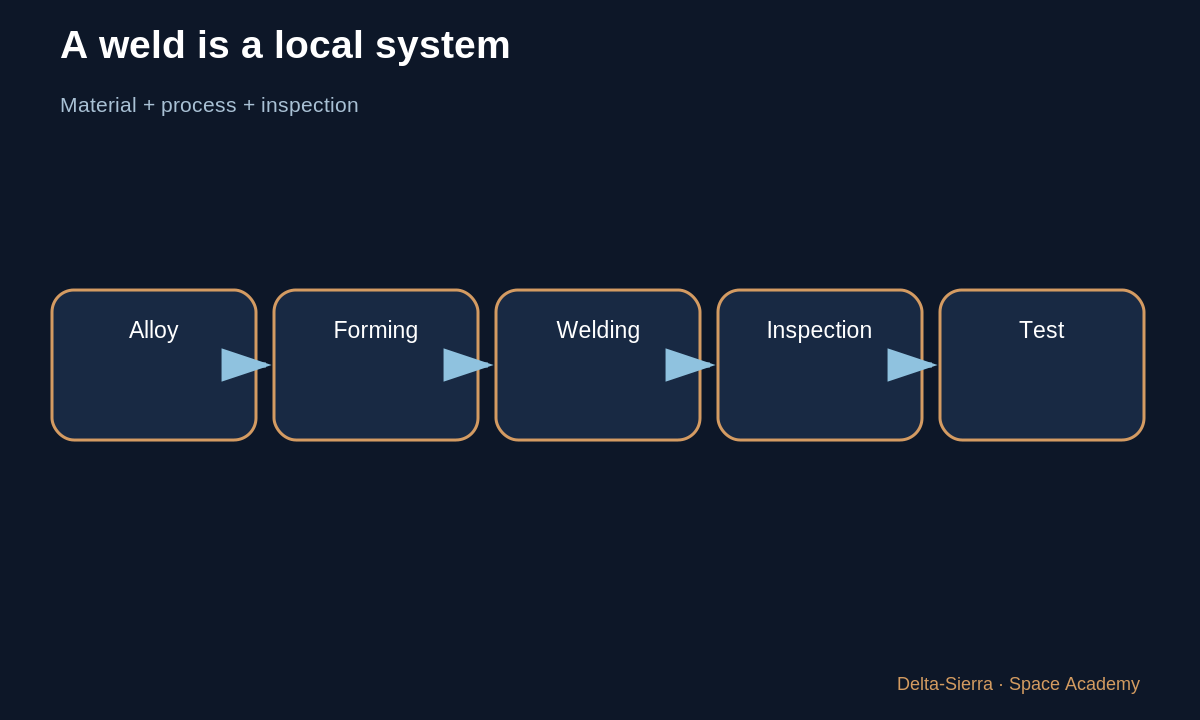
Saturn V illustrates the next step: aluminum alloys, heat treatments, controlled welding, sandwich bulkheads, and deeper structural analysis. NASA documented weld-porosity control and forming research.
The lesson is fundamental: naming the alloy is not enough. The manufacturing process changes the real strength of the finished part.
7 — Read subsystems as a dependency chain
A rocket does not have an engine on one side and a structure on the other as independent objects. Engine flow demand creates feed lines; lines pass through structure; structure carries loads; tank mass changes during flight; guidance must cope with that evolving mass. A local change can therefore move a problem somewhere else.
Thinking in dependencies is more useful than memorizing a parts catalog. Changing a tank forces questions about center of mass, vibration, interfaces, engine feed and flight sequence. Space Academy will use the same method on modern launch vehicles: understand relationships between functions first.
8 — Manufacturing changes the design
On paper a component has perfect geometry. In a factory it has tolerances, welds, heat-affected zones, surface condition and material scatter. Two parts built to one definition are never absolutely identical. Industrialization therefore means designing something that can also be manufactured, inspected and accepted against defined criteria.
The jump from V-2 to Saturn was not only about newer materials or bigger engines. It also involved metrology, traceability, quality procedures and the ability to investigate anomalies. A rocket becomes an engineered product when production variation is controlled as well.
Exercises and answers
Architecture
Why is guidance separate from the engine?
Mass
Why can 100 kg of added structure cost more than 100 kg of performance?
Manufacturing
Why can a weld matter as much as the chosen alloy?