Course compass
Guiding question : How can electricity split water into hydrogen and oxygen, and where does every atom go?
1 — The physical question
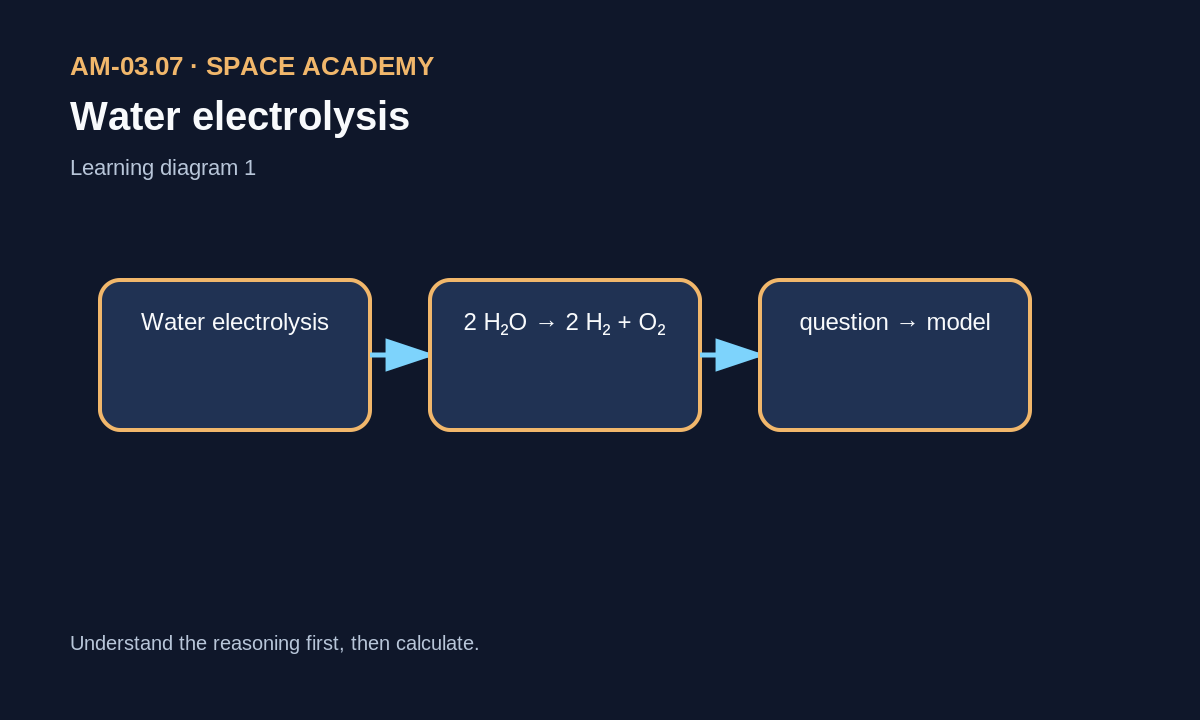
How can electricity split water into hydrogen and oxygen, and where does every atom go?
2 — Symbols, reading and units
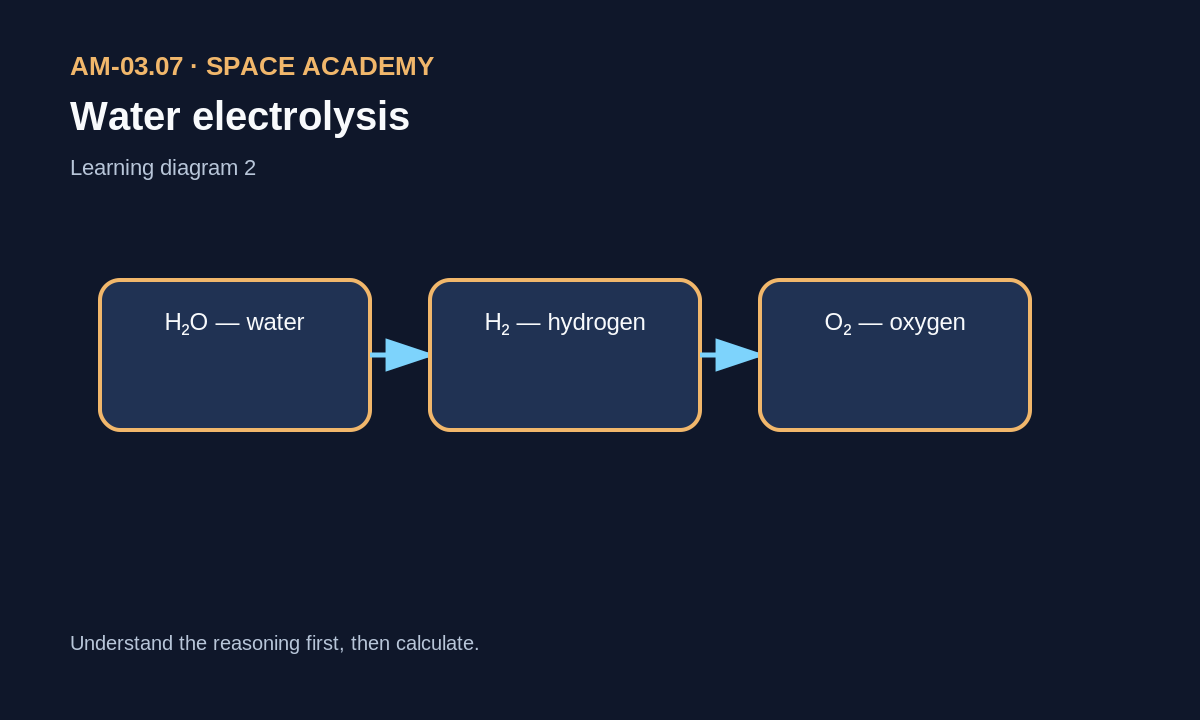
H₂O — water; H₂ — hydrogen; O₂ — oxygen; arrow → — chemical transformation; coefficients 2,2,1 — stoichiometric proportions.
3 — Where does the relation come from?
Electrolysis supplies electrical energy to drive a reaction that does not proceed spontaneously at the required rate. Atoms must be conserved: the left side has 4 H and 2 O; the right side has 4 H in 2 H₂ and 2 O in O₂.
4 — A — Count molecules
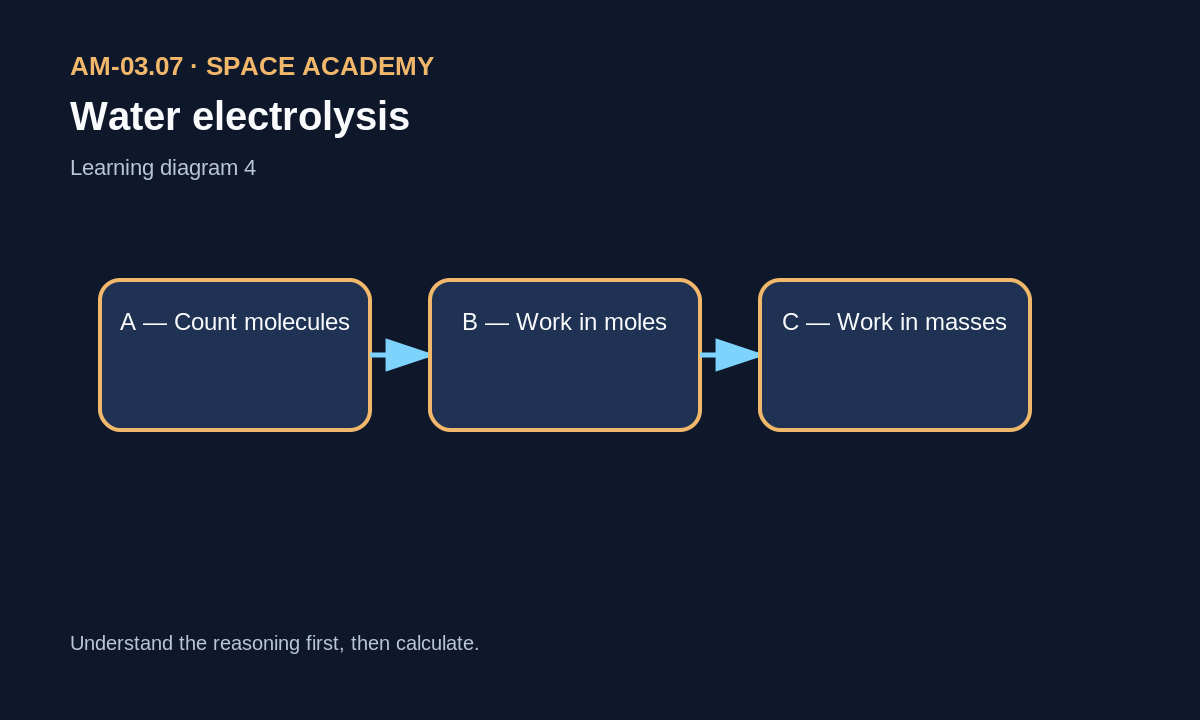
2 water molecules correspond to 2 H₂ molecules and 1 O₂ molecule in the stoichiometric equation.
5 — B — Work in moles
2 mol H₂O → 2 mol H₂ + 1 mol O₂. Coefficients become direct ratios of amount of substance.
6 — C — Work in masses
Using classroom rounded molar masses: 36 g water corresponds to 4 g H₂ + 32 g O₂. 4+32=36 g: total mass is conserved.
7 — Go deeper
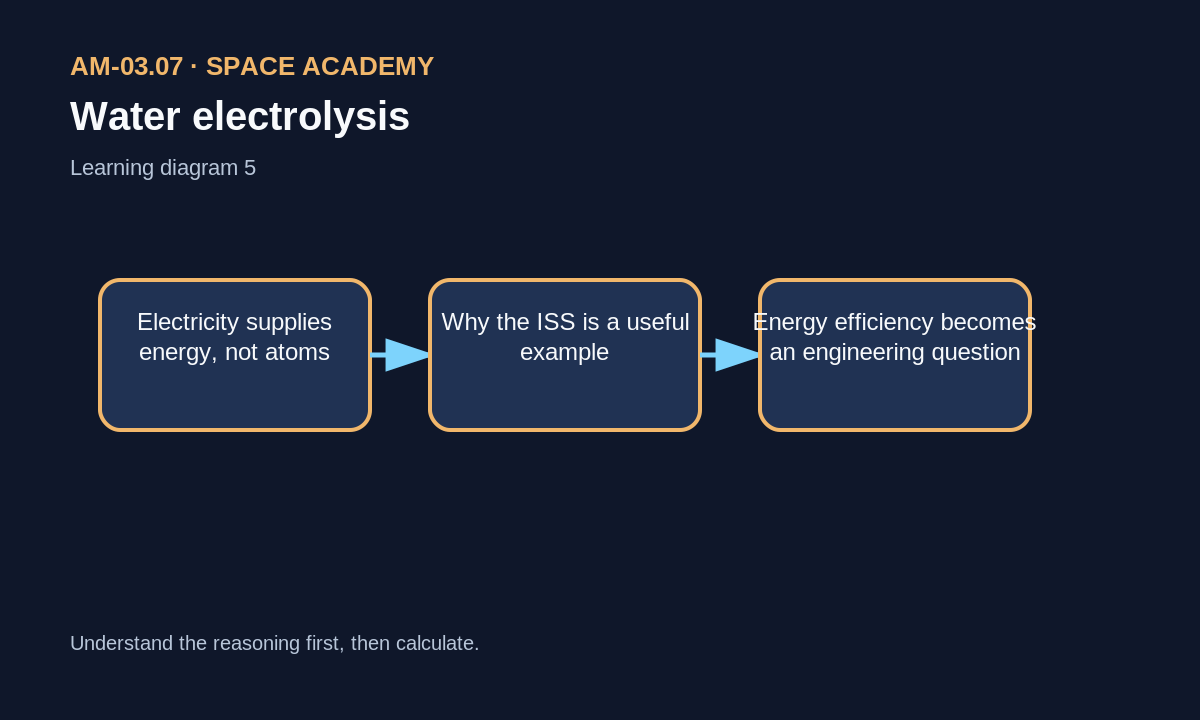
Electricity supplies energy, not atoms
Electrical current does not turn into oxygen. It enables the chemical bonds of existing water molecules to be rearranged.
Why the ISS is a useful example
The ISS Oxygen Generating Assembly uses polymer-electrolyte-membrane electrolysis to split water. Oxygen goes to the cabin atmosphere while hydrogen can feed a carbon-dioxide reduction system.
Energy efficiency becomes an engineering question
The chemical equation alone does not tell us required electricity, cooling, maintenance or cell replacement. A Mars settlement must separate theoretical chemistry from real industrial performance.
The overall equation hides two half-reactions
An electrochemical cell separates transformations occurring at two electrodes. Half-reactions let us track where electrons are produced or consumed and which ions cross the electrolyte. This course stays conceptual: the goal is to understand material accounting before studying detailed design of a real electrolyzer.
Current is connected to production rate
Electric current is a rate of charge flow. Over a time t, total charge is Q=I×t. Faraday’s laws then connect charge to moles transformed. This explains why raising current can raise production rate while also increasing losses, heating and hardware stress.
Real cell voltage exceeds the thermodynamic minimum
A reaction has a thermodynamic energy requirement, but a real cell also has overpotentials, electrical resistance and transport losses. The practical applied voltage must therefore exceed the theoretical minimum. The difference appears as heat or electrochemical loss — another application of asking where the energy went.
Gas separation is part of the system
Producing H₂ and O₂ is not enough: a system must prevent hazardous mixing and manage pressure, humidity, purity, sensing and venting. A membrane or cell architecture contributes to this separation. Chemical performance must therefore be evaluated together with safety and product quality.
Electrolysis belongs to a resource chain
In life support, water can feed oxygen generation while hydrogen can participate in CO₂ reduction. On Mars the same chemistry can also become part of an ISRU chain. Sizing then depends on daily demand, buffer storage, electric power and the chosen level of redundancy.
8 — Exercises and answers
Challenge 1
A — Count molecules: repeat the reasoning with the stated values, then explain the physical meaning of the result.
Challenge 2
B — Work in moles: repeat the reasoning with the stated values, then explain the physical meaning of the result.
Challenge 3
C — Work in masses: repeat the reasoning with the stated values, then explain the physical meaning of the result.