Course compass
Guiding question : What exactly do the letters and the small ₂ in H₂O tell us?
1 — The physical question
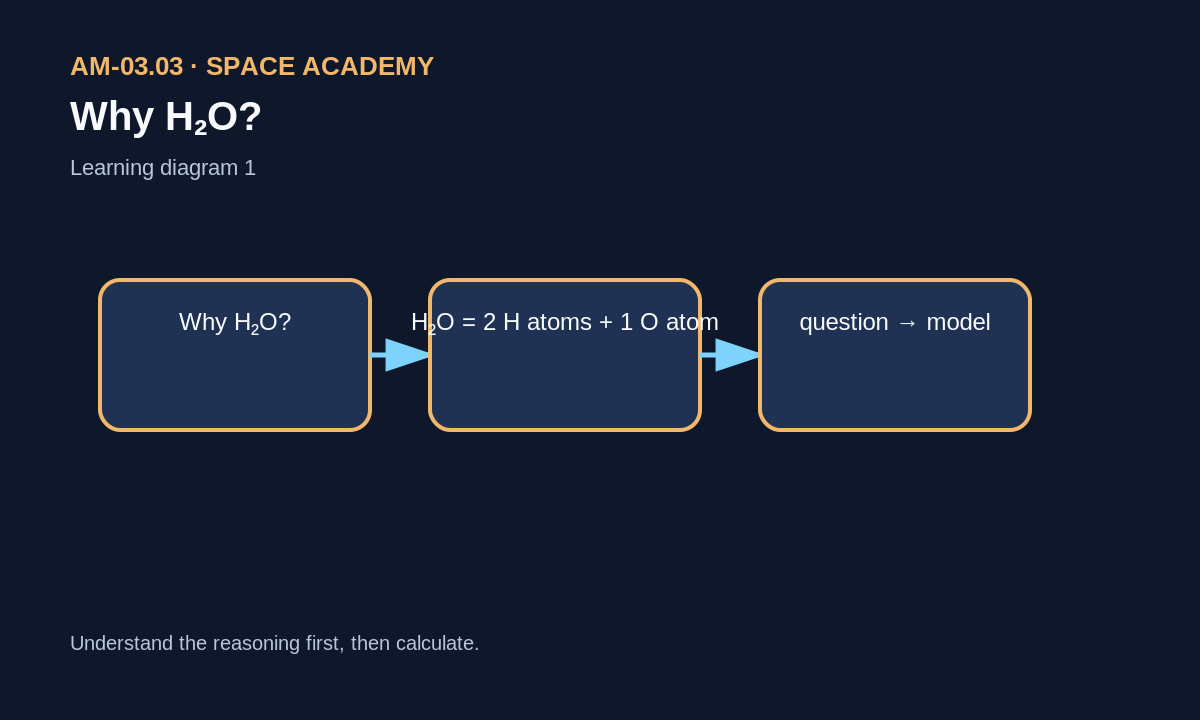
What exactly do the letters and the small ₂ in H₂O tell us?
2 — Symbols, reading and units
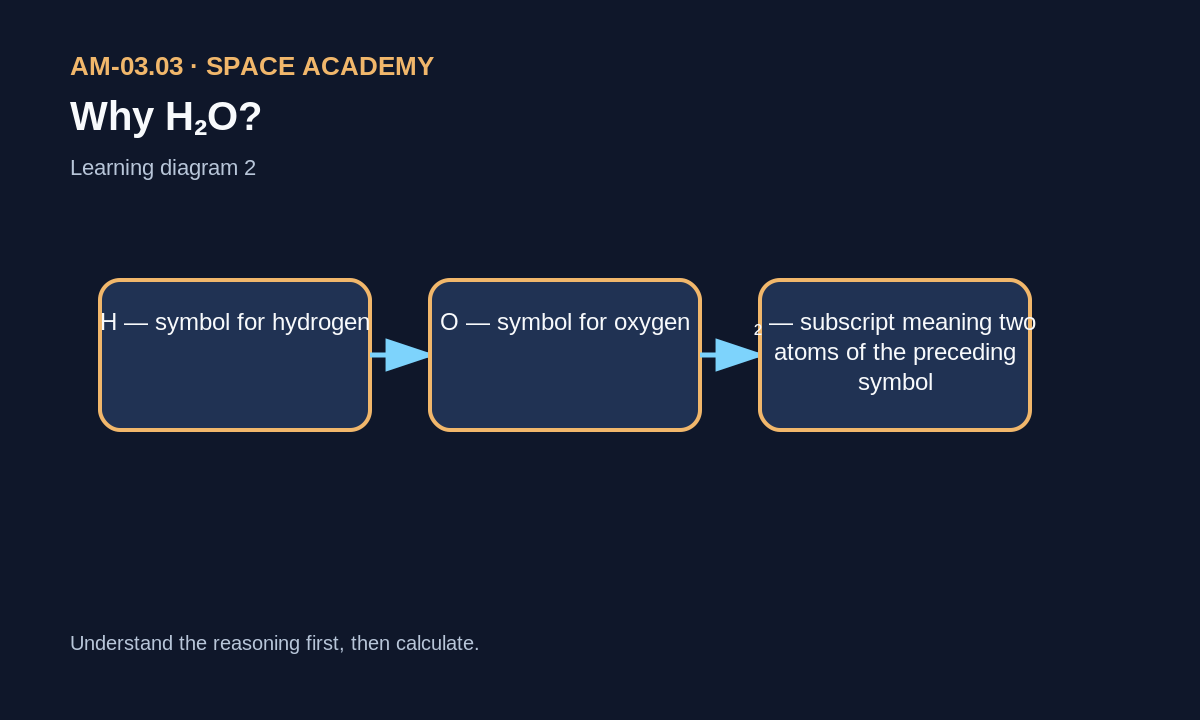
H — symbol for hydrogen; O — symbol for oxygen; ₂ — subscript meaning two atoms of the preceding symbol; no subscript — one atom.
3 — Where does the relation come from?
A chemical formula tells which elements make up a molecule and their atomic proportions. A small subscript applies to the symbol before it. H₂O therefore describes a molecule made of two hydrogen atoms and one oxygen atom.
4 — A — Read H₂
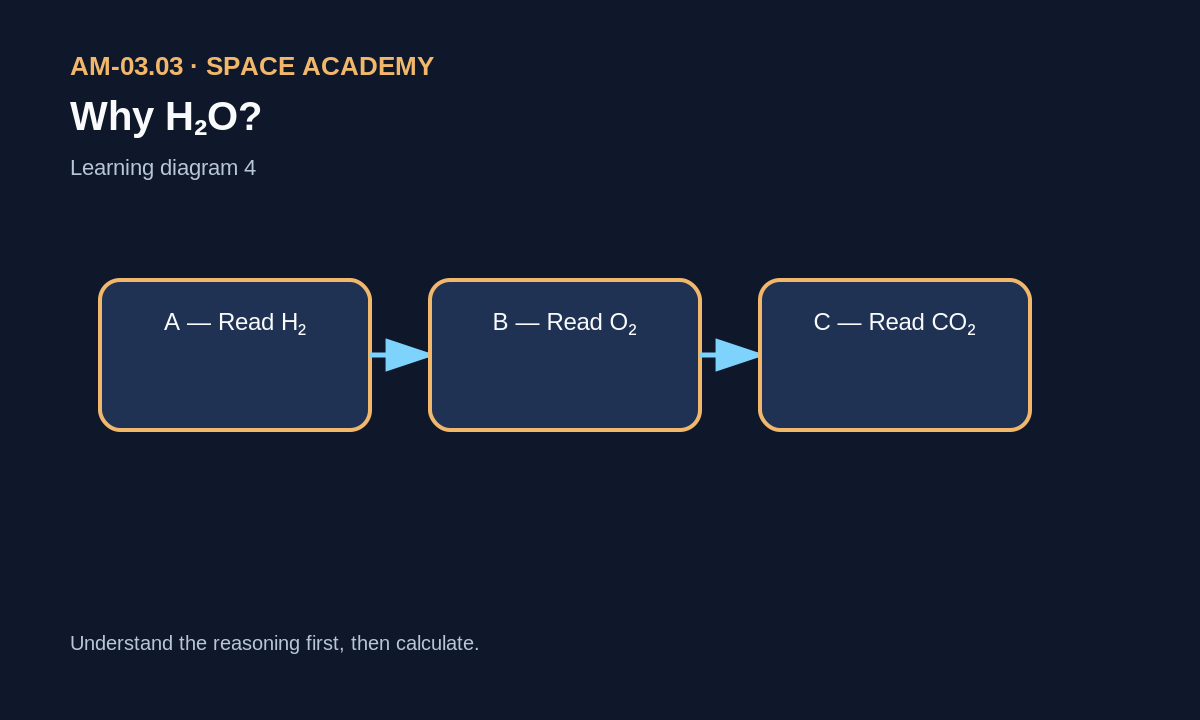
H₂ means two hydrogen atoms bonded in a hydrogen molecule.
5 — B — Read O₂
O₂ means two oxygen atoms in an oxygen molecule.
6 — C — Read CO₂
CO₂ contains one carbon atom and two oxygen atoms. No subscript after C means 1, not zero.
7 — Go deeper
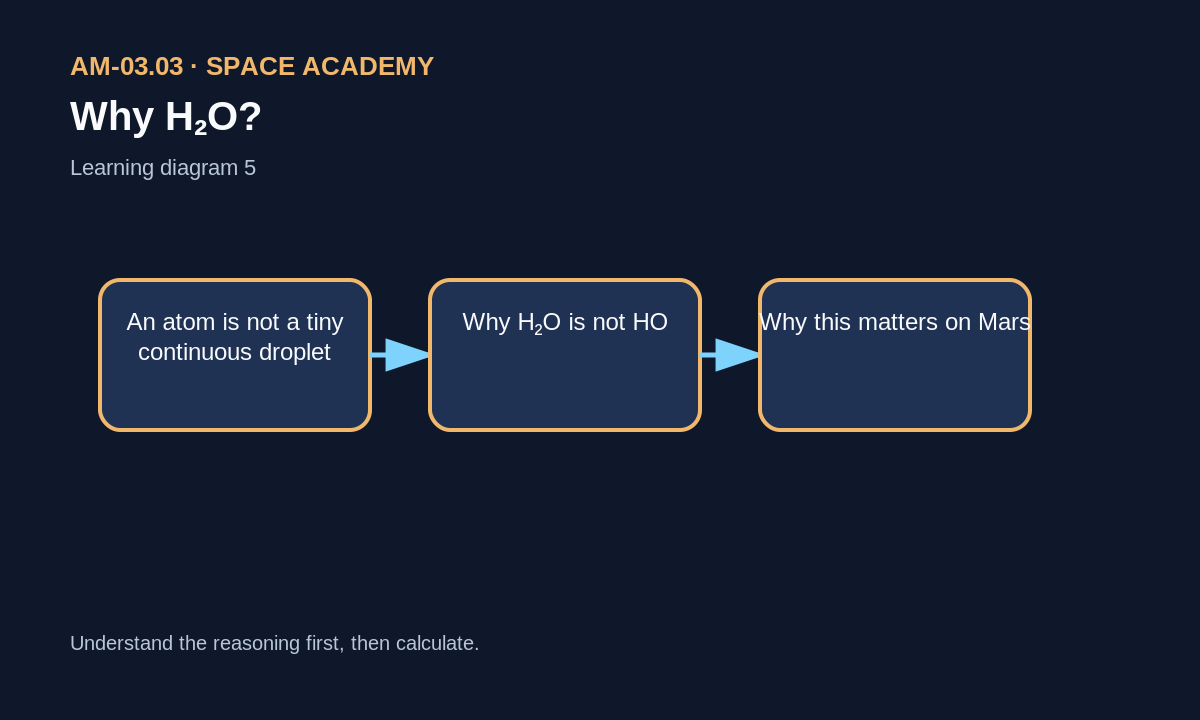
An atom is not a tiny continuous droplet
An atom has a nucleus surrounded by electrons. Chemical behavior largely comes from how electrons can be shared or transferred between atoms.
Why H₂O is not HO
The 2:1 ratio comes from electronic structure and the stable bonds hydrogen and oxygen form. Quantum mechanics is not required yet; the key is that the formula represents real molecular structure, not arbitrary notation.
Why this matters on Mars
Water can be split by electrolysis into O₂ and H₂. Before discussing a plant, the learner must understand what the formula says: matter does not disappear; atoms are rearranged.
Atom, element and molecule are different levels
A chemical element is defined by its number of protons. An atom is one unit of that element; a molecule is a bonded assembly of atoms. H names hydrogen as an element, one H atom is a hydrogen atom, and H₂ describes a molecule containing two hydrogen atoms. Mixing these levels makes chemical equations confusing.
A subscript is not a coefficient
In H₂O, the ₂ is part of the molecule’s formula. In 2 H₂O, the large 2 in front means two molecules — or two moles when working with amount of substance. This distinction is crucial when balancing reactions: changing a subscript changes the substance; changing a coefficient changes the amount.
Ice, liquid or vapor: the formula remains H₂O
Changing the physical state of water changes molecular arrangement and energy, not chemical composition. Ice, liquid water and vapor are all H₂O. This prepares the learner for thermodynamics: a phase change can require substantial energy without turning the molecules into a different chemical species.
Isotopes do not change the element symbol
Atoms of one element can contain different numbers of neutrons; these are isotopes. Hydrogen includes protium, deuterium and tritium. For the Academy’s first material balances we use ordinary composition and rounded molar masses; isotopic details become important in more specialized contexts.
Read an equation as an inventory of atoms
Before calculating a reaction, count every element on the left and right. If the counts differ, the equation is not balanced. This simple method prepares electrolysis and Sabatier calculations: the installation does not create atoms; it rearranges them into different molecules.
8 — Exercises and answers
Challenge 1
A — Read H₂: repeat the reasoning with the stated values, then explain the physical meaning of the result.
Challenge 2
B — Read O₂: repeat the reasoning with the stated values, then explain the physical meaning of the result.
Challenge 3
C — Read CO₂: repeat the reasoning with the stated values, then explain the physical meaning of the result.