Course compass
Guiding question: Why can the smallest nozzle passage set the flow rate of the whole engine?
1 — The physical question
Why can the smallest nozzle passage set the flow rate of the whole engine?
We start from the concrete problem before notation. The goal is to understand what we seek, then why mathematics becomes useful.
2 — How to read the symbols and units
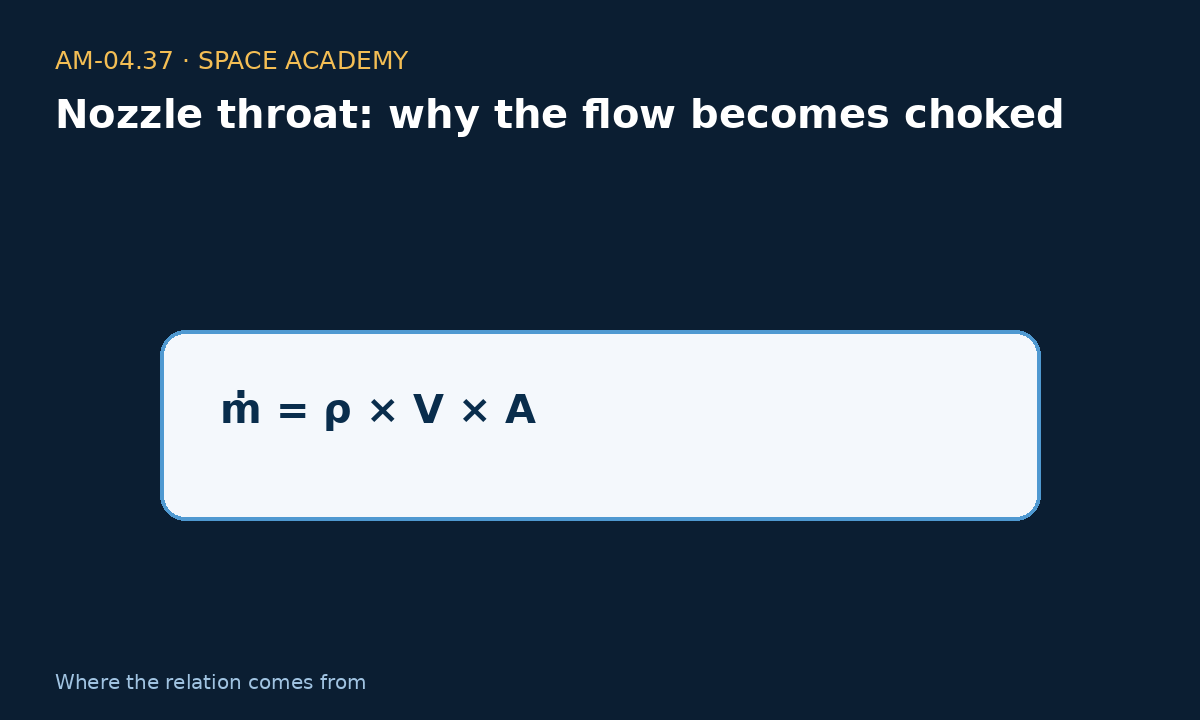
ṁ = ρ × V × A. Read: “m dot equals rho times V times A”.
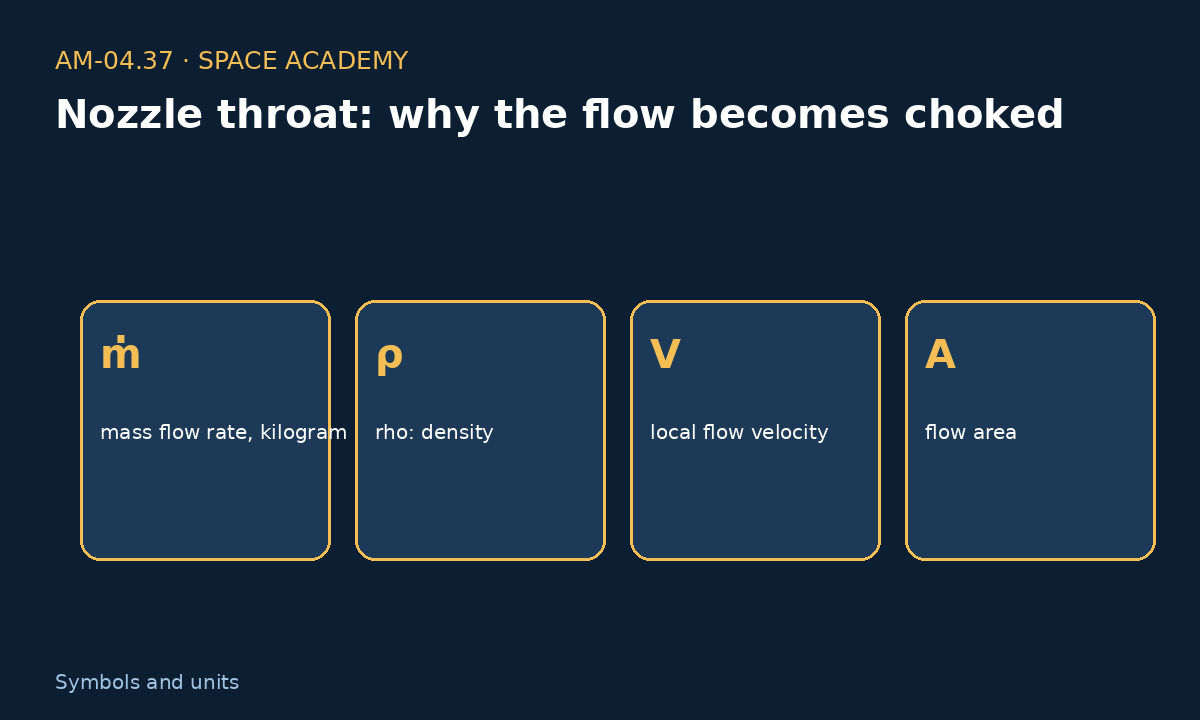
ṁ — mass flow rate, kilograms per second ; ρ — rho: density ; V — local flow velocity ; A — flow area ; M — Mach number; M=1 at a choked throat
3 — Where does the relation come from?
Mass conservation requires the same steady mass flow through every section. In compressible flow, the throat is chosen so Mach 1 is reached; beyond that condition, lowering downstream pressure no longer increases mass flow in the same way: the flow is choked.
Every number used below is explicitly treated as data, convention, learning assumption, or calculated result.
4 — A — Mental incompressible flow
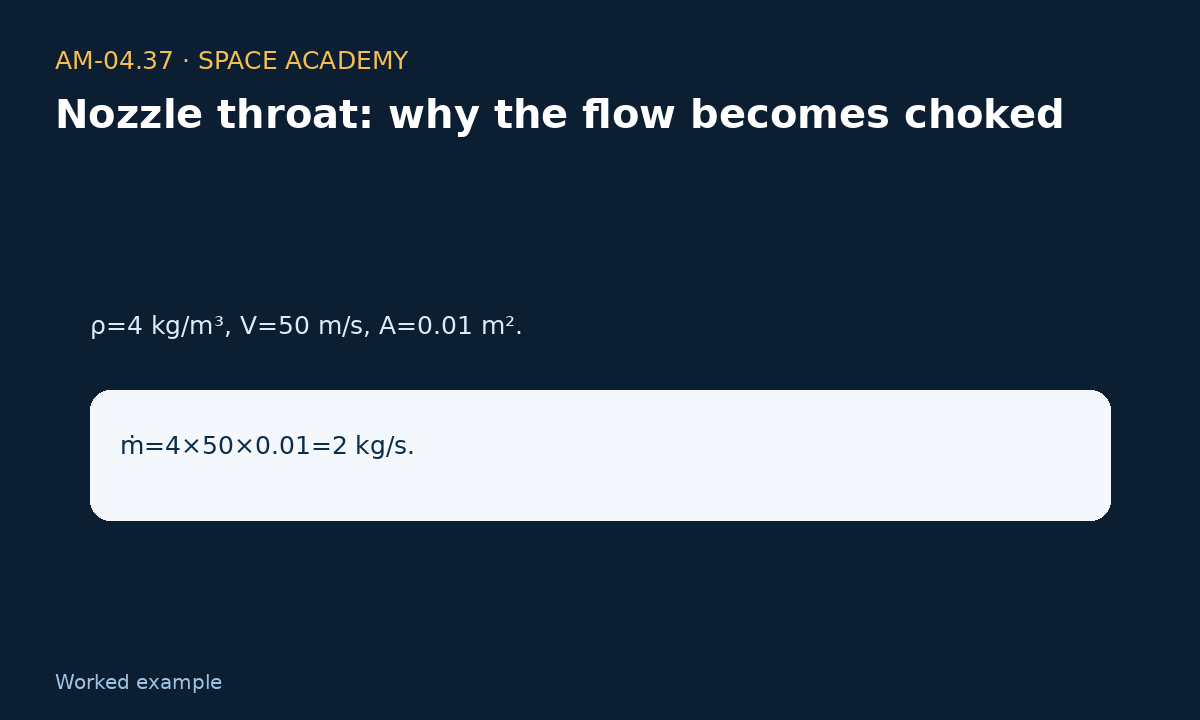
Where do the numbers come from? ρ=4 kg/m³, V=50 m/s, A=0.01 m².
Step-by-step calculation: ṁ=4×50×0.01=2 kg/s.
This first calculation teaches units; real rocket gas is compressible.
5 — B — Double area
Where do the numbers come from? Same ρ and V, A=0.02 m².
Step-by-step calculation: ṁ=4×50×0.02=4 kg/s.
In this simple model, doubling area doubles flow.
6 — C — Why Mach 1 changes the problem
Where do the numbers come from? At the throat, M=1. Local velocity equals local speed of sound.
Step-by-step calculation: The full calculation uses total pressure, temperature, γ, R and A*.
The advanced treatment replaces ρVA with NASA’s choked-flow equation.
7 — Sensitivity, inverse calculation, and sanity check
Change one input, predict the direction of the result, calculate, then check units, sign, order of magnitude, and limits.
Essential limit for Nozzle throat: why the flow becomes choked: the displayed relation is a learning model. A real system adds detailed geometry, variable properties, sensors, uncertainty, transients, and testing.
8 — Why this matters in a mission
In a space mission, why can the smallest nozzle passage set the flow rate of the whole engine? The useful skill is not reciting the formula but knowing which data are needed, which are measured, and when the model becomes insufficient.
10 — Go deeper: from calculation to physical understanding
The throat is more than the narrowest section
In a converging-diverging nozzle, the throat is the minimum area and has a dynamic role: when upstream and downstream conditions allow it, the flow reaches Mach 1 there. The flow is then “choked.” This does not mean the gas stops; it means a further reduction in downstream pressure no longer increases mass flow in the same simple way.
Why Mach 1 changes the problem
A pressure disturbance travels through a gas at a speed related to the speed of sound. When the flow reaches that speed at the throat, information from downstream can no longer propagate freely upstream through the throat. This gives an intuitive reason why mass flow is then governed mainly by the upstream state, throat geometry, and gas thermodynamic properties.
ṁ=ρVA is a doorway, not the complete model
Multiplying density ρ, velocity V, and area A gives mass flow when the local values are consistent. In a compressible nozzle, however, ρ and V change together along the duct. We cannot arbitrarily take tank density and exit velocity and multiply them by throat area. A full choked-flow lesson adds compressible-gas thermodynamics.
Engineering question: what changes with a larger throat?
All else equal in a first-order model, increasing throat area increases flow capacity. But it also changes the balance with chamber and nozzle behaviour; a real engine must balance gas generation, chamber pressure, flow, expansion, and stability. This lesson therefore teaches dependencies without providing a fabrication geometry recipe.
9 — Exercises and answers
Challenge 1
ρ=4 kg/m³, V=50 m/s, A=0.01 m².
Challenge 2
Same ρ and V, A=0.02 m².
Challenge 3
At the throat, M=1. Local velocity equals local speed of sound.