Course compass
Goal: understand every word, symbol, unit and operation before using the formula.
Method: concrete situation → vocabulary → step-by-step calculation → three examples → check.
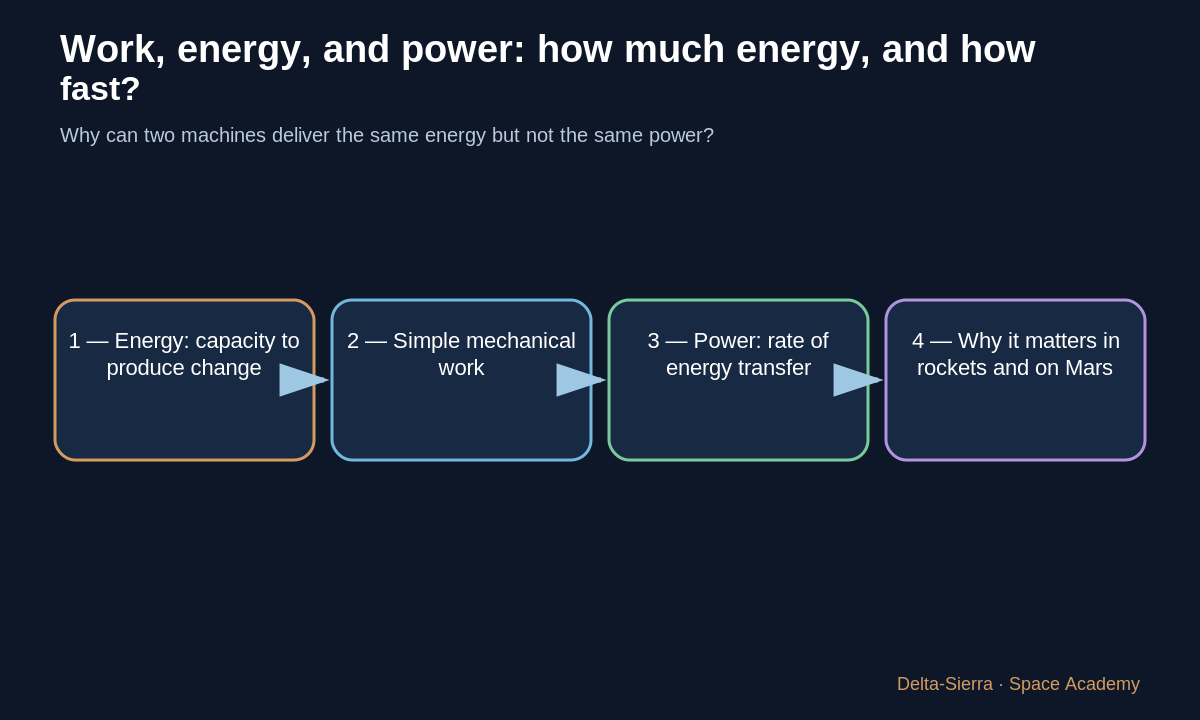
1 — Work, energy and power are related but not identical
A Mars winch lifts a crate. Mechanical work is done as force acts through a displacement. Energy is transferred or transformed. Power tells how quickly that energy transfer occurs.
2 — Mechanical work in the simple aligned case
Read: “W equals F times d”. W is work in joules, F force in newtons, d displacement in metres.
100 N × 5 m = 500 JJ is read “joule”.
3 — Energy can be stored, transferred and transformed
A battery stores chemical energy converted to electrical energy. A motor transforms part of it into motion and heat. A lifted mass gains gravitational potential energy.
4 — Power: joules transferred each second
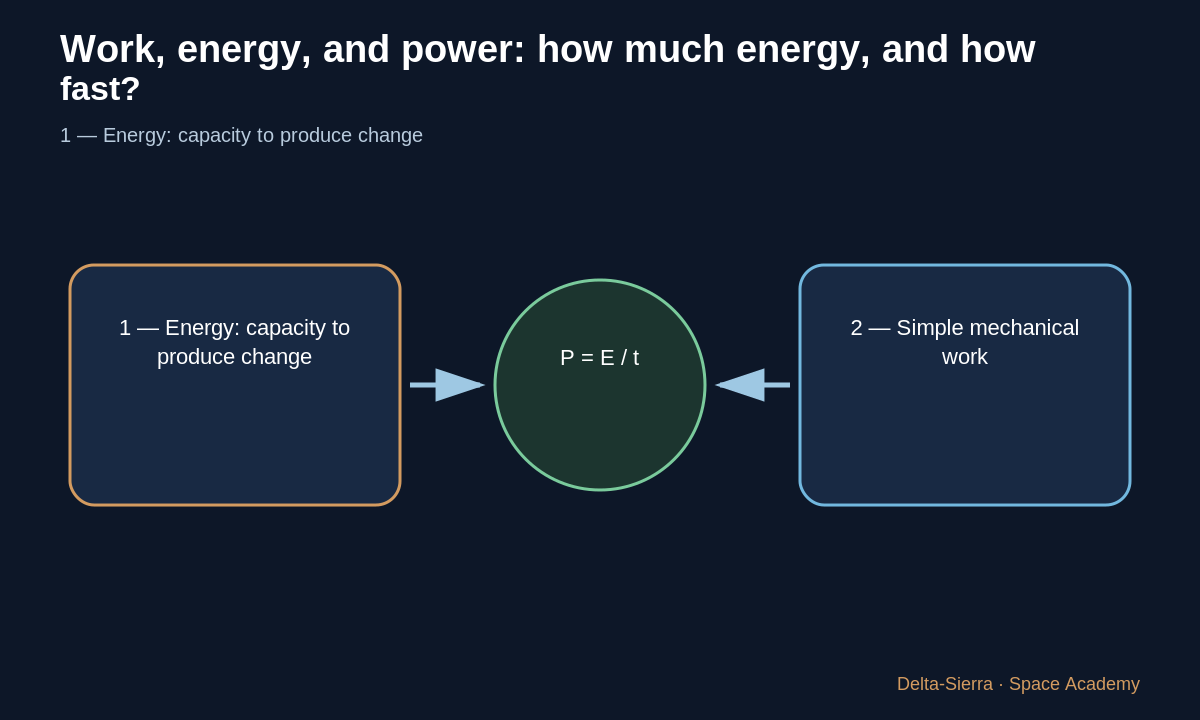
P is power in watts, E energy in joules, t time in seconds.
1,000 J ÷ 5 s = 200 W1 W = 1 J/s.
5 — Kinetic energy: energy of motion
A 100 kg rover moving at 4 m/s:
v² = 16
E k = 0.5 × 100 × 16 = 800 J
Double speed gives four times the kinetic energy.
6 — Lifting a load: gravitational potential energy
Near the Martian surface, use g ≈ 3.71 N/kg for this exercise.
50 kg × 3.71 × 2 m = 371 JA real system draws more electrical energy because of losses.
7 — Three concrete examples
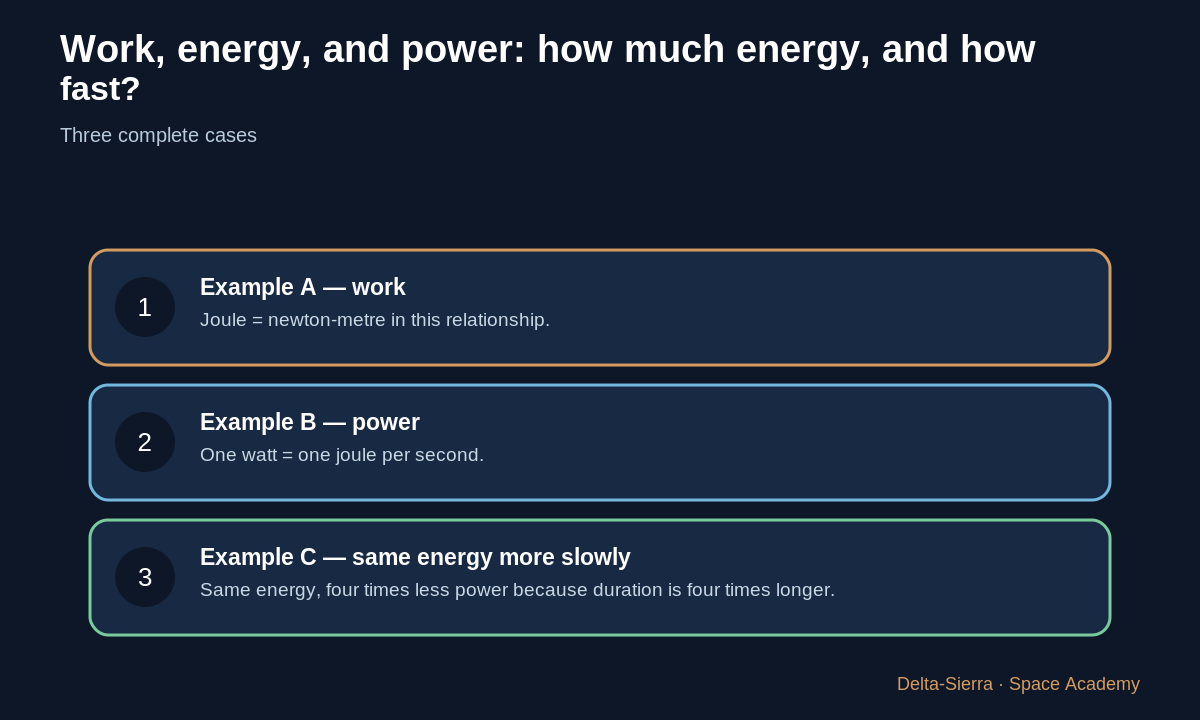
Example A — Winch
250 N × 4 m = 1,000 J
if done in 10 s: P = 100 W
Example B — Same energy, different power
2,000 J in 20 s = 100 W
2,000 J in 5 s = 400 W
Example C — Pump efficiency
600 W useful at 75% efficiency.
input power = 600 ÷ 0.75 = 800 W8 — Building an energy budget on Mars
Power rating alone is not enough. A base must track operating duration, total energy, efficiency, startup peaks and reserve margins.
A 1,000 W device used for 2 h ideally uses 2 kWh. 1 kWh = 3.6 MJ.
Beginner checkpoint — joules answer “how much?”, watts answer “how fast?”
Energy and power are often confused because both appear on equipment specifications. Joules measure an amount of energy. Watts measure the rate at which energy is transferred: one watt is one joule per second. A small machine can therefore use a large total amount of energy if it runs for a long time, while a powerful machine may use less total energy if it operates only briefly.
For Mars systems this distinction is essential. Battery sizing depends on energy over time, while cables, converters, motors and generators must also handle power peaks. A base can possess enough stored energy for the day and still fail if it cannot deliver the required instantaneous power to start a pump, compressor or machine tool.
9 — Corrected exercises
Exercise 1
80 N over 3 m?
Exercise 2
3,600 J in 30 s?