Course compass
Guiding question : How do engineers choose when the desired material properties conflict?
Evidence tags : 📏 MEASURED · 📐 CONVENTION · 🧮 CALCULATED · 🎓 LEARNING ASSUMPTION · 🚀 MISSION DATA · 🏭 MANUFACTURER DATA · ⚠️ APPROXIMATION
Objectives :
- reason with strength-to-mass tradeoffs
- separate cold structure from hot chamber needs
- understand aluminum-lithium interest
- understand copper/high-temperature alloy roles
- see why manufacturing matters as much as raw properties
1 — There is no perfect material
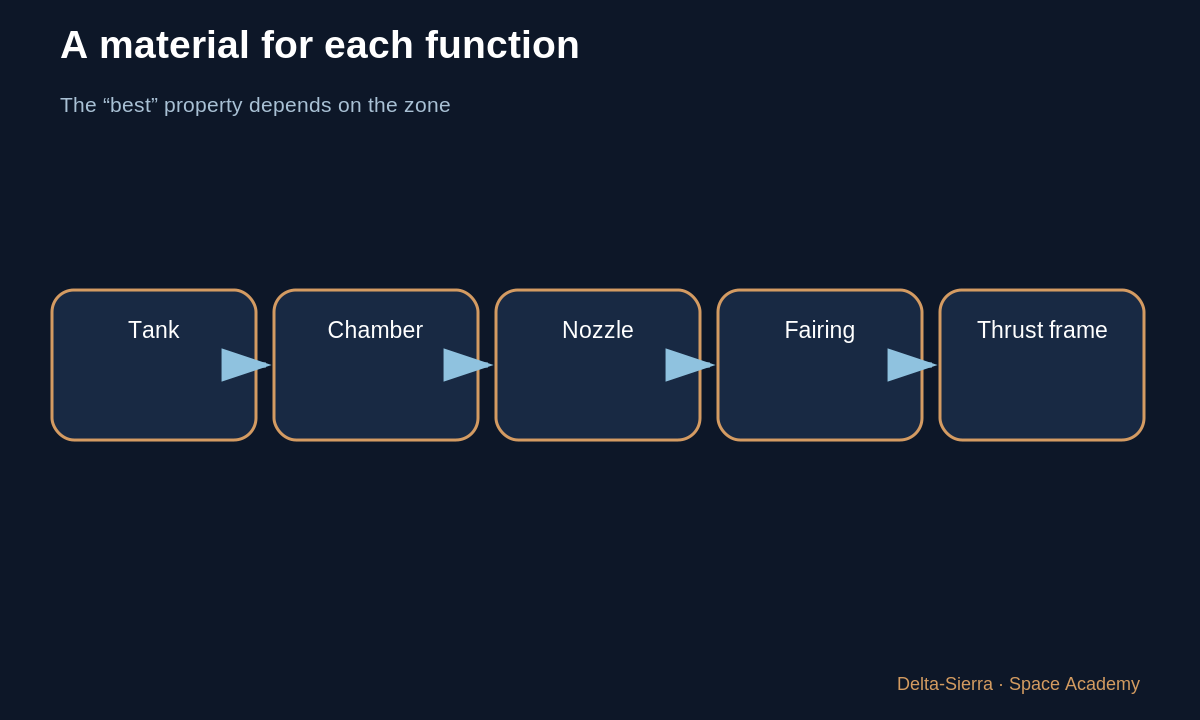
Steel can be very strong but dense. Aluminum is light but some alloys lose advantage at high temperature. Copper moves heat exceptionally well but is not used for the whole rocket.
Engineers select properties for functions: stiffness, strength, thermal conductivity, cryogenic toughness, weldability, fatigue, corrosion resistance, cost, and inspectability.
2 — Tanks: strength-to-mass dominates
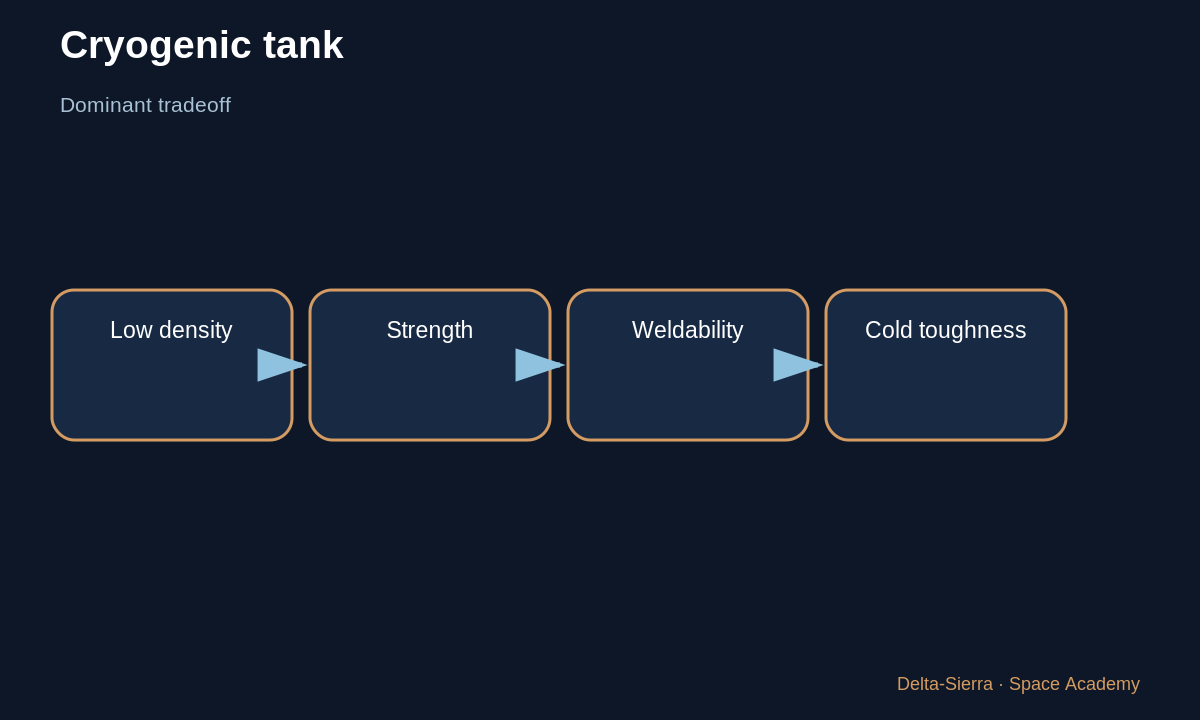
Tanks cover large areas. A small mass saving per square meter becomes important across an entire launch vehicle.
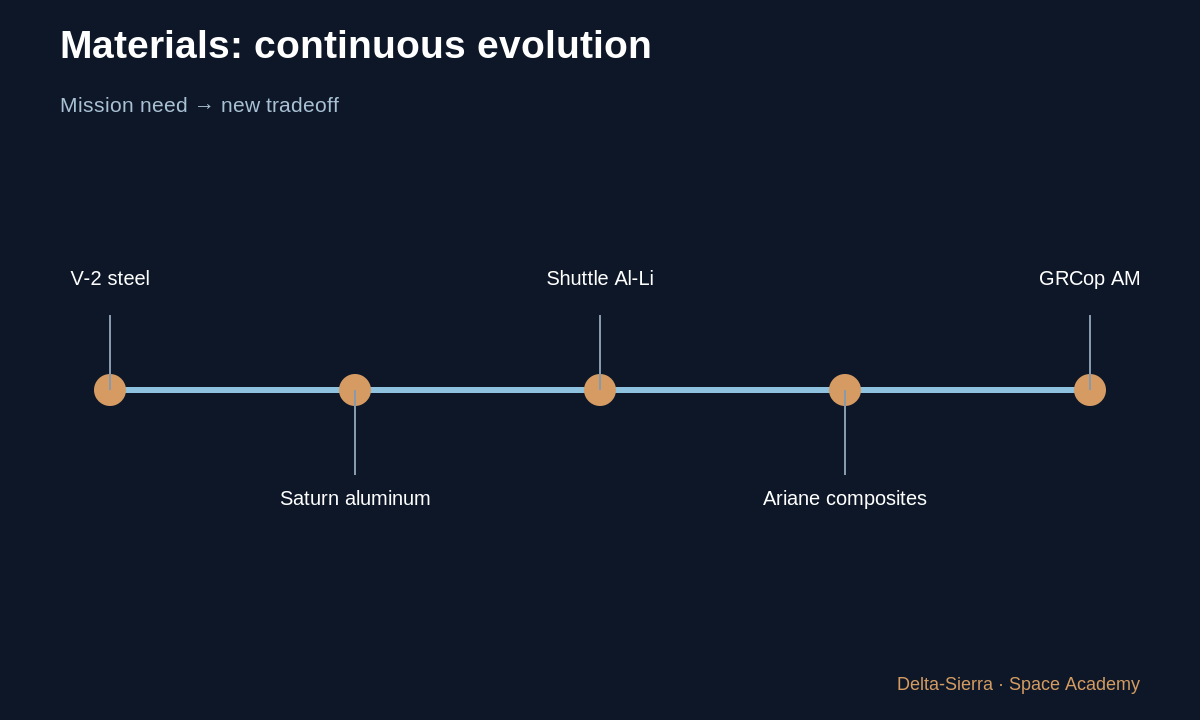
NASA studied weldable aluminum alloys for cryogenic service, then Al-Li 2195 because it combines lower density and higher mechanical properties than baseline Al 2219 in some applications.
3 — Combustion chamber: heat flux becomes central
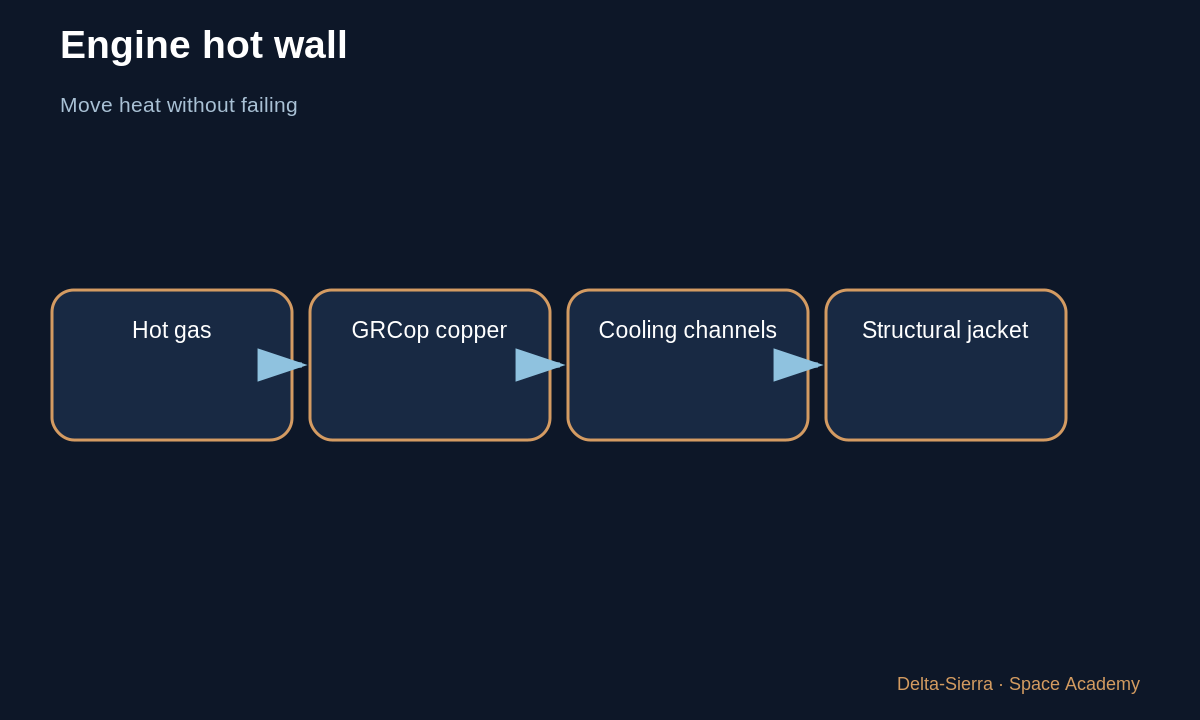
In a liquid-engine hot wall, heat must move rapidly toward the coolant. NASA developed copper alloys such as GRCop-42 to combine high conductivity with high-temperature strength.
That choice is local. A load-carrying jacket of another metal or composite may surround the conductive liner because the components serve different functions.
4 — Nickel and high-temperature materials
Nozzle or turbomachinery regions may require alloys that tolerate heat, thermal fatigue, oxidation, and hydrogen environments. Process choice also matters: forging, welding, brazing, additive manufacturing, or deposition.
“Works at 1000 °C” is not enough. Stress, duration, cycles, atmosphere, cooling, and geometry must be specified.
5 — Composites: low mass, different behavior
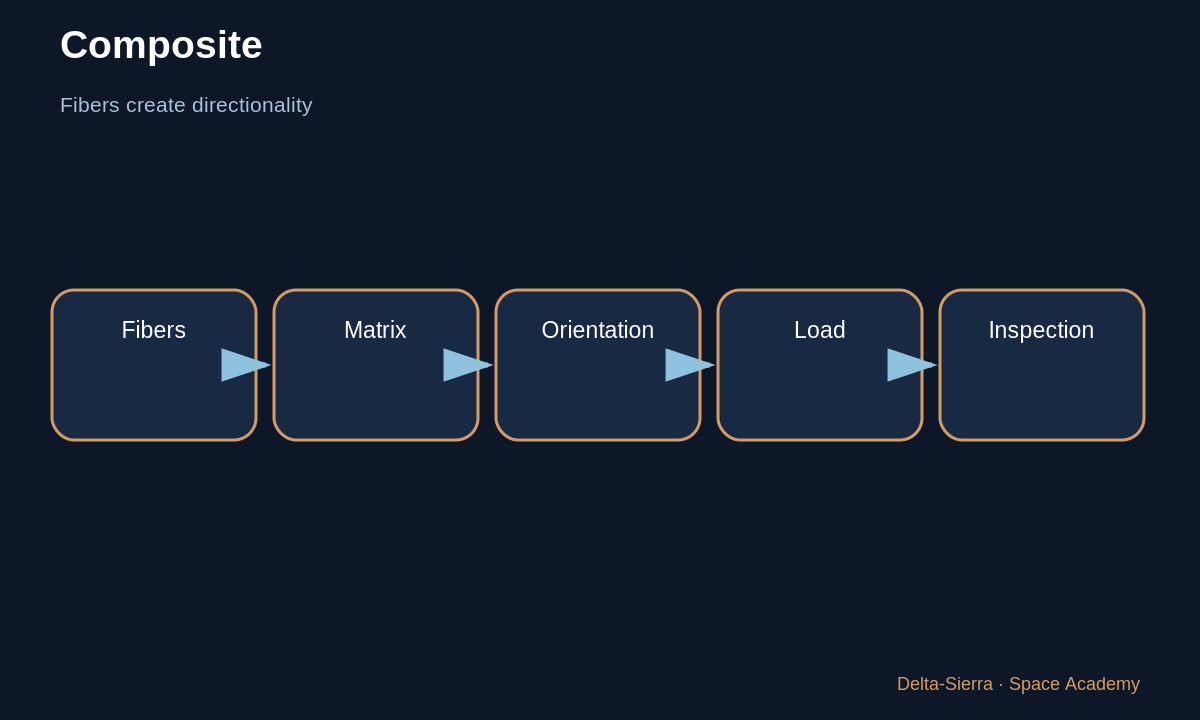
Carbon composites can offer excellent stiffness-to-mass and are used in fairings and structures. ESA describes the Ariane 6 fairing as a carbon-glass-fiber composite.
A composite is anisotropic: strength depends on fiber direction. Impact, joints, temperature, and inspection require different methods from sheet metal.
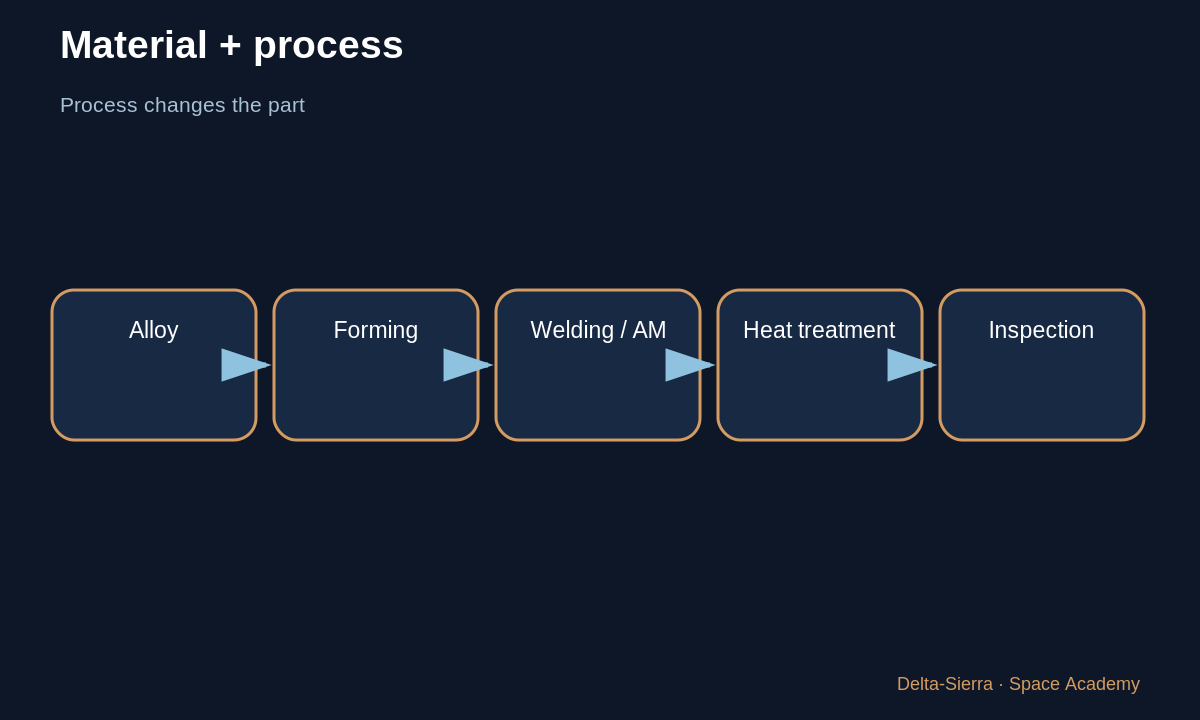
6 — Manufacturing and quality control are part of the material
An excellent alloy can perform badly if welding creates porosity, forming excessively thins the part, or heat treatment is uncontrolled.
Saturn V required dedicated research on forming, welding, and alloy process control. Material selection and manufacturing selection are inseparable.
7 — Material always means material + process + joining + inspection
Saying “aluminum” or “nickel” is not enough. A real component depends on the exact alloy, metallurgical state, forming or welding process, and the method used to inspect critical defects. Chemically similar components can behave very differently after processing or joining.
This changes how generations of rockets should be compared. Ask not only “which metal?” but “for what function, at what temperature, with what manufacturing route, what repairability and what inspection?”. Material then becomes a system decision rather than a table entry.
8 — Modern materials do not automatically make a launcher better
A composite can be very light and stiff in selected directions, yet require different joining and inspection methods. A metallic alloy may be heavier but offer ductility, repairability or a mature industrial base. An engine chamber may prioritize heat transfer while an external structure prioritizes stiffness-to-mass.
Evolution is therefore not a simple ladder from steel to aluminum to composite. Material families coexist because functions differ. Modern vehicles often use several specialized materials in one assembly, each chosen for a dominant constraint and for how it interacts with its neighbors.
Exercises and answers
Function
Why use copper in a chamber but not necessarily in a whole propellant tank?
Comparison
Why can lower density compensate for somewhat lower strength?
Trap
Why is “titanium is best” false?