Course compass
Guiding question: Why can’t a large rocket engine simply open all its valves at once?
1 — The physical question
Why can’t a large rocket engine simply open all its valves at once?
We start from the concrete problem before notation. The goal is to understand what we seek, then why mathematics becomes useful.
2 — How to read the symbols and units
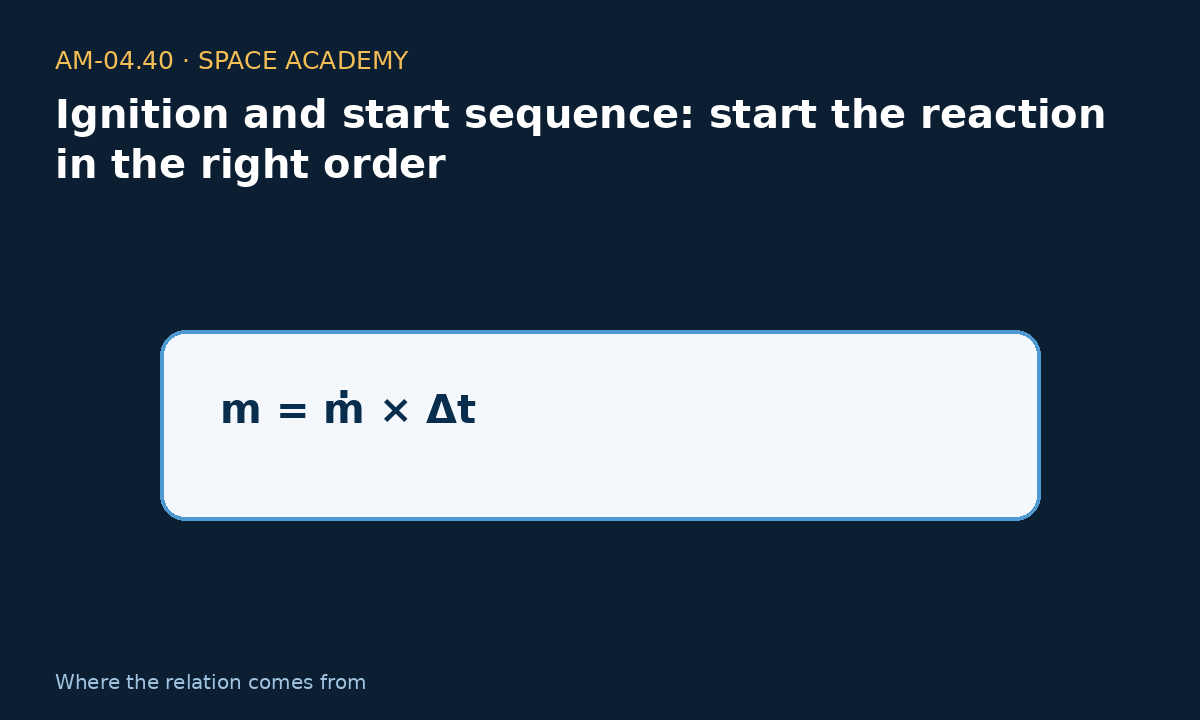
m = ṁ × Δt. Read: “m equals m dot times delta t”.
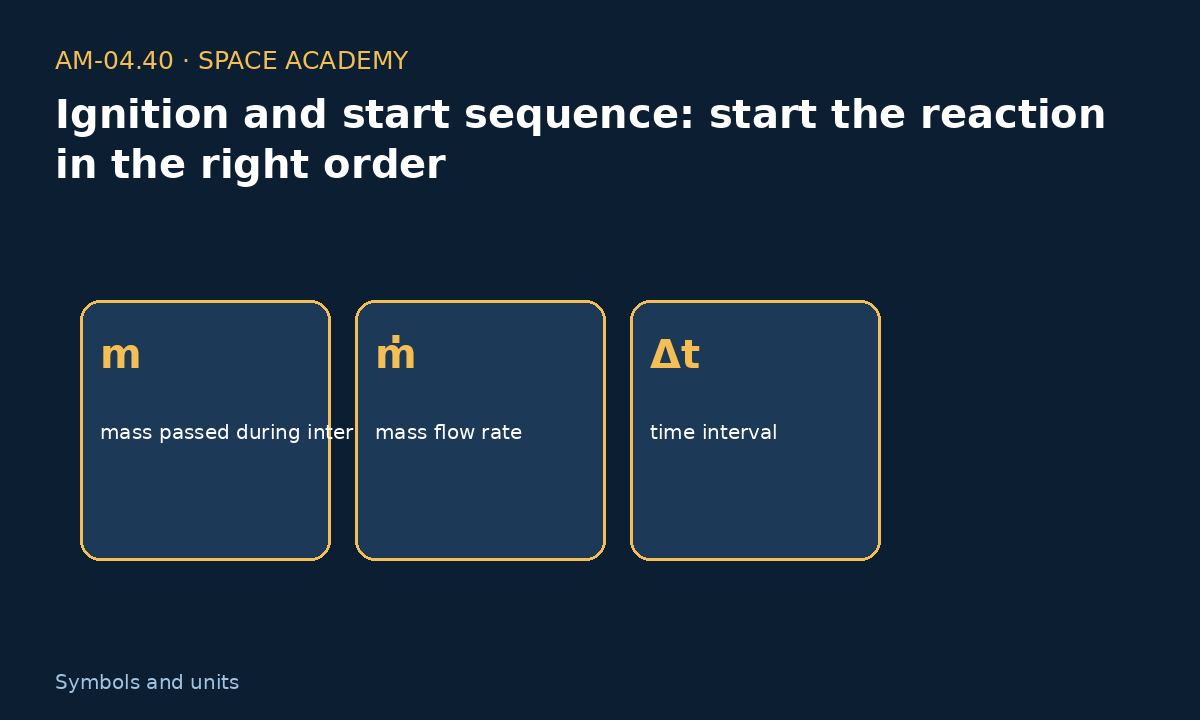
m — mass passed during interval ; ṁ — mass flow rate ; Δt — time interval
3 — Where does the relation come from?
During a transient start, even fractions of a second of flow represent significant propellant mass. Valve timing, ignition, turbomachinery spin-up and chamber pressure must therefore be coordinated to avoid dangerous mixtures or pressure excursions.
Every number used below is explicitly treated as data, convention, learning assumption, or calculated result.
4 — A — 0.2 second
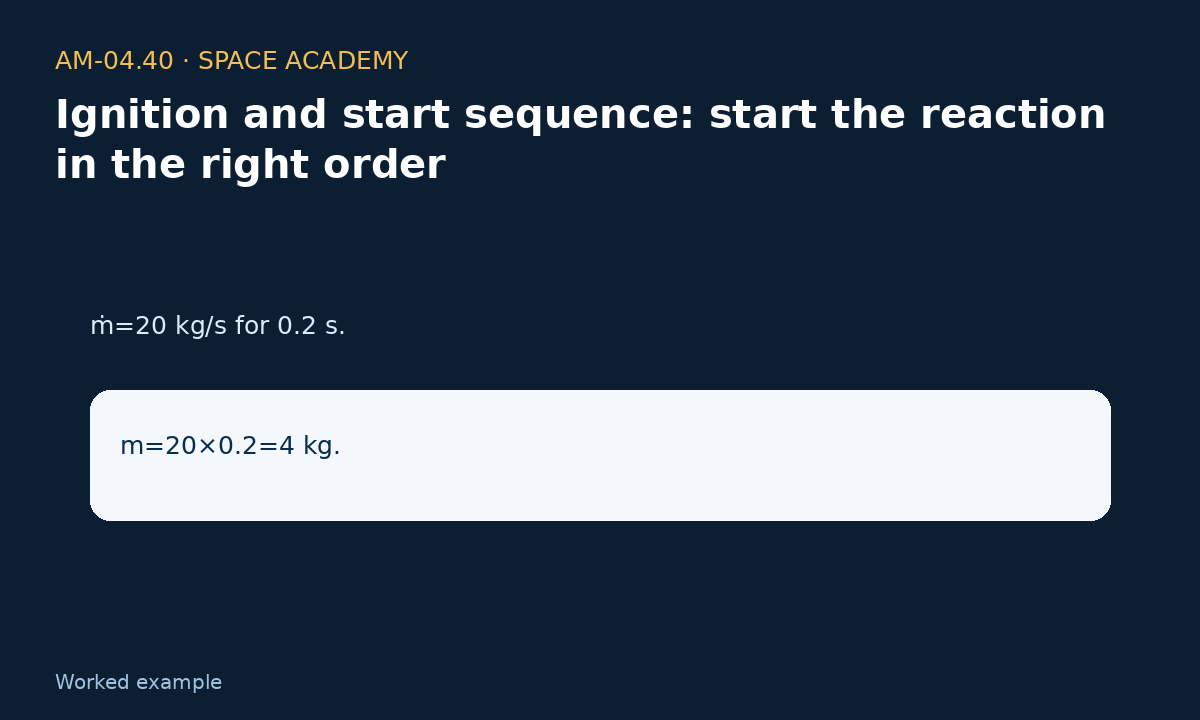
Where do the numbers come from? ṁ=20 kg/s for 0.2 s.
Step-by-step calculation: m=20×0.2=4 kg.
A small timing delay can represent several kilograms.
5 — B — Higher flow
Where do the numbers come from? ṁ=100 kg/s for 0.2 s.
Step-by-step calculation: m=20 kg.
At high flow, sequencing becomes even more critical.
6 — C — Shorter delay
Where do the numbers come from? ṁ=100 kg/s for 0.05 s.
Step-by-step calculation: m=5 kg.
Cutting duration by four cuts accumulated mass by four in this model.
7 — Sensitivity, inverse calculation, and sanity check
Change one input, predict the direction of the result, calculate, then check units, sign, order of magnitude, and limits.
Essential limit for Ignition and start sequence: start the reaction in the right order: the displayed relation is a learning model. A real system adds detailed geometry, variable properties, sensors, uncertainty, transients, and testing.
8 — Why this matters in a mission
In a space mission, why can’t a large rocket engine simply open all its valves at once? The useful skill is not reciting the formula but knowing which data are needed, which are measured, and when the model becomes insufficient.
10 — Go deeper: from calculation to physical understanding
An engine does not jump instantly from zero to nominal operation
At startup, tanks, lines, pumps, valves, ignition systems, and chamber volumes are not yet in their steady operating state. Pressures and flows build over time. A startup sequence therefore orders events so that the chamber is not exposed to a combination of flows or energy incompatible with the current system state.
Why event order matters
Opening a valve, spinning a turbomachine, and triggering an ignition source are not interchangeable actions. The general goal is to establish compatible conditions before allowing the next step. Real engines use sequences specific to their architecture; this lesson teaches interlock logic without giving an operational timeline for a particular piece of hardware.
The calculation m=ṁΔt gives a filling intuition
If an average flow of 2 kg/s passes through a circuit for 0.5 s, the transferred mass in this simple model is 1 kg. Doubling time at the same flow doubles mass. A real startup has transient flows that do not remain constant; integrating flow over time replaces simple multiplication when a more faithful description is needed.
Shutdown is also a sequence
Ending combustion is not merely turning off a switch. Remaining fluid in lines and volumes, turbomachine inertia, residual pressure, and temperature must be managed. The same reasoning about sequencing, sensors, and criteria therefore applies to shutdown, although its objectives differ from startup.
9 — Exercises and answers
Challenge 1
ṁ=20 kg/s for 0.2 s.
Challenge 2
ṁ=100 kg/s for 0.2 s.
Challenge 3
ṁ=100 kg/s for 0.05 s.