Course compass
Guiding question: Why is “98% efficiency” never a complete explanation by itself?
Markers: 📏 MEASURED · 📐 CONVENTION · 🧮 CALCULATED · 🎓 TEACHING ASSUMPTION · ⚠️ APPROXIMATION
- understand the concept
- do a simple calculation
- explain every symbol
- check a result
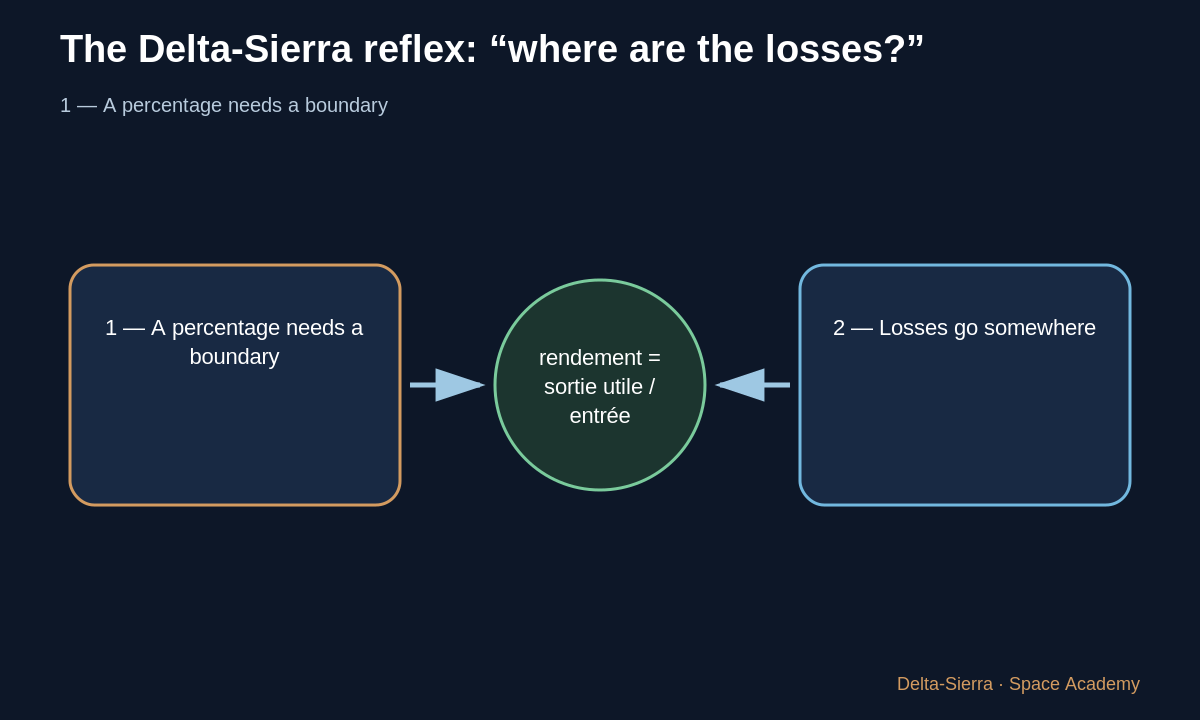
1 — A percentage needs a boundary
98% of what? Which stream? Over what time? Under which conditions? Efficiency without a system boundary can mislead.
Before calculating, identify what enters, what leaves usefully, and what leaves by another path.
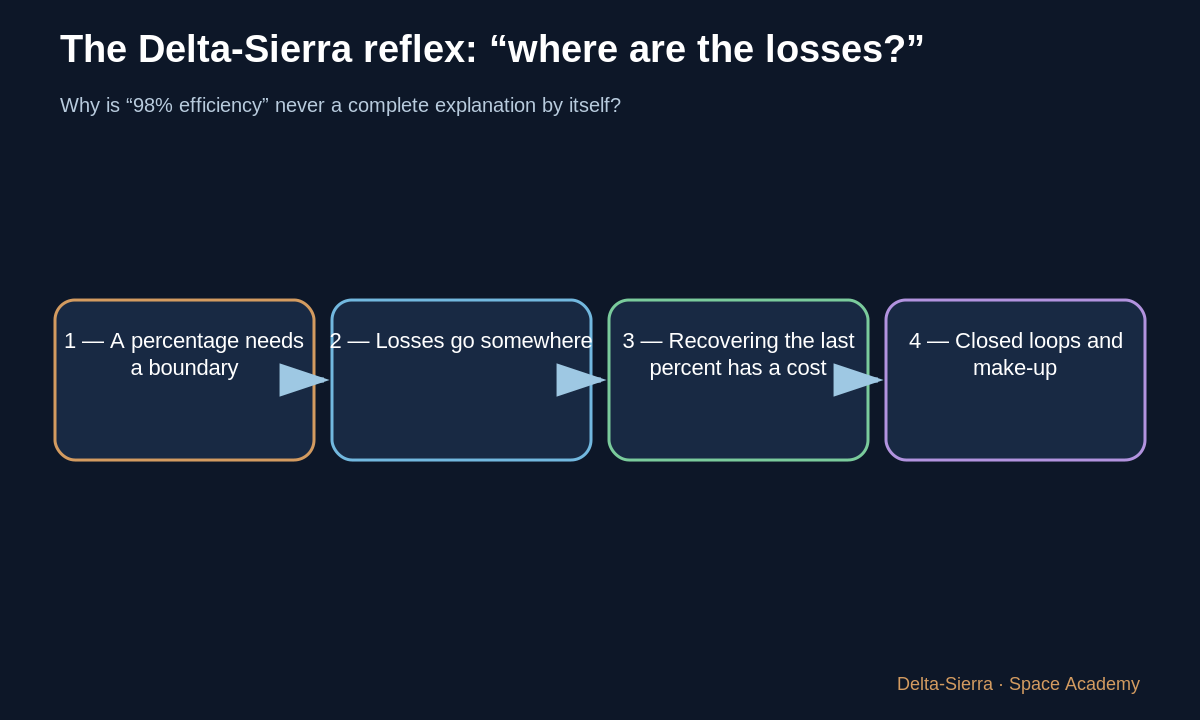
2 — Losses go somewhere
Energy becomes heat, water remains in brine, mass is vented, time is spent on maintenance: a “loss” is not necessarily disappearance.
Naming the destination makes the system understandable and may reveal recovery options.
3 — Recovering the last percent has a cost
Moving from 98 to 99.8% may require more energy, filters, pumps, mass, and maintenance.
Survival optimum is not automatically maximum isolated efficiency.
4 — Closed loops and make-up
In a settlement, a small unrecovered fraction can matter over months. Calculate make-up flow and ask whether local resources can supply it.
This connects an abstract percentage to logistics.
Three complete examples: change one assumption to understand
Before each calculation, identify where every number comes from and whether it is measured, conventional, assumed, or calculated.
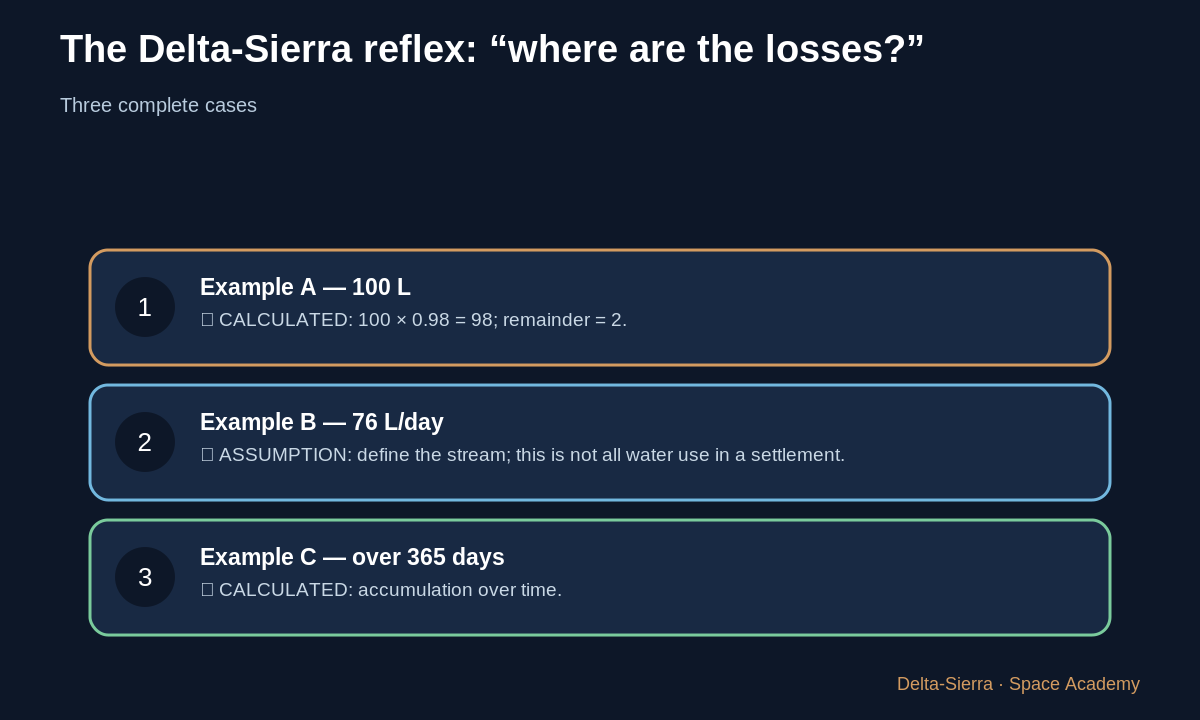
Example A — 100 L
For a defined 100 L stream, 98% recovery returns 98 L and leaves 2 L outside the useful recovered stream.
🧮 CALCULATED: 100 × 0.98 = 98; remainder = 2.
Example B — 76 L/day
For 76 L/day, 98% gives 74.48 L/day recovered and a theoretical 1.52 L/day make-up.
🎓 ASSUMPTION: define the stream; this is not all water use in a settlement.
Example C — over 365 days
1.52 L/day × 365 = 554.8 L/year. A small daily fraction becomes a visible logistics quantity.
🧮 CALCULATED: accumulation over time.
Inverse calculation
If make-up is limited to 0.76 L/day for the same stream, what recovery is required? Loss = 0.76/76 = 1%, so recovery = 99%.
Common trap and result check
Trap: calling everything outside the useful output a “loss” without asking where the matter or energy actually went.
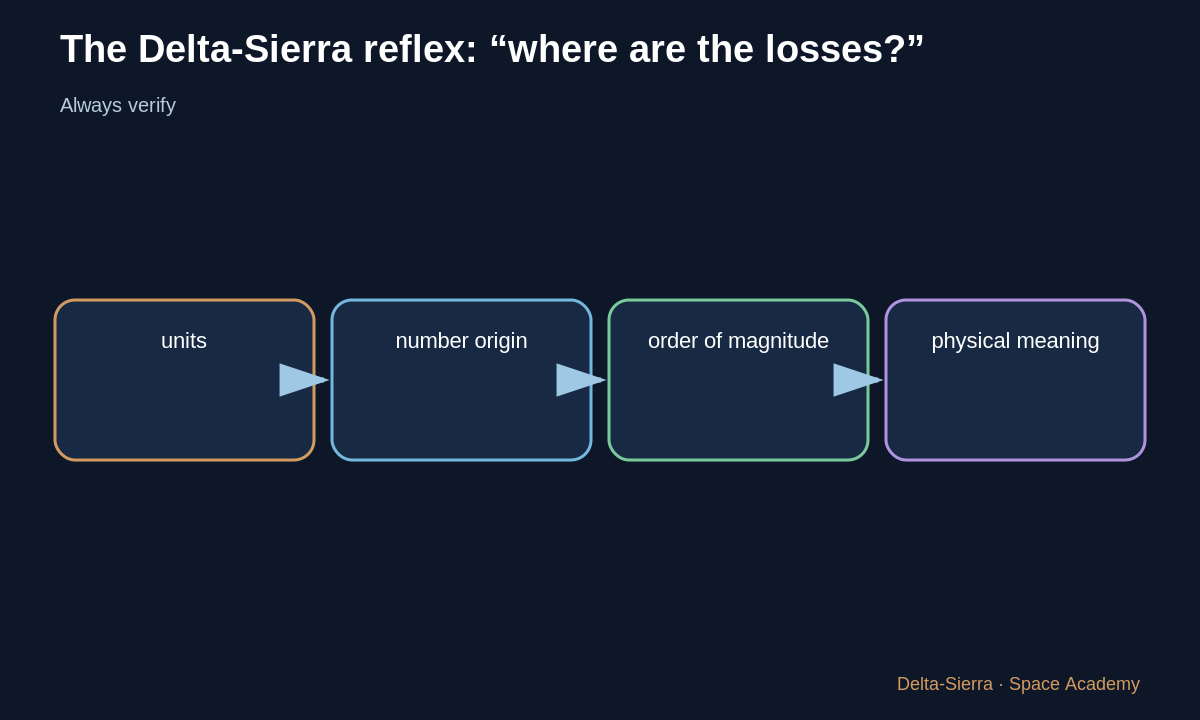
Always check units, order of magnitude, and physical meaning before accepting a result.
Exercises and answers
Understand
Explain the relationship in your own words.
Change an assumption
Modify one input and predict the direction of change before calculating.
Verify
Name two checks after a calculation.