Course compass
Guiding question: What does “isolate x” really mean, and why may we perform the same operation on both sides?
Markers: 📏 MEASURED · 📐 CONVENTION · 🧮 CALCULATED · 🎓 TEACHING ASSUMPTION · ⚠️ APPROXIMATION
- understand the concept
- do a simple calculation
- explain every symbol
- check a result
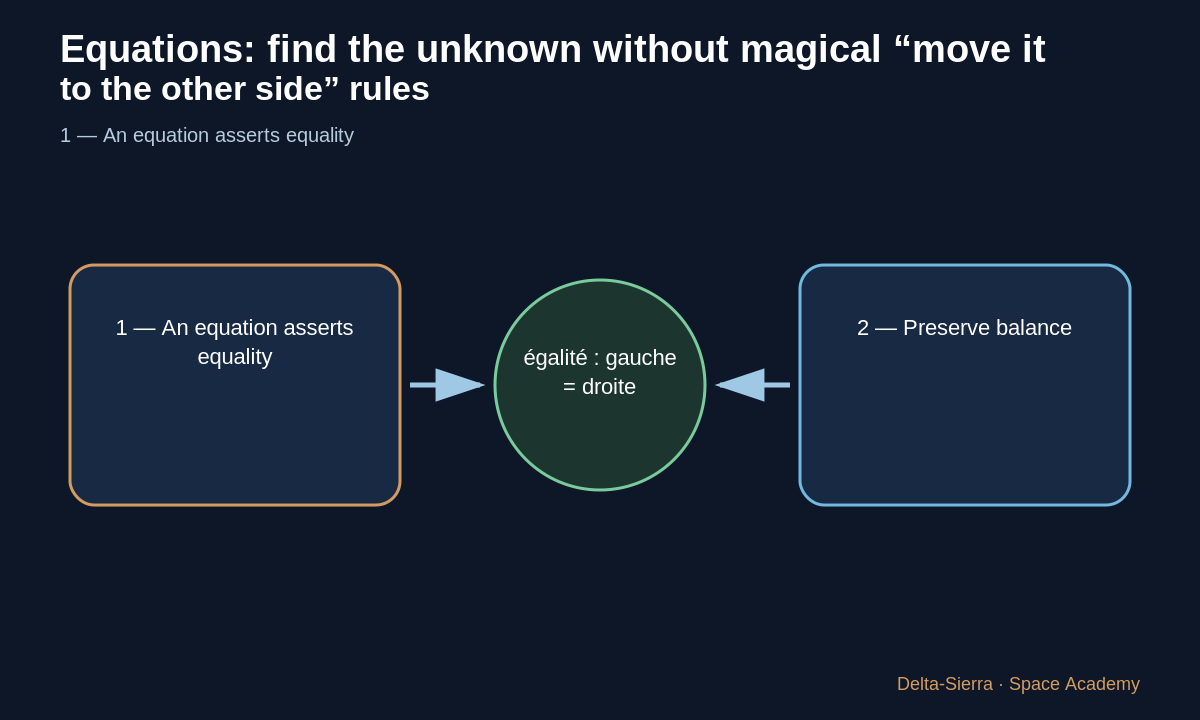
1 — An equation asserts equality
The equals sign says both expressions have the same value. An equation is not an instruction; it is a statement to satisfy.
Solving means finding the unknown value that makes it true.
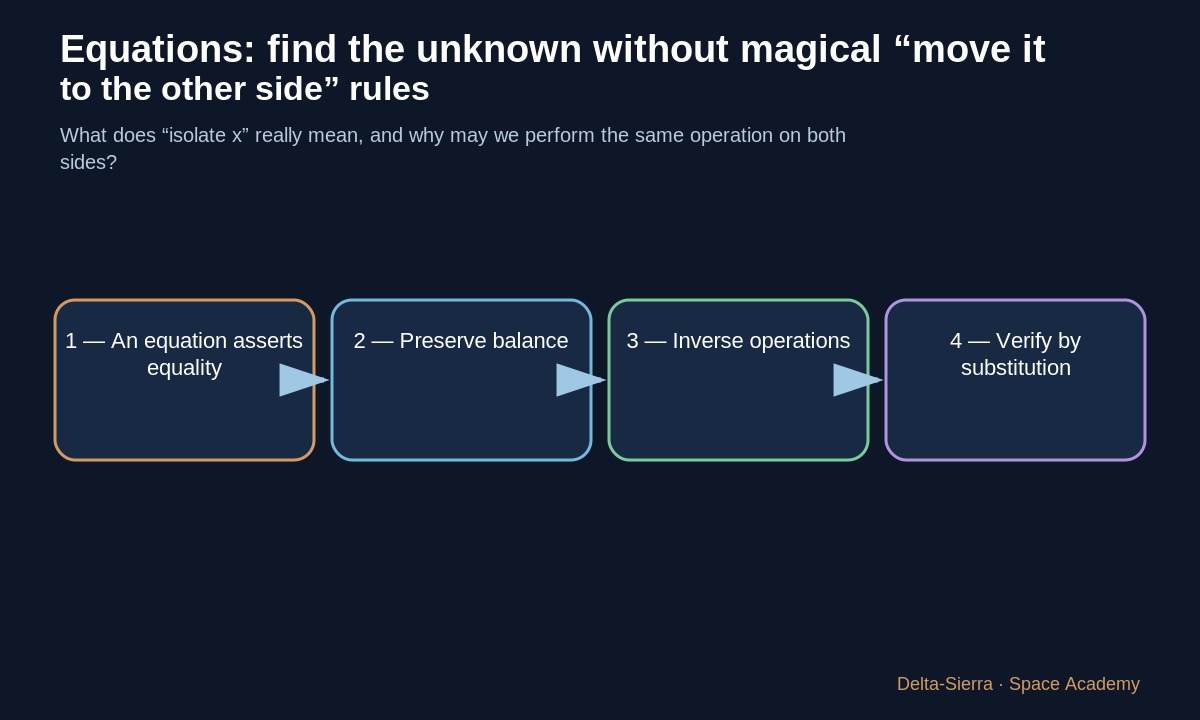
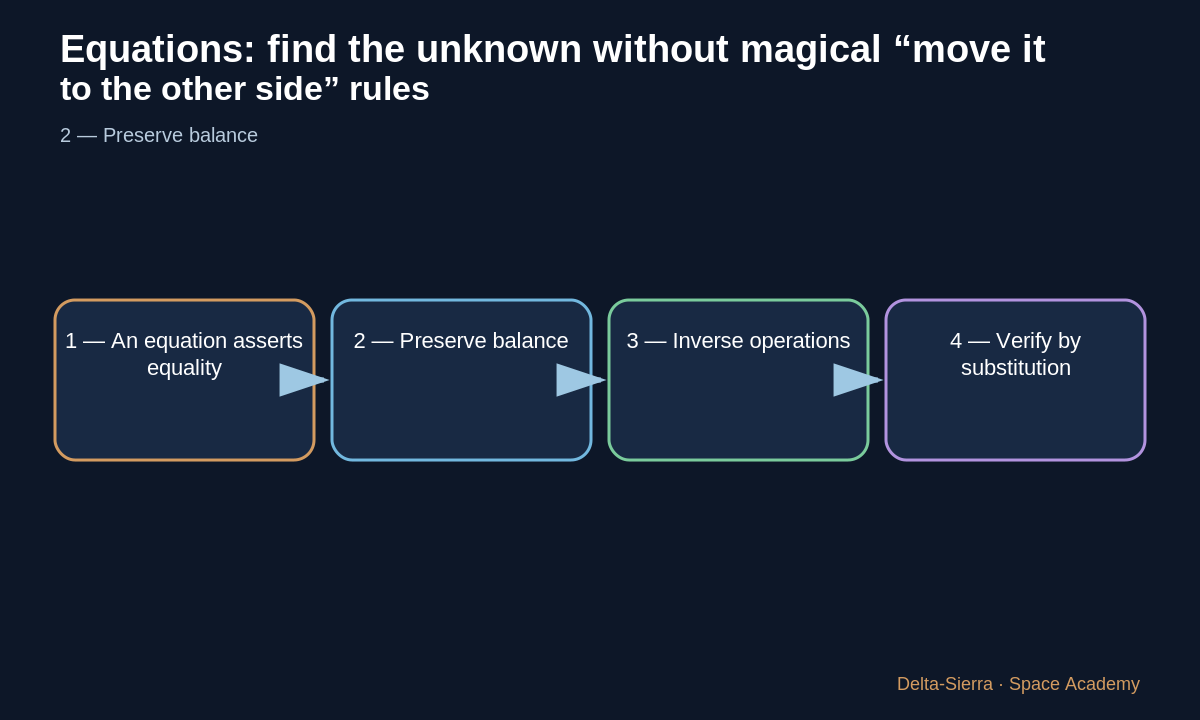
2 — Preserve balance
If two sides are equal, adding, subtracting, multiplying, or dividing both sides by the same nonzero quantity preserves equality.
The balance analogy helps, then we return to actual operations.
3 — Inverse operations
Addition and subtraction undo each other; multiplication and division do too. To free x from ×3, divide both sides by 3.
Nothing “jumps across” the equals sign; the same operation is applied to both sides.
4 — Verify by substitution
After finding x, replace x in the original equation. If both sides differ, the solution is wrong.
Substitution is a simple strong check.
Three complete examples: change one assumption to understand
Before each calculation, identify where every number comes from and whether it is measured, conventional, assumed, or calculated.
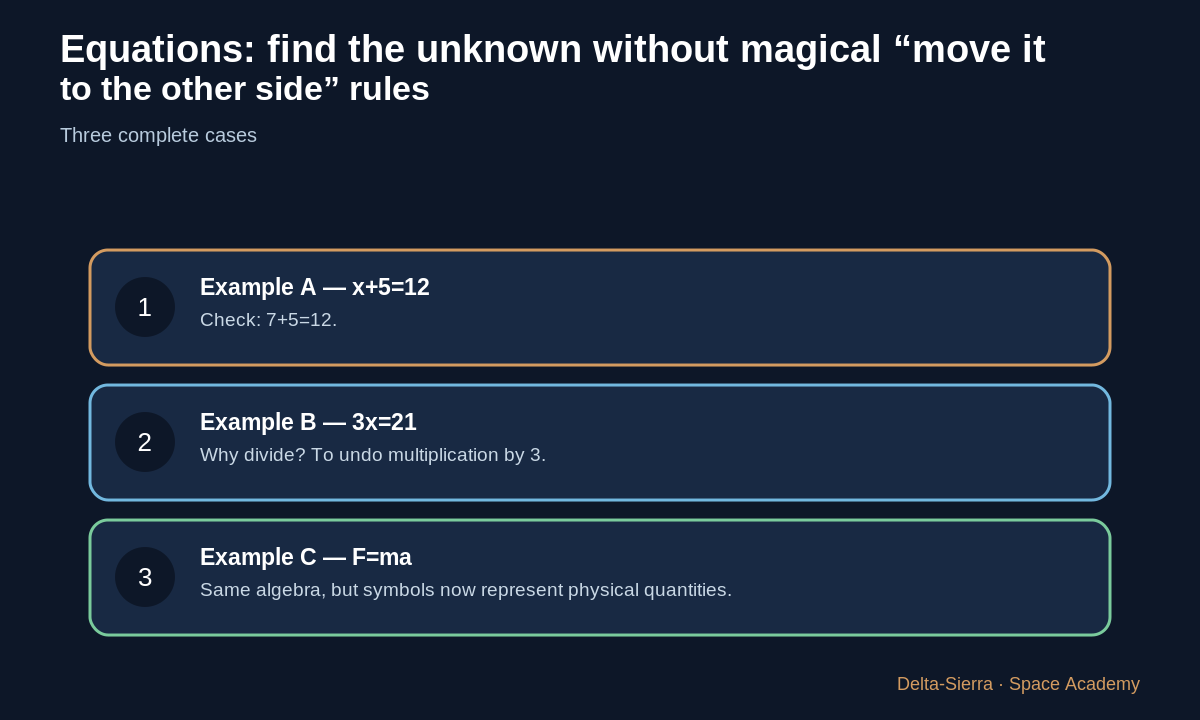
Example A — x+5=12
Subtract 5 from both sides: x+5−5 = 12−5, so x=7.
Check: 7+5=12.
Example B — 3x=21
Divide both sides by 3: x=21/3=7.
Why divide? To undo multiplication by 3.
Example C — F=ma
If F=100 N and m=20 kg, a=F/m=100/20=5 m/s².
Same algebra, but symbols now represent physical quantities.
Inverse calculation
If a=5 m/s² and m=20 kg, recover F=ma=100 N. Direct and inverse calculations should agree.
Common trap and result check
Trap: dividing by a quantity without checking that it is nonzero and without tracking units.
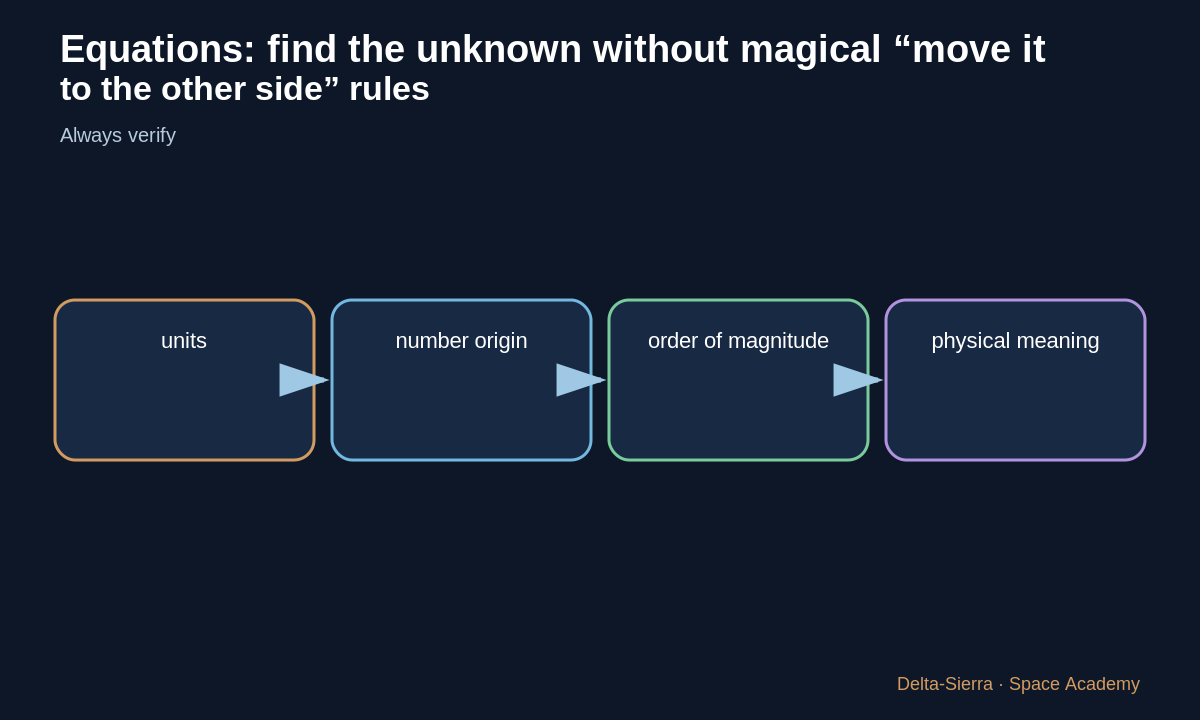
Always check units, order of magnitude, and physical meaning before accepting a result.
Exercises and answers
Understand
Explain the relationship in your own words.
Change an assumption
Modify one input and predict the direction of change before calculating.
Verify
Name two checks after a calculation.