Course compass
Guiding question: What does “engine at 70%” actually mean?
1 — The physical question
What does “engine at 70%” actually mean?
We start from the concrete problem before notation. The goal is to understand what we seek, then why mathematics becomes useful.
2 — How to read the symbols and units
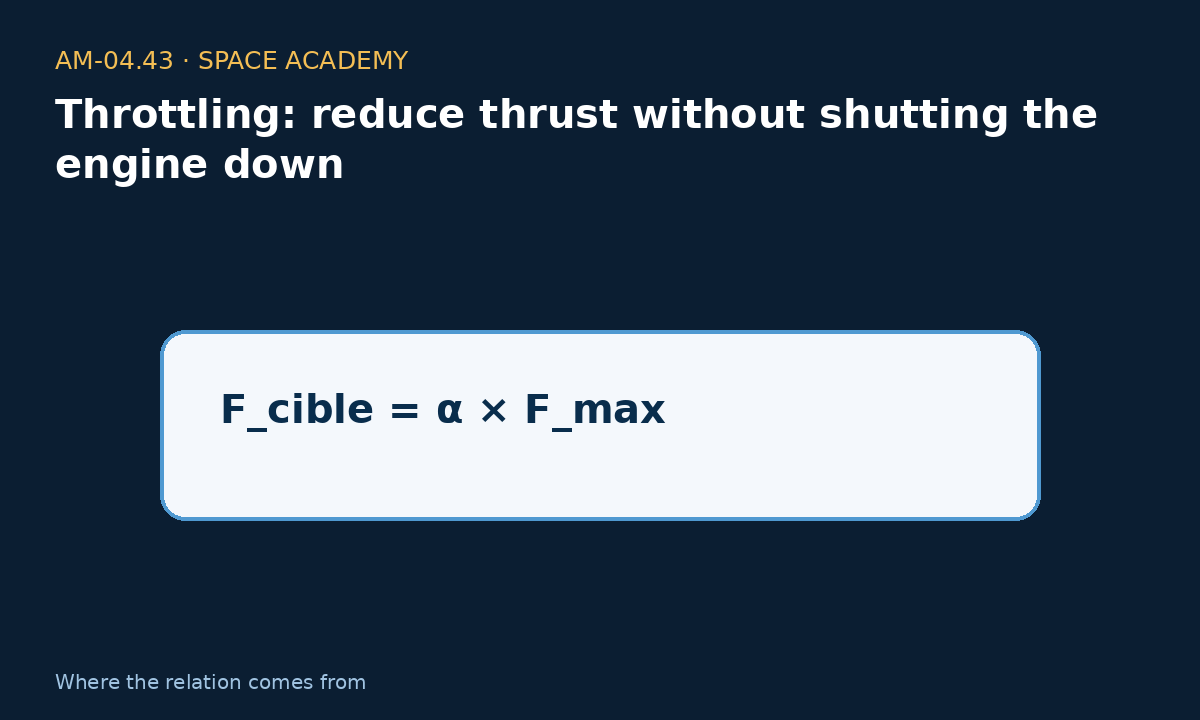
F_cible = α × F_max. Read: “target F equals alpha times F max”.
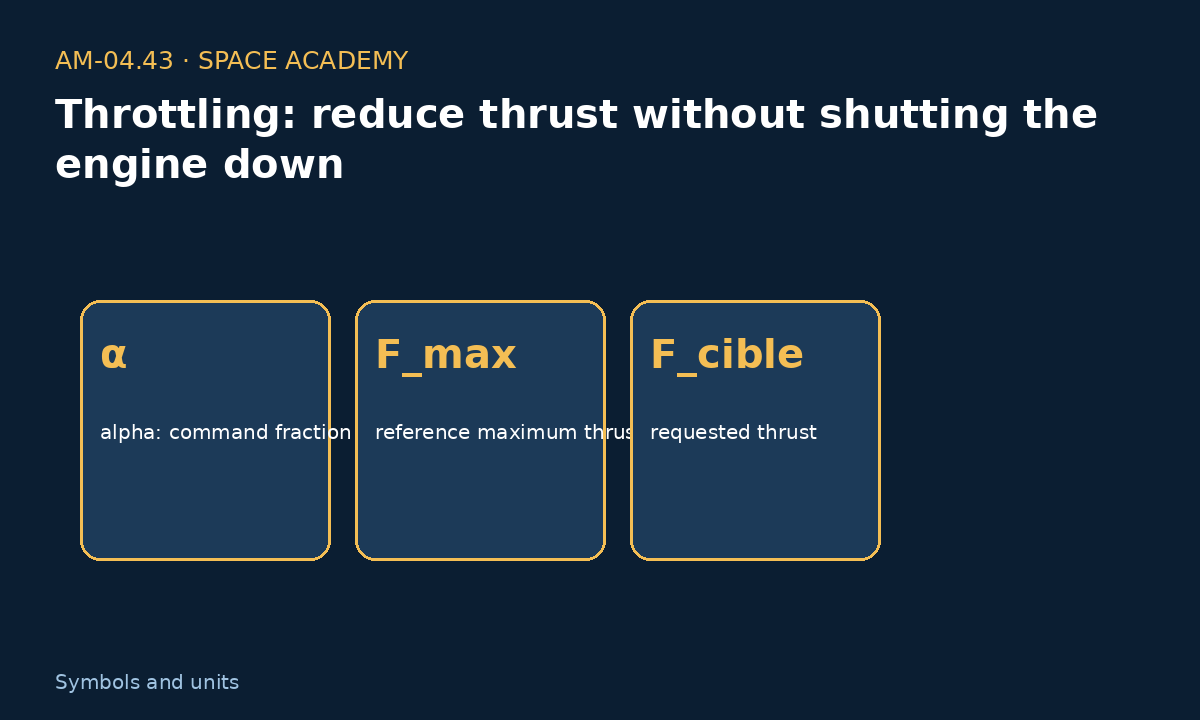
α — alpha: command fraction between 0 and 1 ; F_max — reference maximum thrust ; F_cible — requested thrust
3 — Where does the relation come from?
For first intuition, α is a fraction of maximum thrust: 1.00 means 100%, 0.70 means 70%. A real engine does not necessarily scale flow, chamber pressure and thrust perfectly linearly; this is a learning model.
Every number used below is explicitly treated as data, convention, learning assumption, or calculated result.
4 — A — 70%
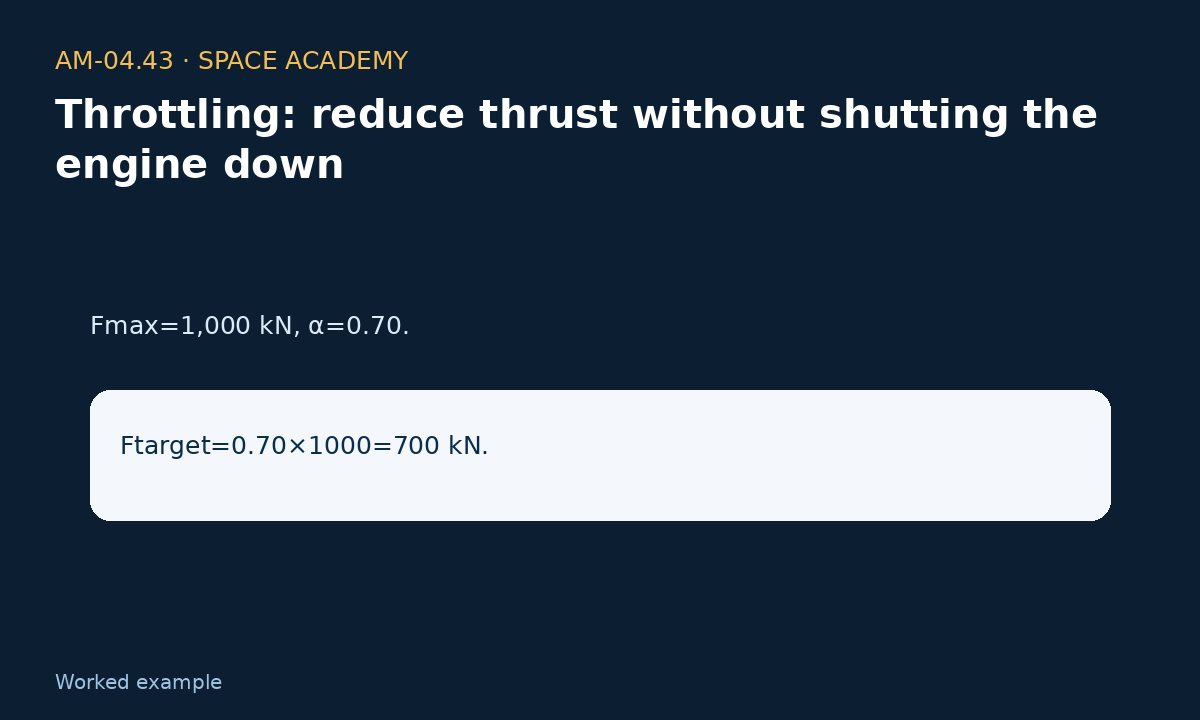
Where do the numbers come from? Fmax=1,000 kN, α=0.70.
Step-by-step calculation: Ftarget=0.70×1000=700 kN.
Percentage is converted to a fraction before multiplication.
5 — B — 40%
Where do the numbers come from? Fmax=1,000 kN, α=0.40.
Step-by-step calculation: Ftarget=400 kN.
A real engine may have a minimum stable throttle above this value.
6 — C — Solve for α
Where do the numbers come from? Ftarget=825 kN, Fmax=1,100 kN.
Step-by-step calculation: α=825÷1100=0.75=75%.
Inverse calculation: recover relative command from requested thrust.
7 — Sensitivity, inverse calculation, and sanity check
Change one input, predict the direction of the result, calculate, then check units, sign, order of magnitude, and limits.
Essential limit for Throttling: reduce thrust without shutting the engine down: the displayed relation is a learning model. A real system adds detailed geometry, variable properties, sensors, uncertainty, transients, and testing.
8 — Why this matters in a mission
In a space mission, what does “engine at 70%” actually mean? The useful skill is not reciting the formula but knowing which data are needed, which are measured, and when the model becomes insufficient.
10 — Go deeper: from calculation to physical understanding
Throttling is not simply closing a valve halfway
The model F_target=αF_max is useful for understanding a command: α=0.7 asks for 70% of maximum thrust in this approximation. A real engine architecture must simultaneously establish compatible flows, pressures, mixture ratio, turbomachine speeds, and margins. Valve position and thrust are therefore not necessarily linearly related.
Why going too low can become difficult
At low operating level, phenomena that were comfortably nominal can change: combustion stability, turbomachinery behaviour, atomisation, cooling, or actuator precision. An engine therefore has a qualified throttle range, not an abstract promise to operate from 0 to 100% in every condition.
The control loop seeks a state, not only a number
The controller compares thrust or correlated quantities with command and acts on several devices. At the same time it monitors limits. A request for more thrust can be refused or limited if pressure, temperature, or rotational speed approaches a threshold. This is control under constraints.
Why throttling matters in a mission
Changing thrust lets a vehicle adapt acceleration, loads, trajectory, or a landing phase. But the mission must know dynamic response: how long does it take to move from one operating point to another and with what possible overshoot? An instantaneous command on a display never implies an instantaneous machine response.
9 — Exercises and answers
Challenge 1
Fmax=1,000 kN, α=0.70.
Challenge 2
Fmax=1,000 kN, α=0.40.
Challenge 3
Ftarget=825 kN, Fmax=1,100 kN.