Course compass
Guiding question: Why must a chemical equation count the same number of each atom before and after?
Markers: 📏 MEASURED · 📐 CONVENTION · 🧮 CALCULATED · 🎓 TEACHING ASSUMPTION · ⚠️ APPROXIMATION
- define reactant and product
- balance by counting
- respect conservation
- distinguish equation from process
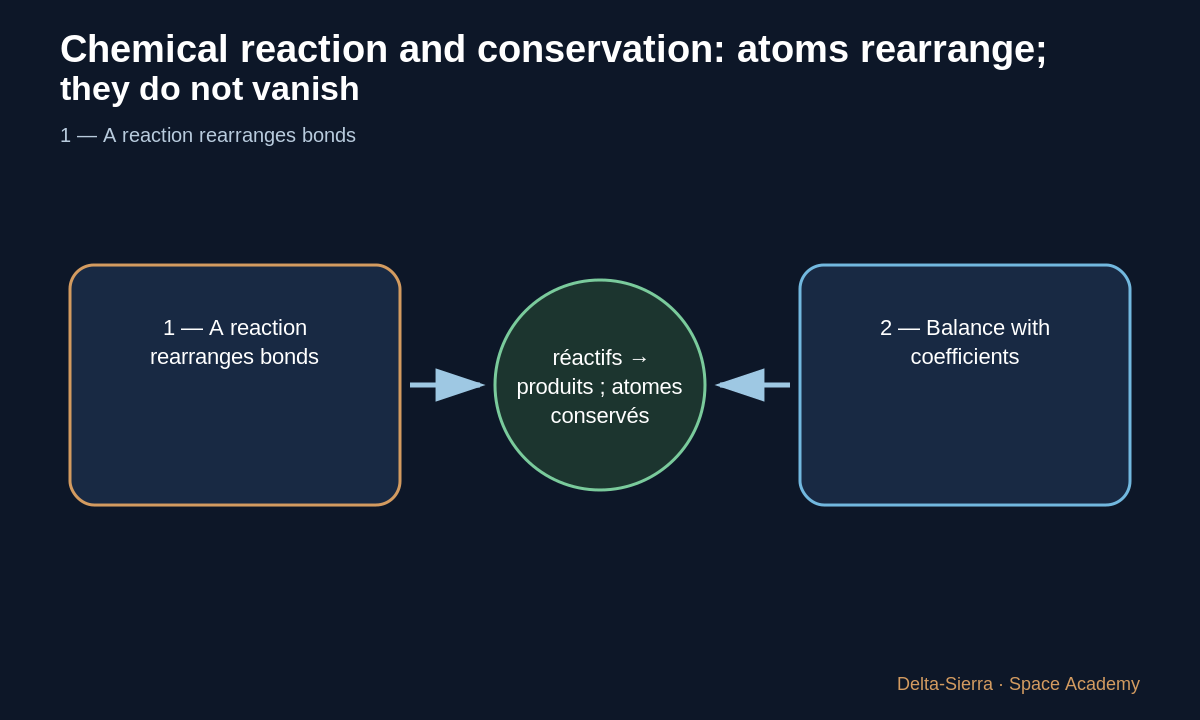
1 — A reaction rearranges bonds
Starting substances are reactants; formed substances are products. Atoms are rearranged among molecules.
The equation must conserve each element in the chemical model.
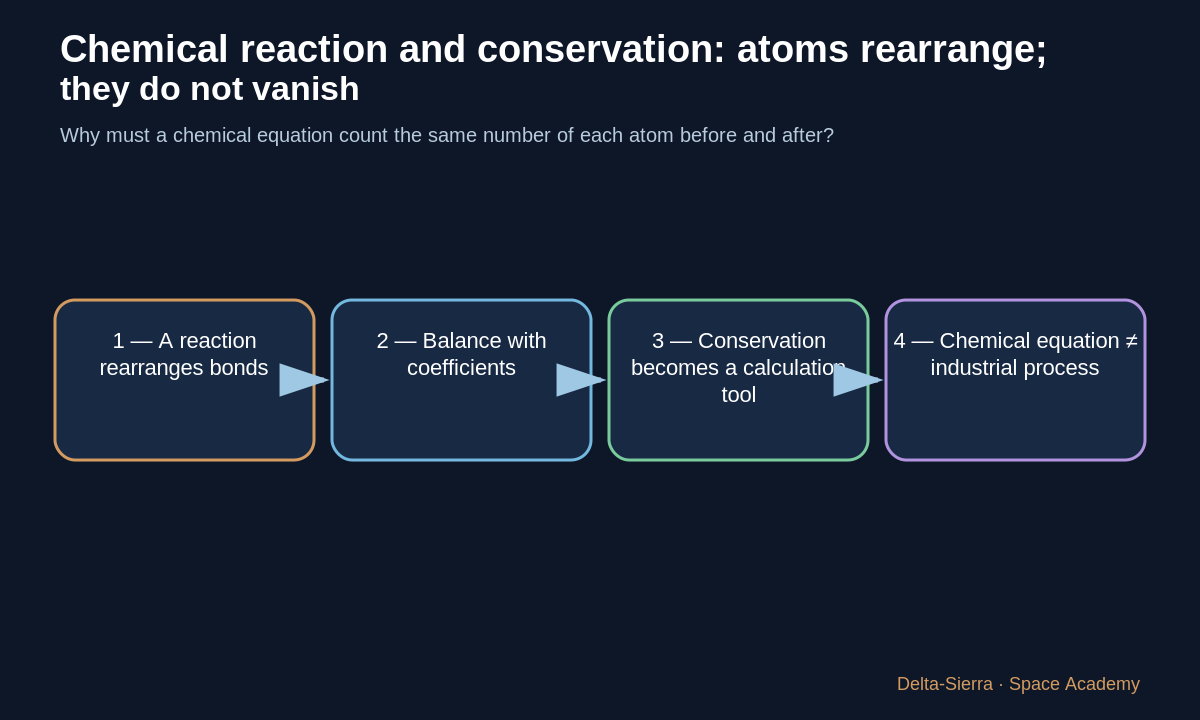
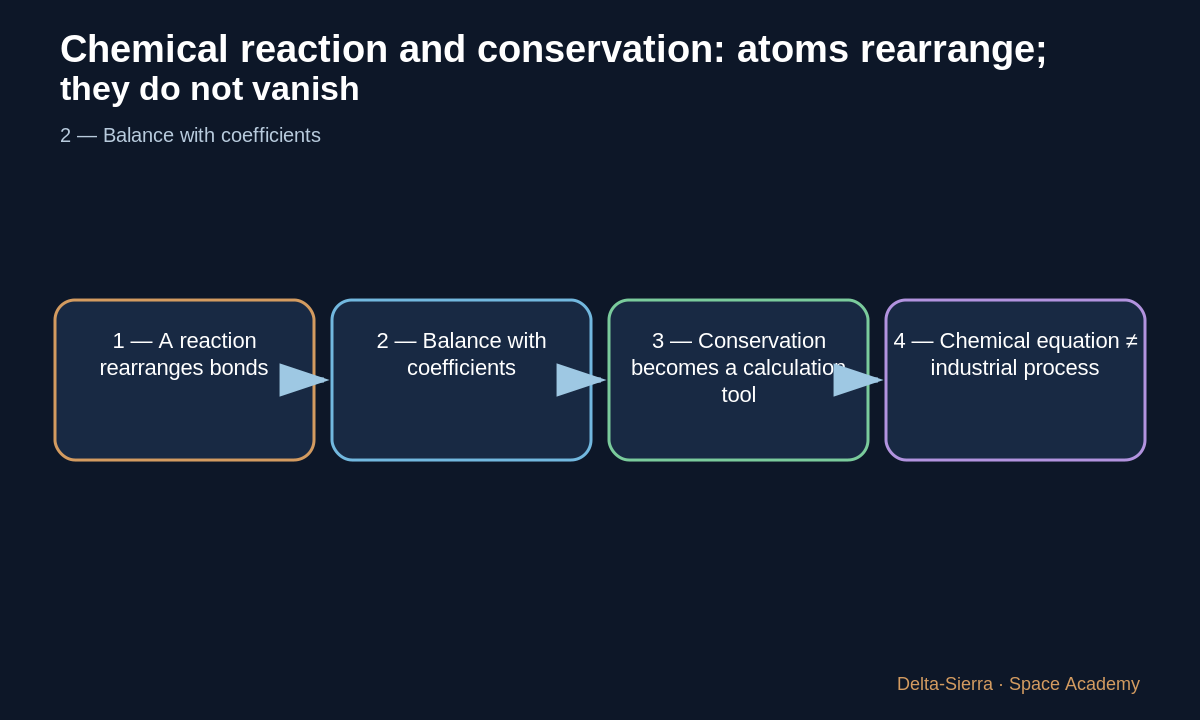
2 — Balance with coefficients
For water formation, H₂ + O₂ → H₂O does not conserve O.
2 H₂ + O₂ → 2 H₂O counts 4 H and 2 O on both sides.
3 — Conservation becomes a calculation tool
Once coefficients are balanced, they give ratios of molecule counts or moles.
Real mass calculations then require molar masses, taught elsewhere.
4 — Chemical equation ≠ industrial process
A reaction written on paper does not by itself specify temperature, catalyst, kinetics, efficiency, safety, or equipment.
Space Academy teaches stoichiometric logic before process engineering.
Three complete examples: change one assumption to understand
Before each calculation, identify where every number comes from and whether it is measured, conventional, assumed, or calculated.
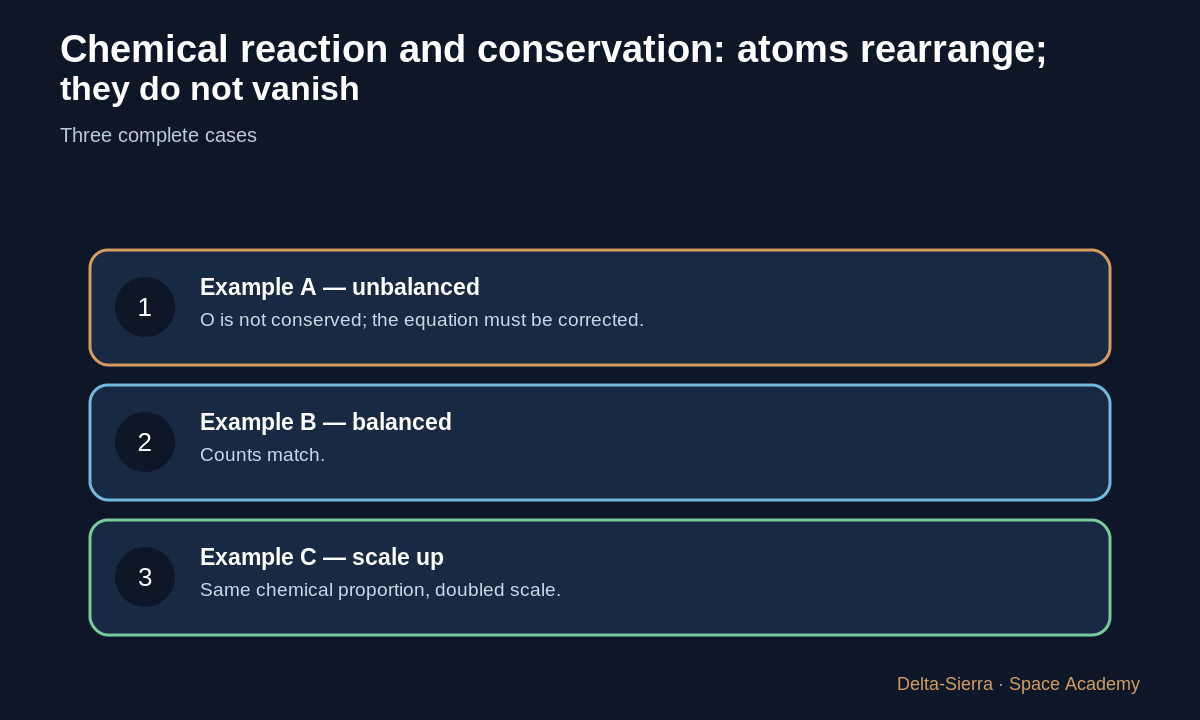
Example A — unbalanced
H₂ + O₂ → H₂O: left H=2,O=2; right H=2,O=1.
O is not conserved; the equation must be corrected.
Example B — balanced
2 H₂ + O₂ → 2 H₂O: left H=4,O=2; right H=4,O=2.
Counts match.
Example C — scale up
4 H₂ + 2 O₂ → 4 H₂O is also balanced: all coefficients doubled.
Same chemical proportion, doubled scale.
Inverse calculation
If 6 H₂ molecules react in a 2:1 ratio with O₂, the stoichiometric count requires 6/2=3 corresponding O₂ units.
Common trap and result check
Trap: believing a balanced equation proves a reaction will be fast, complete, or easy to implement.
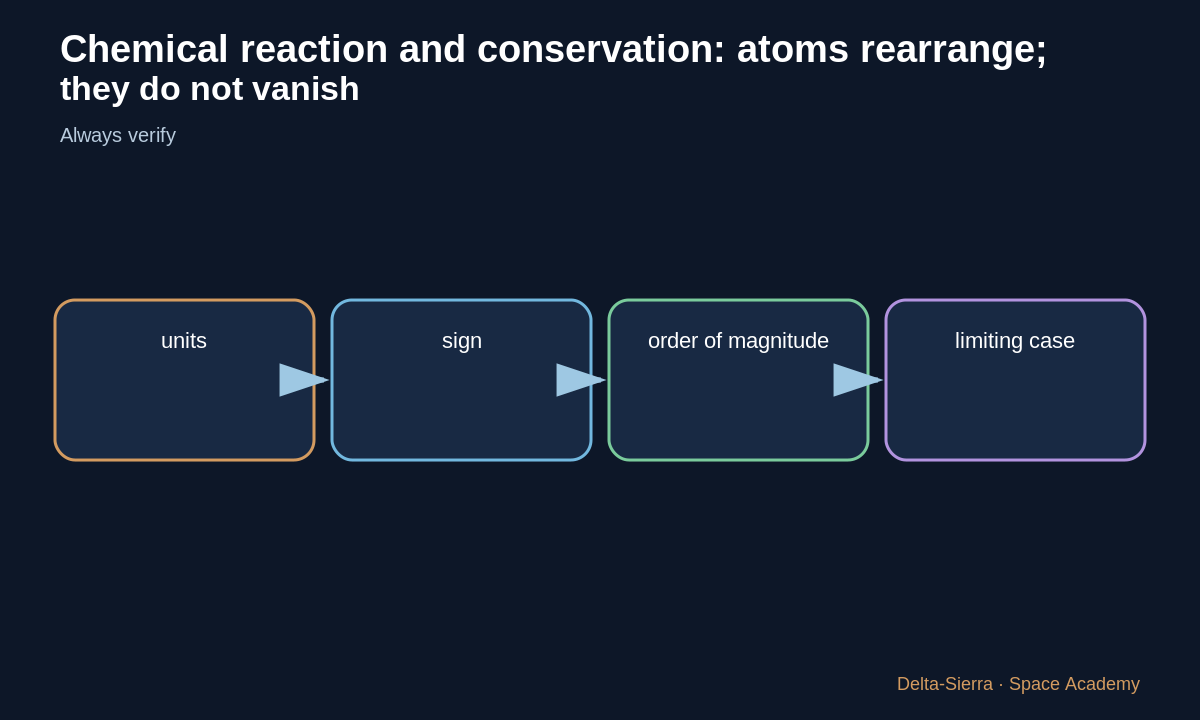
Check units, sign, order of magnitude, and consistency with a limiting case.
Exercises and answers
Restate
Explain in your own words what the equation connects.
Vary
Halve one input and predict the result before calculating.
Check
What independent check can you perform?