Course compass
Goal: understand every word, symbol, unit and operation before using the formula.
Method: concrete situation → vocabulary → step-by-step calculation → three examples → check.
1 — Start with a real measurement: an instrument never gives infinite precision
Imagine an oxygen crate on a scale inside a Mars habitat. The display reads 20.0 kg. That does not mean the true mass is known with unlimited precision. The scale has resolution, calibration limits and small imperfections.
An honest educational statement could be 20.0 ± 0.2 kg. The symbol ± is read “plus or minus”. Here it means: “our best estimate is 20.0 kg, with an uncertainty of 0.2 kg around it.”
2 — What does “± 0.2 kg” mean?
lower value = 20.0 − 0.2 = 19.8 kg
upper value = 20.0 + 0.2 = 20.2 kg
This is an educational uncertainty interval, not a claim that the true value sits at one end.
Absolute uncertainty uses the same unit as the measurement. Relative uncertainty compares the margin with the measured value.
relative uncertainty = 0.2 ÷ 20.0 = 0.01 = 1%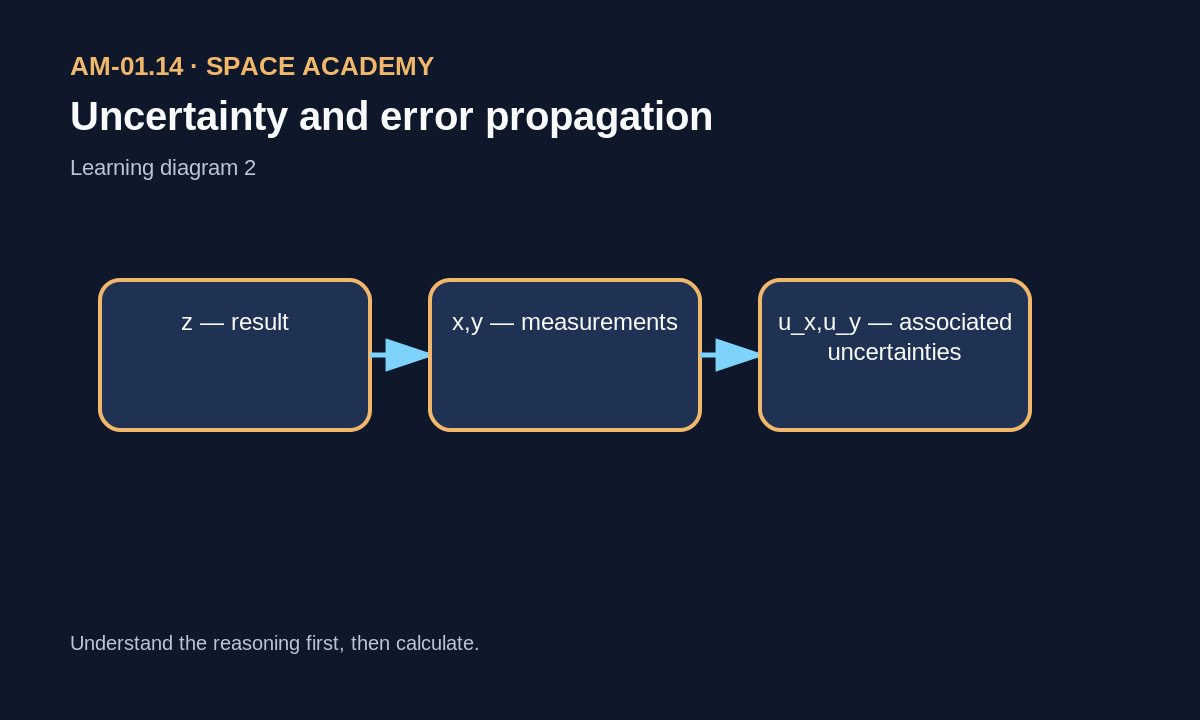
3 — Read the symbols aloud
- ±: “plus or minus”;
- Δ: “delta”, often meaning a change or difference;
- Δm: “delta m”, a change or uncertainty associated with mass depending on context;
- %: “percent”, meaning parts per hundred.
A letter is only a short label. Before calculating, always state what it represents, its unit and where the number came from.
4 — Adding and subtracting: a conservative beginner rule
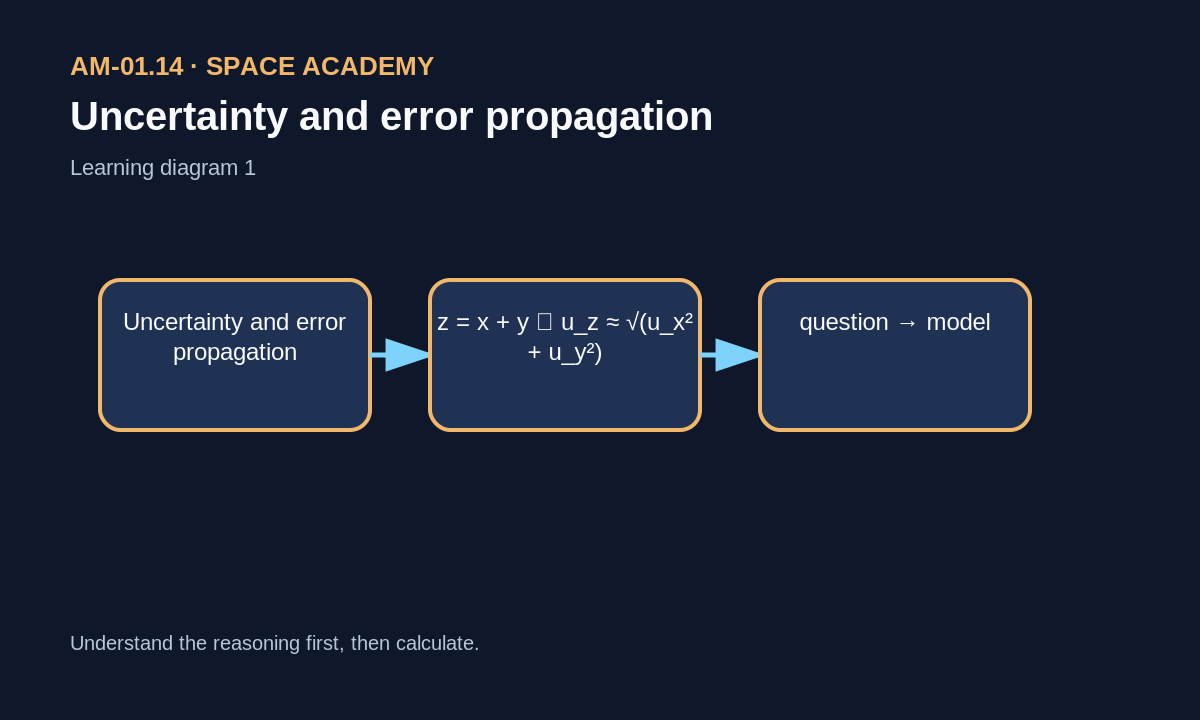
For a first pedagogical model, when adding or subtracting independent measurements we can conservatively add their absolute uncertainties. More advanced statistical methods come later.
A = 12.0 ± 0.1 kg
B = 8.0 ± 0.2 kg
A + B = 20.0 kg
conservative uncertainty = 0.1 + 0.2 = 0.3 kg
result: 20.0 ± 0.3 kg
5 — Multiplication and division: compare percentage uncertainties
In a conservative beginner rule, relative uncertainties are added for multiplication and division.
A pump transfers 120 ± 2 kg of water in 60 ± 1 s.
flow = 120 ÷ 60 = 2.00 kg/s
mass relative uncertainty ≈ 1.67%
time relative uncertainty ≈ 1.67%
conservative flow relative uncertainty ≈ 3.34%
absolute flow uncertainty ≈ 0.07 kg/s
result ≈ 2.00 ± 0.07 kg/s6 — Three concrete examples
Example A — Cargo mass
15.0 ± 0.2 kg plus 10.0 ± 0.1 kg.
total = 25.0 kg
conservative uncertainty = 0.3 kg
25.0 ± 0.3 kg
Example B — Water flow
50.0 ± 0.5 kg in 25.0 ± 0.5 s.
flow = 2.00 kg/s
relative margins = 1% + 2% = 3%
absolute margin ≈ 0.06 kg/s
2.00 ± 0.06 kg/s
Example C — Solar power received
A 2.00 ± 0.02 m² panel receives 500 ± 10 W/m².
power = 1,000 W
relative margins = 1% + 2% = 3%
absolute margin ≈ 30 W
1,000 ± 30 W
7 — Error, uncertainty and mistake are not the same idea
A data-entry mistake is a fault. Uncertainty describes what is not known perfectly. Measurement error, in technical use, is the difference between a measured value and a reference value when such a comparison is available.
8 — Why this matters on Mars
A Mars settlement will make decisions from oxygen stocks, water, power, flow, temperature, pressure and navigation measurements. A number without a precision statement can create false confidence.
Beginner checkpoint — what should you say before trusting a calculated number?
Always state the measured quantity, its unit and its uncertainty. Then identify whether the next operation is an addition, subtraction, multiplication or division. That tells you whether the beginner rule uses absolute or relative uncertainty. Finally, translate the result back into ordinary language. A result such as 2.00 ± 0.07 kg/s is not merely a formula output: it means the best estimate of the flow is 2.00 kilograms per second and the stated uncertainty is about 0.07 kilograms per second under the assumptions used.
Also keep measurement uncertainty separate from a safety margin. An engineering team may deliberately require extra reserve even after the uncertainty has been estimated. Uncertainty describes what is not known perfectly; a safety margin is an additional design choice.
9 — Corrected exercises
Exercise 1
−20.0 ± 0.5 °C: what educational interval does that represent?
Exercise 2
40.0 ± 0.4 kg: relative uncertainty?