Course compass
Goal: understand every word, symbol, unit and operation before using the formula.
Method: concrete situation → vocabulary → step-by-step calculation → three examples → check.
1 — A simple scene: where is the rover, and how far did it drive?
A rover leaves the habitat, drives 100 m east, then comes back 40 m west. Three different questions appear: where is it now, how much path did it cover, and how much did its position change from start to finish?
Those are position, distance and displacement.
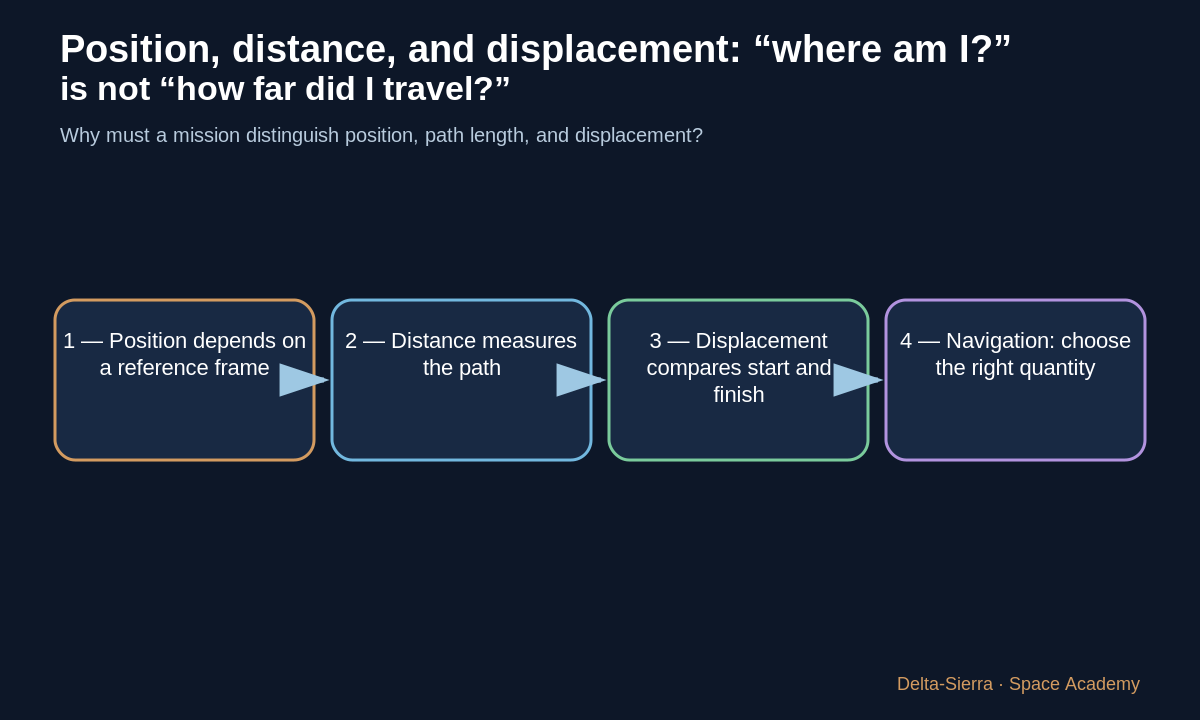
2 — Position needs an origin and an axis
Choose the habitat as the origin, 0. Choose east as positive and west as negative. That sign choice is a convention.
If the rover is 60 m east, write x = +60 m. The letter x is simply the name of the chosen axis.
3 — Distance: how much path was actually travelled?
outbound = 100 m
return = 40 m
total distance = 100 + 40 = 140 m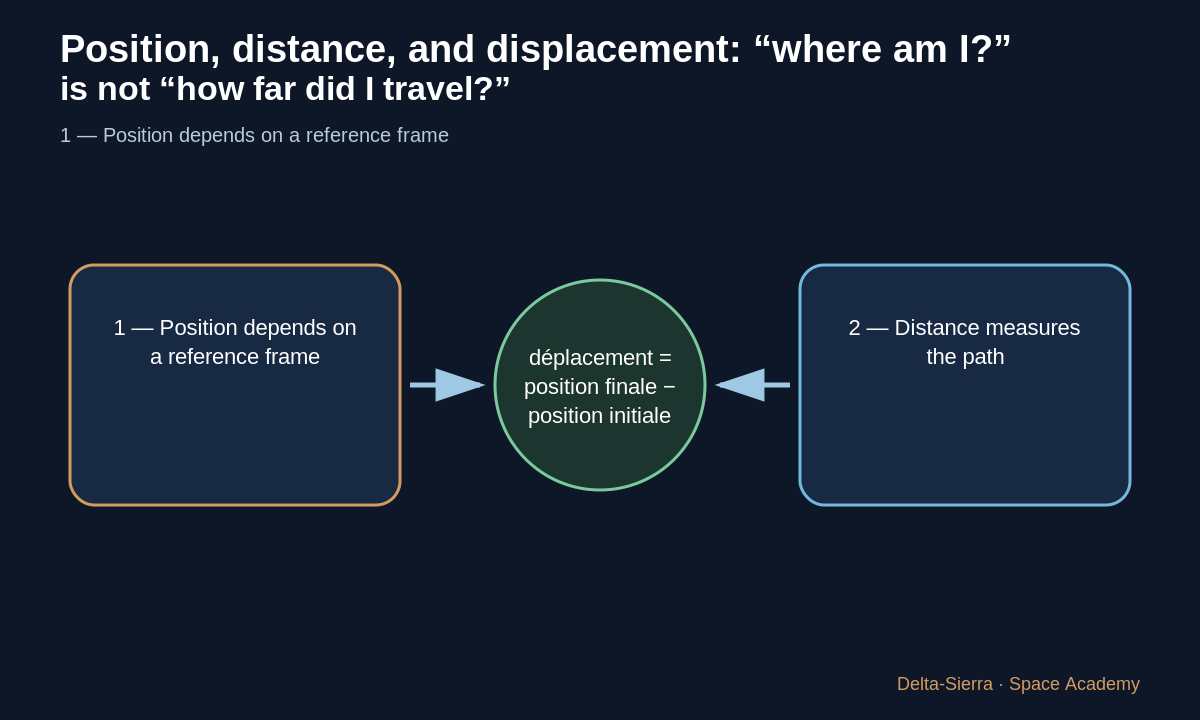
4 — Displacement: compare only start and finish
Δ is read “delta” and means change here. Δx is “delta x”.
x initial = 0 m
x final = +60 m
Δx = 60 − 0 = +60 m
The positive sign tells us the net change is in the chosen positive direction.
5 — Why can displacement be negative?
From +20 m to −30 m:
Δx = −30 − (+20) = −50 mThe minus sign does not mean “negative distance”. It gives direction.
6 — On a map: two axes locate a point
Use x for east-west and y for north-south. The point (3 m, 4 m) is 3 m along x and 4 m along y from the origin.
straight-line length = √(3² + 4²) = √25 = 5 m7 — Three concrete examples
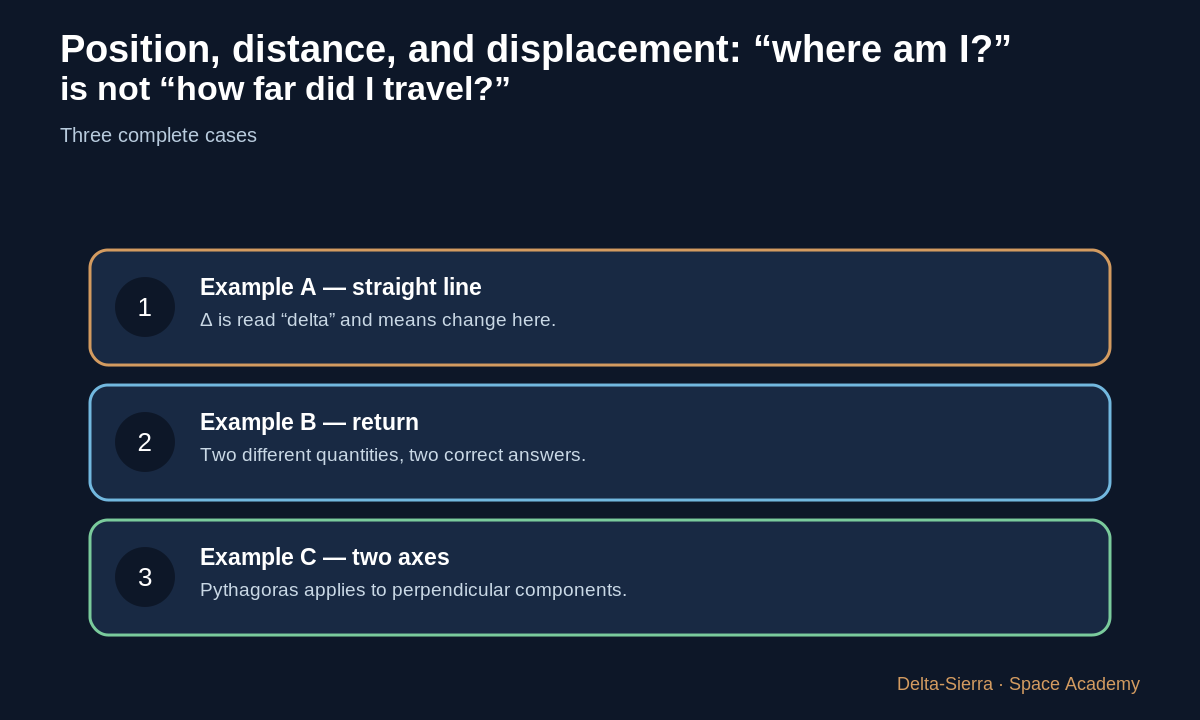
Example A — Sensor round trip
80 m east + 80 m west = 160 m distance
displacement = 0 m
Example B — Habitat to antenna
From (0,0) to (300,400) m.
straight displacement = √(300² + 400²) = 500 mExample C — Crater detour
Actual route 900 m; finish only 600 m straight-line from start. Distance = 900 m, displacement magnitude = 600 m.
8 — What each quantity is used for
- position: where the rover is;
- distance: energy, wear and travel time;
- displacement: direction and correction needed to reach a target.
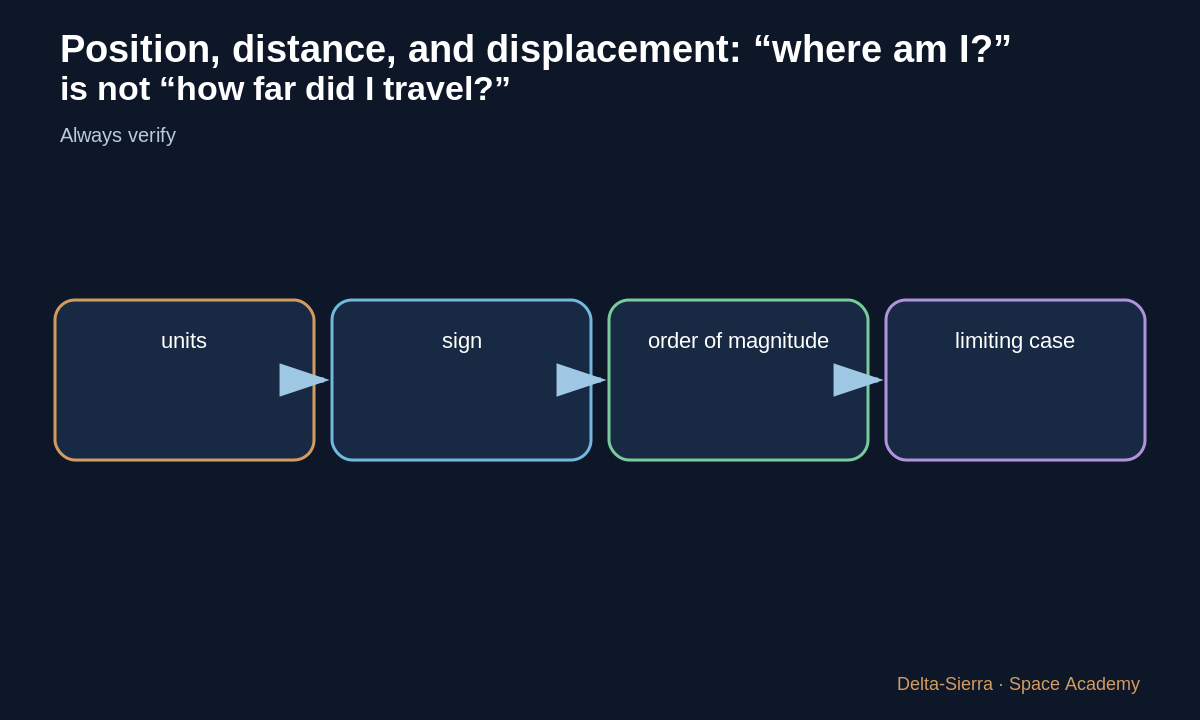
Beginner checkpoint — ask “path or start-to-finish?”
When a problem mentions a rover journey, do not immediately calculate. First ask what the question wants. If it asks how much the wheels travelled, use distance and add the lengths of the route. If it asks how far and in what direction the rover ended from its starting point, use displacement. If it asks where the rover is on the map, use position coordinates relative to the chosen origin.
The same trip can therefore have three valid numbers. A rover may travel 900 m around a crater, finish 600 m from its starting point, and have final coordinates such as (480 m, 360 m). None of those numbers replaces the others. Each describes a different aspect of the mission.
9 — Corrected exercises
Exercise 1
50 m forward then 20 m back.
Exercise 2
From x = −10 m to +25 m.