Course compass
Guiding question: Why does gravity decrease quickly with distance?
1 — The physical question
Why does gravity decrease quickly with distance?
We start from the concrete problem before notation. The goal is to understand what we seek, then why mathematics becomes useful.
2 — How to read the symbols and units
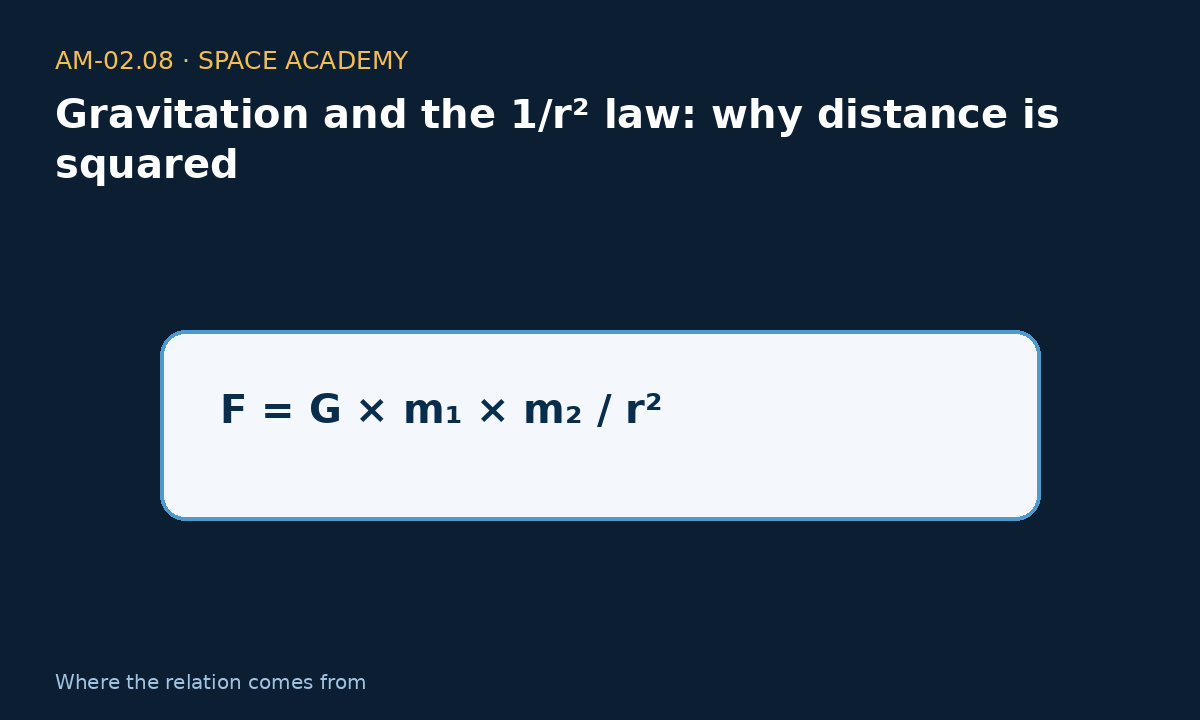
F = G × m₁ × m₂ / r². Read: “F equals G times m one times m two, divided by r squared”.
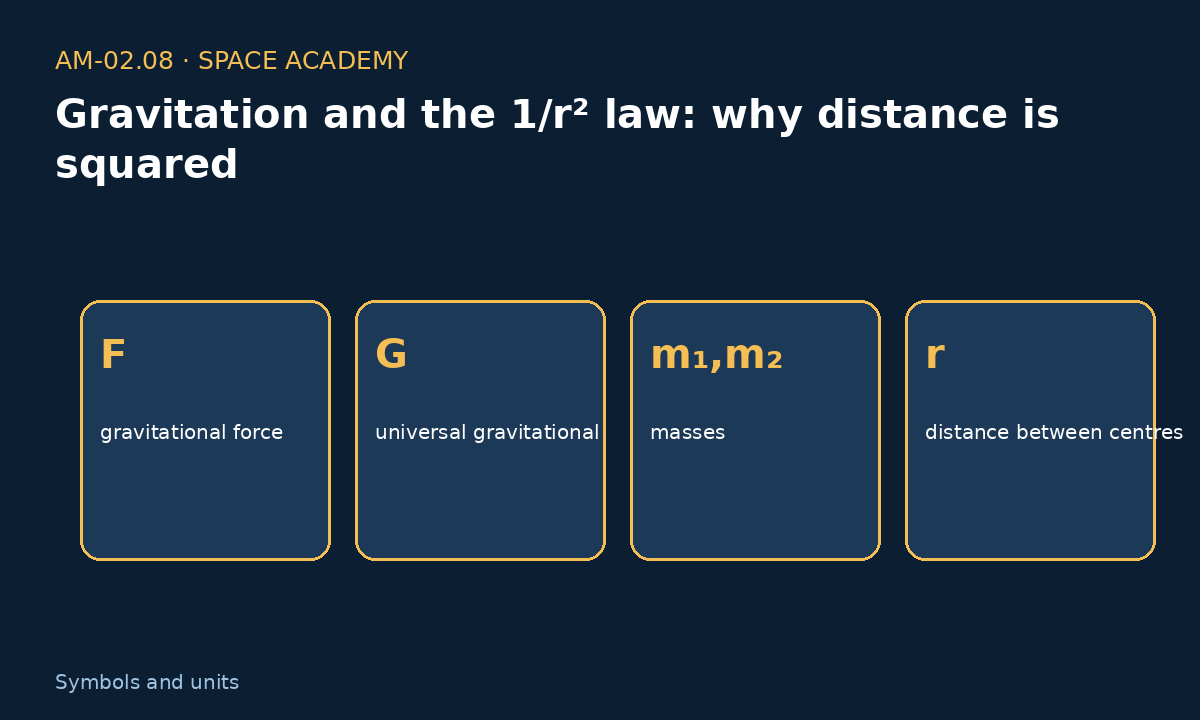
F — gravitational force ; G — universal gravitational constant ; m₁,m₂ — masses ; r — distance between centres
3 — Where does the relation come from?
In Newton’s model, attraction between two masses grows with each mass and decreases with the square of the distance between their centres. The 1/r² dependence underlies much classical orbital mechanics.
Every number used below is explicitly treated as data, convention, learning assumption, or calculated result.
4 — A — Double distance
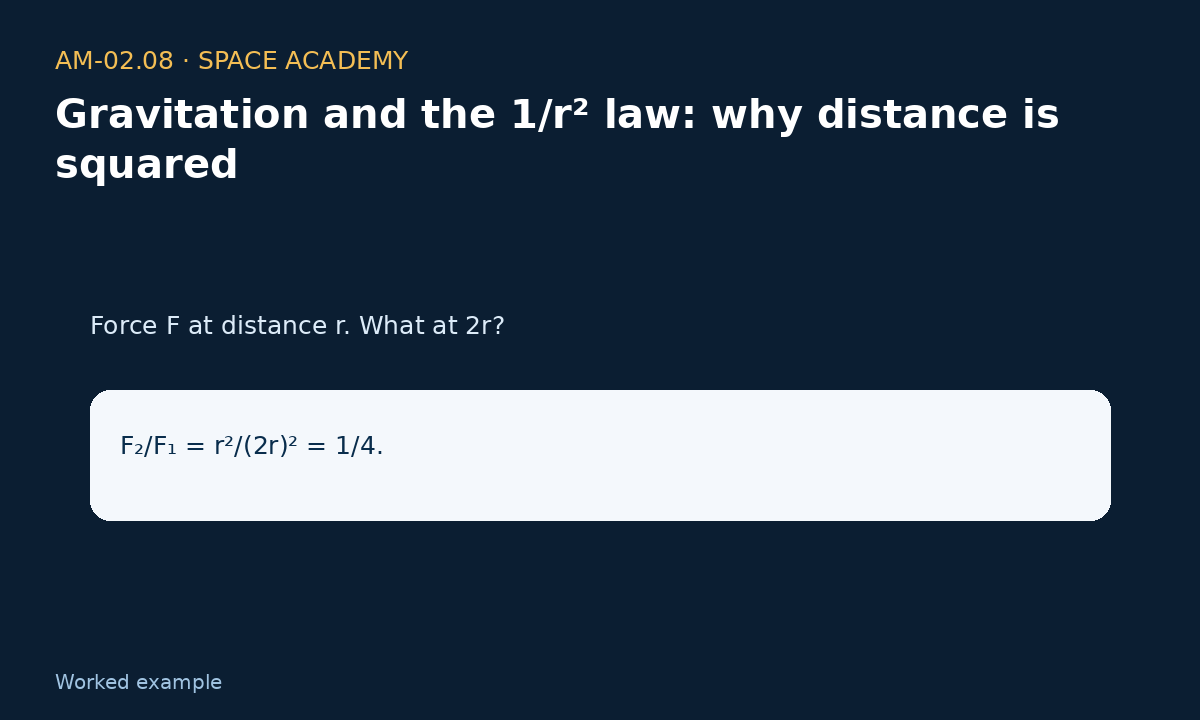
Where do the numbers come from? Force F at distance r. What at 2r?
Step-by-step calculation: F₂/F₁ = r²/(2r)² = 1/4.
Doubling distance divides force by four.
5 — B — Triple distance
Where do the numbers come from? Same masses, distance 3r.
Step-by-step calculation: F₂/F₁ = 1/9.
The square makes the decrease rapid.
6 — C — Double mass
Where do the numbers come from? m₂ becomes 2m₂ at same distance.
Step-by-step calculation: F₂/F₁ = 2.
Mass is linear in the equation, unlike distance.
7 — Sensitivity, inverse calculation, and sanity check
Change one input, predict the direction of the result, calculate, then check units, sign, order of magnitude, and limits.
Essential limit for Gravitation and the 1/r² law: why distance is squared: the displayed relation is a learning model. A real system adds detailed geometry, variable properties, sensors, uncertainty, transients, and testing.
8 — Why this matters in a mission
In a space mission, why does gravity decrease quickly with distance? The useful skill is not reciting the formula but knowing which data are needed, which are measured, and when the model becomes insufficient.
10 — Go deeper: from calculation to physical understanding
Why gravity decreases with the square of distance
In Newton’s model, the same gravitational influence spreads geometrically as distance increases. The 1/r² law means that doubling the centre-to-centre distance divides force by four, while tripling it divides force by nine. The reader should understand this sensitivity before memorising G or any planetary mass: distance matters strongly.
Distance r is measured between centres
For approximately spherical bodies, r is the distance between their centres of mass, not altitude above the ground. At Earth’s surface, r is about Earth’s radius; at 400 km altitude those 400 km must be added to the radius. Confusing altitude with centre distance creates a systematic calculation error.
Why mass appears twice
Force increases with either mass: doubling the first mass doubles F, and doubling the second does the same. Yet the free-fall acceleration of a small object does not depend on its own mass in the ideal model because we then divide force by that mass through F=ma. Connecting the two equations removes the apparent paradox.
From force calculation to orbit calculation
For a space trajectory, engineers mainly use gravitational acceleration and equations of motion, often with several bodies and more precise models. Newton’s law remains the intuitive foundation: it explains why Earth dominates near Earth and why the Sun becomes central during interplanetary flight.
9 — Exercises and answers
Challenge 1
Force F at distance r. What at 2r?
Challenge 2
Same masses, distance 3r.
Challenge 3
m₂ becomes 2m₂ at same distance.