Course compass
Guiding question: How do we turn an O/F ratio into two real flow rates?
1 — The physical question
How do we turn an O/F ratio into two real flow rates?
We start from the concrete problem before notation. The goal is to understand what we seek, then why mathematics becomes useful.
2 — How to read the symbols and units
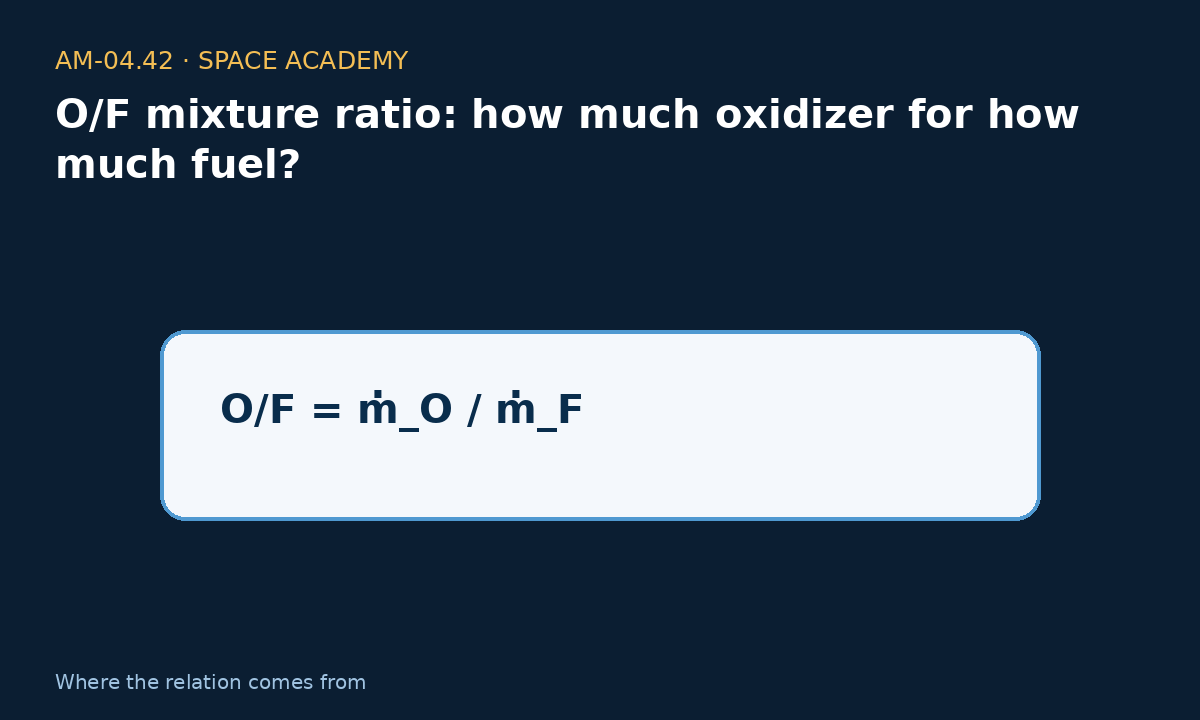
O/F = ṁ_O / ṁ_F. Read: “O over F equals m dot O divided by m dot F”.
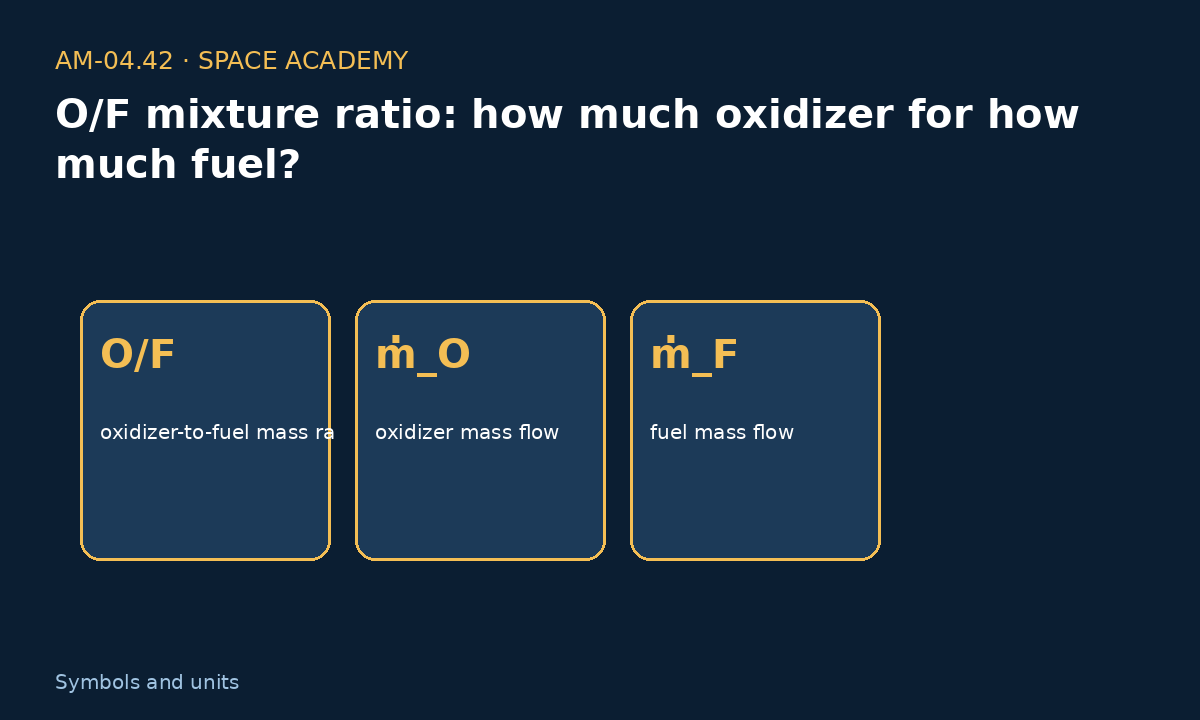
O/F — oxidizer-to-fuel mass ratio ; ṁ_O — oxidizer mass flow ; ṁ_F — fuel mass flow
3 — Where does the relation come from?
Mixture ratio compares oxidizer and fuel mass flow. If total flow is known, solve two equations: ṁ_total=ṁ_O+ṁ_F and O/F=ṁ_O/ṁ_F.
Every number used below is explicitly treated as data, convention, learning assumption, or calculated result.
4 — A — Ratio 3
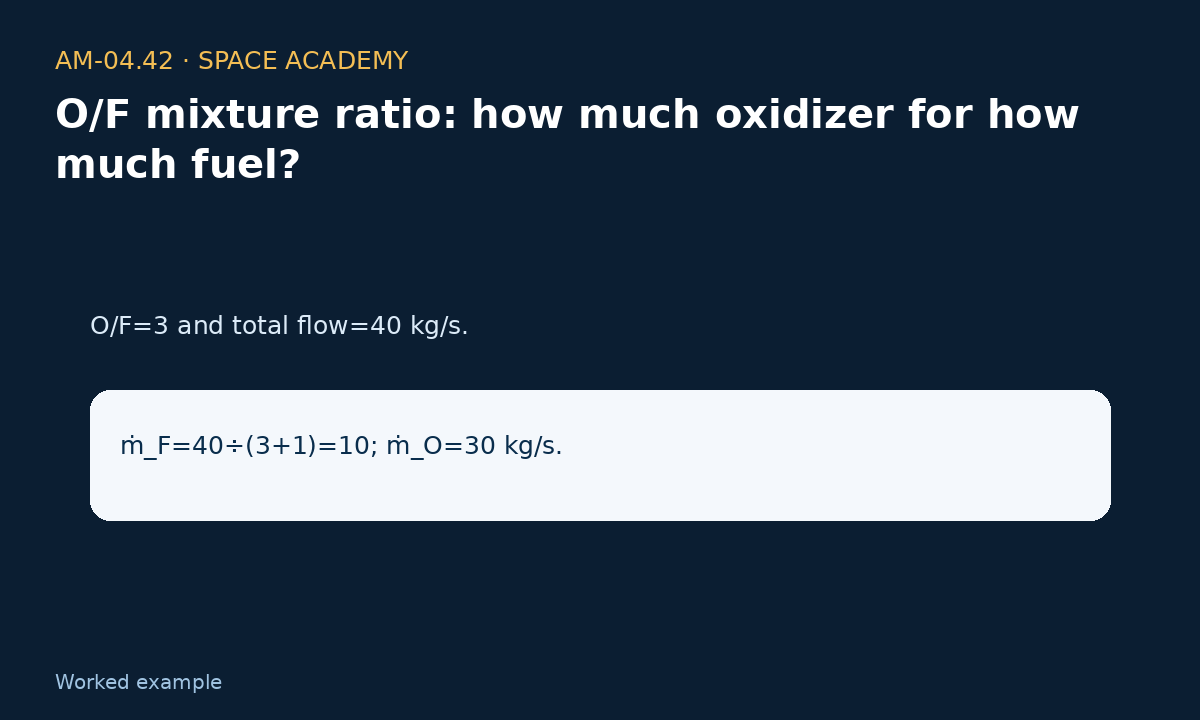
Where do the numbers come from? O/F=3 and total flow=40 kg/s.
Step-by-step calculation: ṁ_F=40÷(3+1)=10; ṁ_O=30 kg/s.
The four total parts are 3 parts O + 1 part F.
5 — B — Ratio 3.6
Where do the numbers come from? O/F=3.6; total=460 kg/s.
Step-by-step calculation: ṁ_F=460÷4.6=100; ṁ_O=360 kg/s.
The calculation directly gives the two flows.
6 — C — Constant total, ratio 2
Where do the numbers come from? Total=60 kg/s, O/F=2.
Step-by-step calculation: ṁ_F=60÷3=20; ṁ_O=40 kg/s.
Changing ratio redistributes total flow between two circuits.
7 — Sensitivity, inverse calculation, and sanity check
Change one input, predict the direction of the result, calculate, then check units, sign, order of magnitude, and limits.
Essential limit for O/F mixture ratio: how much oxidizer for how much fuel?: the displayed relation is a learning model. A real system adds detailed geometry, variable properties, sensors, uncertainty, transients, and testing.
8 — Why this matters in a mission
In a space mission, how do we turn an O/F ratio into two real flow rates? The useful skill is not reciting the formula but knowing which data are needed, which are measured, and when the model becomes insufficient.
10 — Go deeper: from calculation to physical understanding
O/F is a mass ratio, not an intuitive percentage
If O/F=3.6, it means 3.6 kg of oxidiser for 1 kg of fuel under that convention. The corresponding total flow contains 4.6 parts. To recover individual flows from total flow, first divide by 4.6 to obtain the fuel part, then multiply by 3.6 for the oxidiser part. This decomposition explains the algebra instead of asking the learner to memorise a recipe.
Why the ratio influences combustion
Changing O/F changes mixture chemistry and therefore combustion products, temperature, gas properties, and potentially performance and thermal margins. The chemically stoichiometric ratio is not necessarily the operating point selected for a real engine; cooling, materials, cycle, and performance objectives can influence the choice.
Measuring two flows to control one ratio
An engine controller does not know mixture ratio by magic. It receives measurements or estimates of flow, pressure, temperature, and valve positions, then compares observed state with command. A measurement error on one side can make the ratio appear correct when it is not, so sensor quality becomes part of the problem.
Total flow and mixture ratio are different constraints
Two engines can have the same O/F but very different total flows and therefore different thrust. Conversely, holding total flow constant while changing O/F redistributes mass between oxidiser and fuel. This conceptual separation is essential before studying throttling.
9 — Exercises and answers
Challenge 1
O/F=3 and total flow=40 kg/s.
Challenge 2
O/F=3.6; total=460 kg/s.
Challenge 3
Total=60 kg/s, O/F=2.