Course compass
Question directrice : What do a fraction, a ratio and a proportion mean before any formula?
Markers: 📏 MEASURED · 📐 CONVENTION · 🧮 CALCULATED · 🎓 TEACHING ASSUMPTION · ⚠️ APPROXIMATION
- understand the concept
- do a simple calculation
- explain every symbol
- check a result
1 — Before symbols: understand what is being shared
A fraction, ratio or proportion is not primarily a formula. It is a way to answer a concrete question: how is a total quantity shared, compared or scaled?
Before calculating, name the objects. “3 out of 4” is incomplete unless we know what the four things are: batteries, kilograms of water, hours of operation, or something else. Context gives the number meaning.
The word “part”
In this course, a part means one equal share of a total that we mentally divide for distribution. It is not necessarily a physical object.
Example: if 8 kg are divided into 4 equal parts, one part is 8 ÷ 4 = 2 kg.
2 — A fraction describes part of a whole
3/4 is read “three quarters”. It means three equal parts taken out of four equal parts.
The fraction bar also means division: 3/4 = 3 ÷ 4 = 0.75. Since 0.75 equals 75%, we may write 3/4 = 0.75 = 75%.
Concrete example — Three batteries available out of four
A Mars base has 4 identical batteries. Three are available and one is under maintenance. The available fraction is 3/4.
Decimal form: 3 ÷ 4 = 0.75. Percentage: 0.75 × 100 = 75%.
Plain English: 75% of the batteries are available.
3 — A ratio compares two quantities
The ratio 3:1 is read “three to one”. It means that when the first quantity receives three equal parts, the second receives one.
Important: 3:1 does not automatically mean 3 kg and 1 kg. The ratio gives a relationship; a total or one known quantity is still needed to find actual values.
Master example — A Mars computer and its protective shell
We must send an 8 kg computer package to Mars. The 8 kg total includes the computer and its protective shell.
For this teaching example, use the ratio computer : protection = 3:1.
Step 1. Total parts = 3 + 1 = 4.
Why add? Because we need the total number of equal parts making up the 8 kg package.
Step 2. One part = 8 kg ÷ 4 = 2 kg.
Why divide by 4? Because the total is split into four equal shares.
Step 3. Computer = 3 × 2 kg = 6 kg.
Step 4. Protection = 1 × 2 kg = 2 kg.
Check. 6 + 2 = 8 kg.
Plain English: the computer is 6 kg and the protective shell is 2 kg in this example.
Calculator sequence
Type 8 ÷ 4 = to obtain 2. Then 3 × 2 = to obtain 6. Check with 6 + 2 = to recover 8.
4 — Proportionality lets us scale
A relationship is proportional when multiplying one quantity by a factor multiplies the other by the same factor. The essential condition is that the amount per unit remains constant.
Concrete example — Identical oxygen bottles
We have 4 identical bottles. Each contains 5 kg of oxygen.
With 4 bottles: 4 × 5 kg = 20 kg of oxygen.
With 7 identical bottles: 7 × 5 kg = 35 kg of oxygen.
Why multiply? Because every bottle contributes the same 5 kg.
The relationship is proportional only because the bottles are identical and equally filled.
Counterexample — One bottle is half full
If one bottle contains only 2.5 kg instead of 5 kg, “number of bottles × 5 kg” no longer works. The simple proportional rule is broken.
5 — Rates with units should be read aloud
Some comparisons use different physical quantities and create units such as kg/s, N/kg or W/m².
- kg/s means “kilograms per second”;
- N/kg means “newtons per kilogram”;
- W/m² means “watts per square metre”.
The word per is the key: it tells us that one quantity is being related to another.
Three complete examples: understand before abbreviating
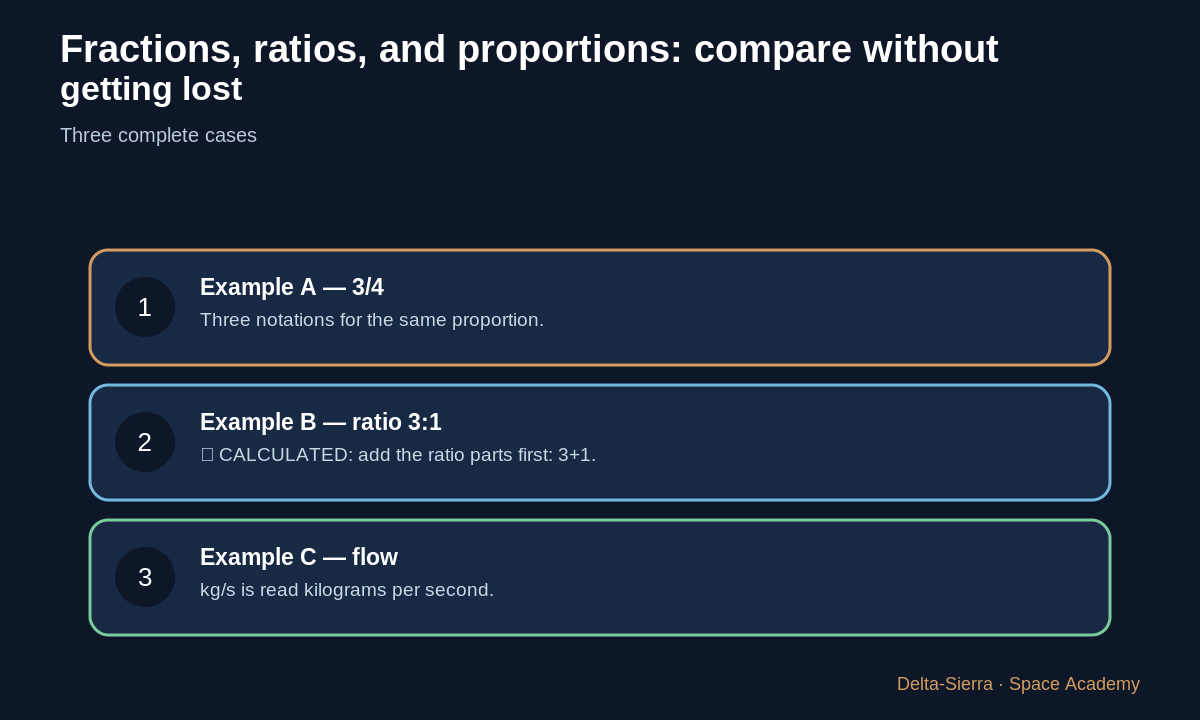
Example A — Share 12 litres of water at 2:1
Total parts: 2 + 1 = 3. One part: 12 ÷ 3 = 4 L. First tank: 8 L. Second tank: 4 L. Check: 8 + 4 = 12 L.
Example B — Share 20 kg of equipment at 3:2
Total parts: 5. One part: 20 ÷ 5 = 4 kg. First crate: 12 kg. Second crate: 8 kg.
Example C — Seven oxygen bottles
Each bottle contains 5 kg. Seven bottles provide 7 × 5 = 35 kg. If the number doubles to 14, the oxygen mass doubles to 70 kg.
6 — Only now move to abstraction
Once the idea is understood, we may call the two masses A and B and write A:B = 3:1.
If the total is T, there are four parts. One part is T/4, so A = 3T/4 and B = T/4.
This notation is shorter, but it is useful only after the reader knows what A, B, T and the four parts mean.
Common traps and checks
- Confusing a ratio with actual values.
- Using proportional reasoning when the relationship is not proportional.
- Leaving numbers without objects or units.
- Failing to recombine the parts to check the original total.
Final check: explain the answer in ordinary language. If the result cannot be stated without symbols, the calculation is not fully understood yet.
Exercises and solutions
Exercise 1 — Ratio 4:1
A 25 kg total is split at 4:1. Find both masses.
Exercise 2 — Proportion
One identical cartridge contains 3 kg of consumable. What mass do 8 cartridges provide?
Exercise 3 — Check the ratio
For a 2:3 ratio and a 30 kg total, a student gives 18 kg and 12 kg. Is the ratio correct?