Course compass
Question directrice : What do eˣ and ln do, how are they read, why are they inverse, and why does ln appear in the ideal rocket equation?
1 — Exponential change: multiply rather than add the same amount
If a reserve gains exactly 10 kg each hour, it grows by +10, +10, +10. Exponential growth is different: the change depends on what is already there. A culture that doubles goes 1, 2, 4, 8, 16.
2 — What does eˣ mean and how is it read?
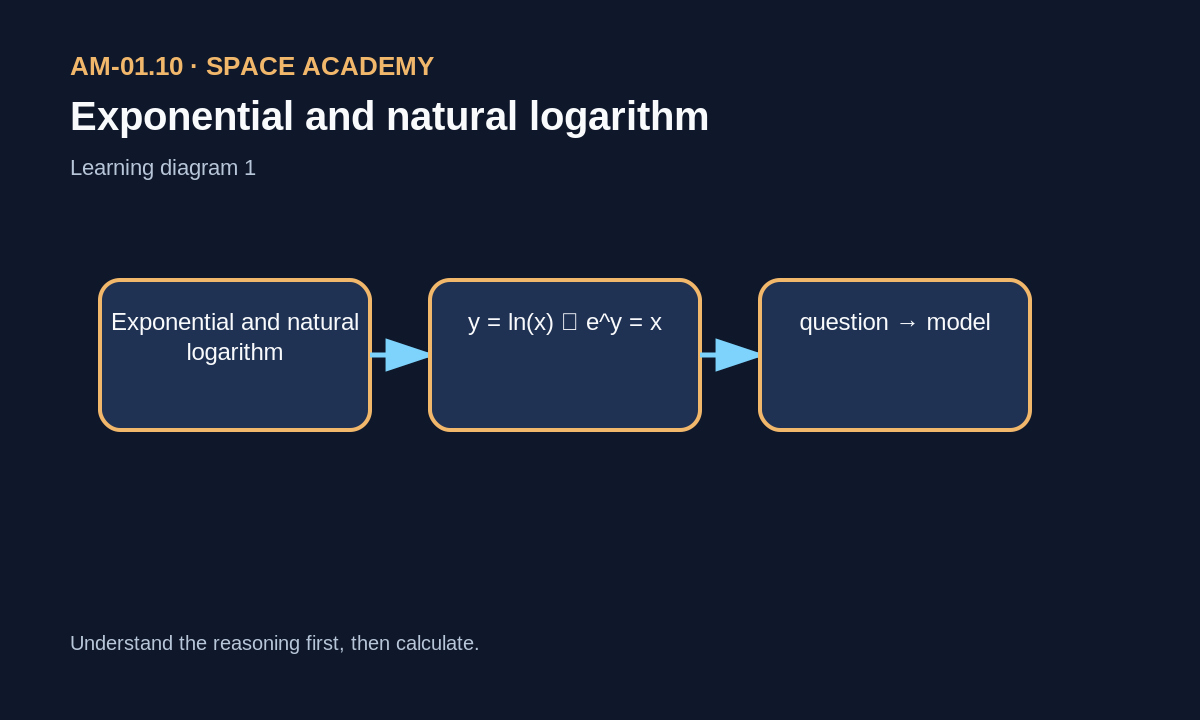
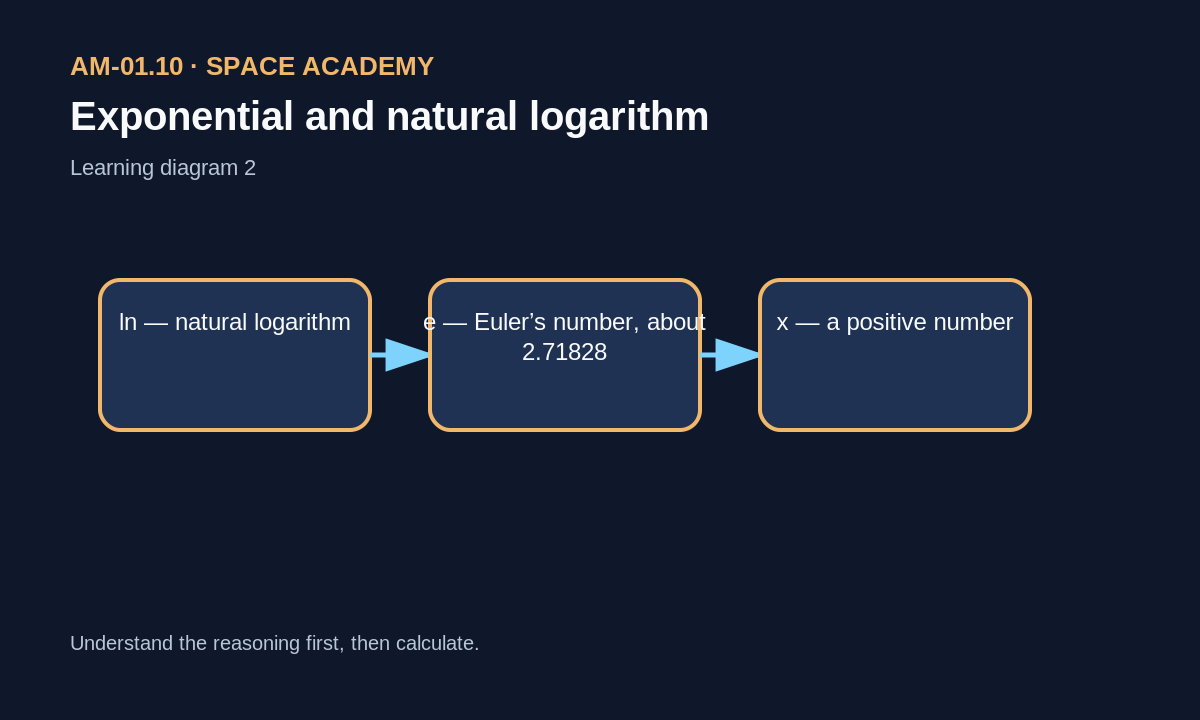
eˣ is read “e to the power x”. The number e is approximately 2.71828 and appears naturally in continuous-change models.
You do not need to memorize its digits. Think of eˣ as turning an exponent x into a multiplication factor.
3 — Natural logarithm: the inverse question
If we know the final factor and want the exponent that produced it, the natural logarithm, written ln, answers that question.
Read: “if e to the power x equals N, then x equals the natural logarithm of N.”
4 — Concrete example 1: how many doublings?
A culture goes 1 → 2 → 4 → 8. Reaching 8 takes three doublings because 2³=8.
Using logs: x = ln(8) ÷ ln(2) ≈ 2.079 ÷ 0.693 ≈ 3.
Because each step multiplies by 2. Dividing by ln(2) converts the natural-log measure into a number of doublings.
5 — Concrete example 2: why a logarithm appears in the ideal rocket equation
Δv is read “delta vee” and is a change in velocity. vₑ is the effective exhaust velocity in this simplified model.
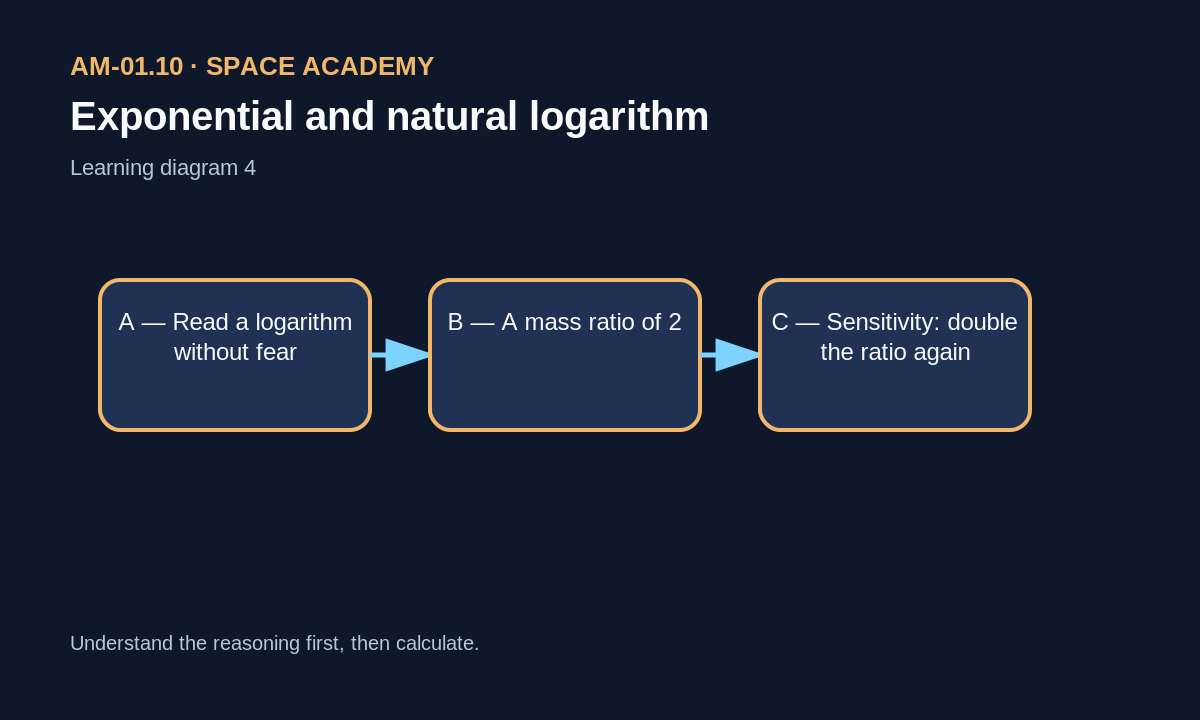
If m₀/m₁=2, ln(2)≈0.693. If the mass ratio becomes 4, ln(4)≈1.386. The benefit does not grow directly in proportion to mass ratio.
6 — Why must the argument of ln be dimensionless?
In ln(m₀/m₁), both m₀ and m₁ are masses. If both use kilograms, kg/kg cancels, leaving a dimensionless ratio.
Writing ln(500 kg) without a reference quantity is not the same kind of meaningful dimensionless operation.
7 — Calculator: ln, eˣ and common mistakes
Compute ln(2): approximately 0.693. Then compute e^0.693 and you recover approximately 2.
8 — Three mental pictures
- Exponential: from exponent to multiplication factor.
- Logarithm: from factor back to exponent.
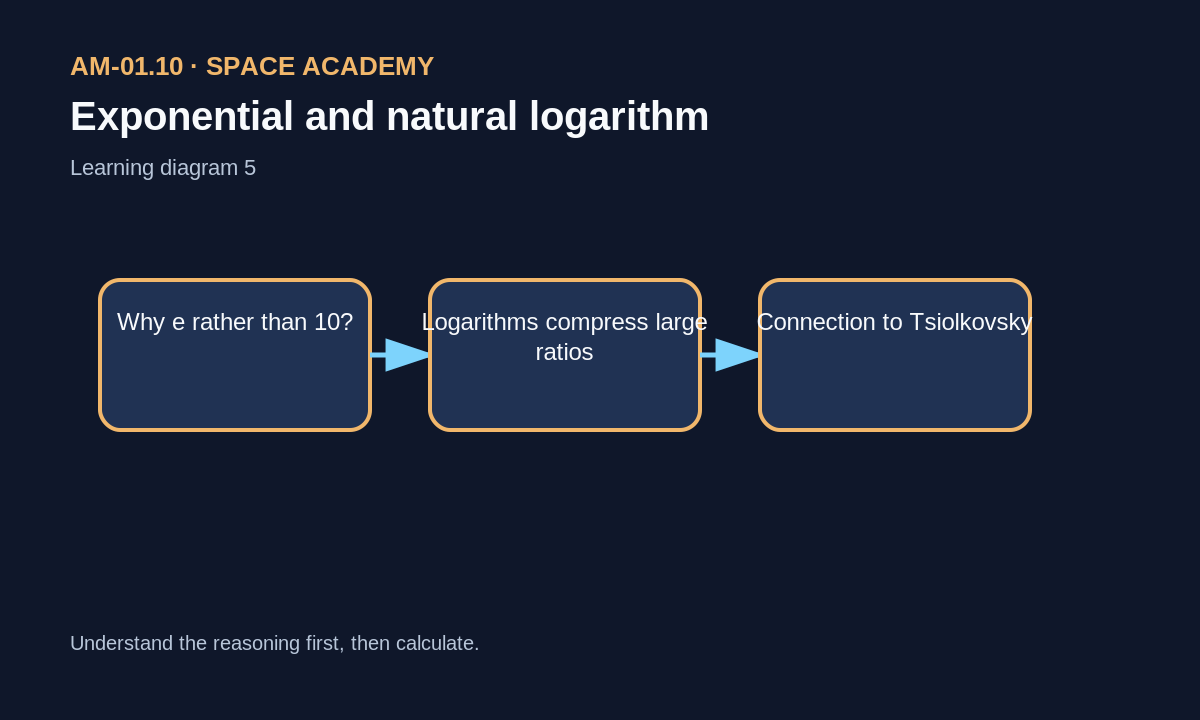
- Rocket equation: a mass ratio contributes through a logarithm, so ever larger ratios become increasingly costly.
Exercises and answers
Exercise 1
A quantity doubles four times from 1. Final value?
Exercise 2
Compute ln(2), then e^ln(2).
Exercise 3
Why is m₀/m₁ dimensionless if both masses are in kg?