Course compass
Question directrice : How does an integral turn a rate into a total, how do we read ∫ and dt, and why does area under a curve have physical meaning?
1 — An integral first answers a simple question: “how much in total?”
A unit produces water at a certain flow rate. Knowing the rate at each instant is not enough if the crew wants to know how many kilograms were produced in total.
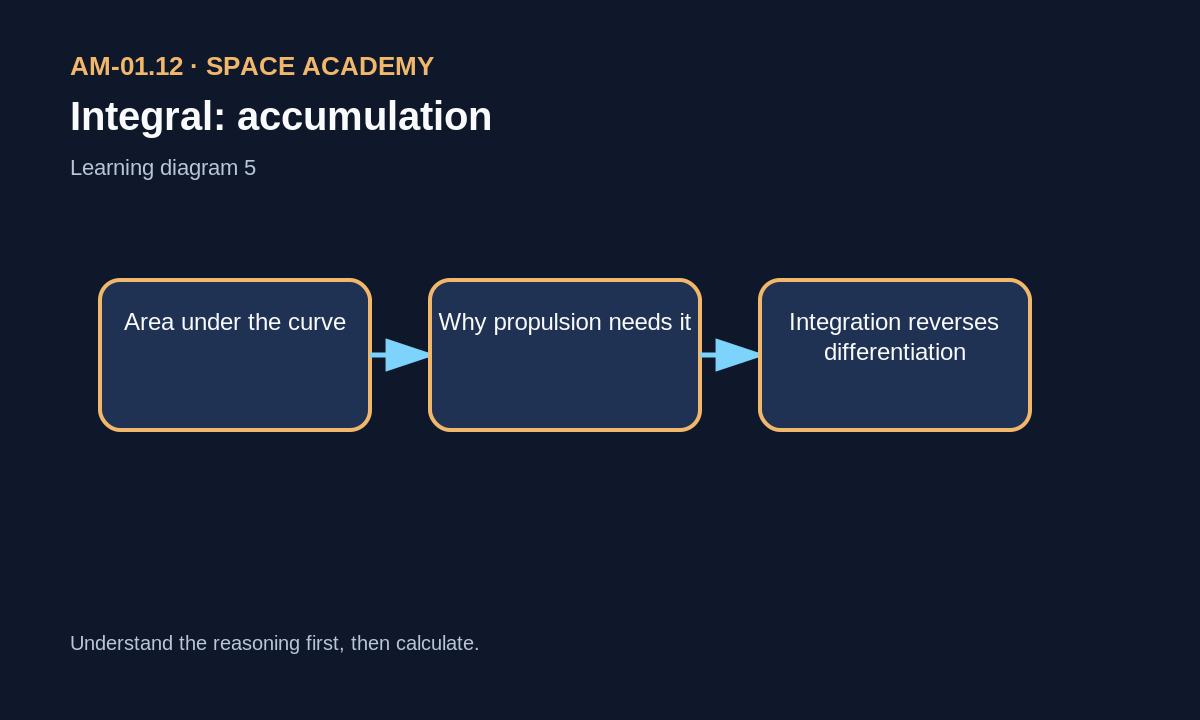
An integral is an accumulation tool. It adds many small contributions.
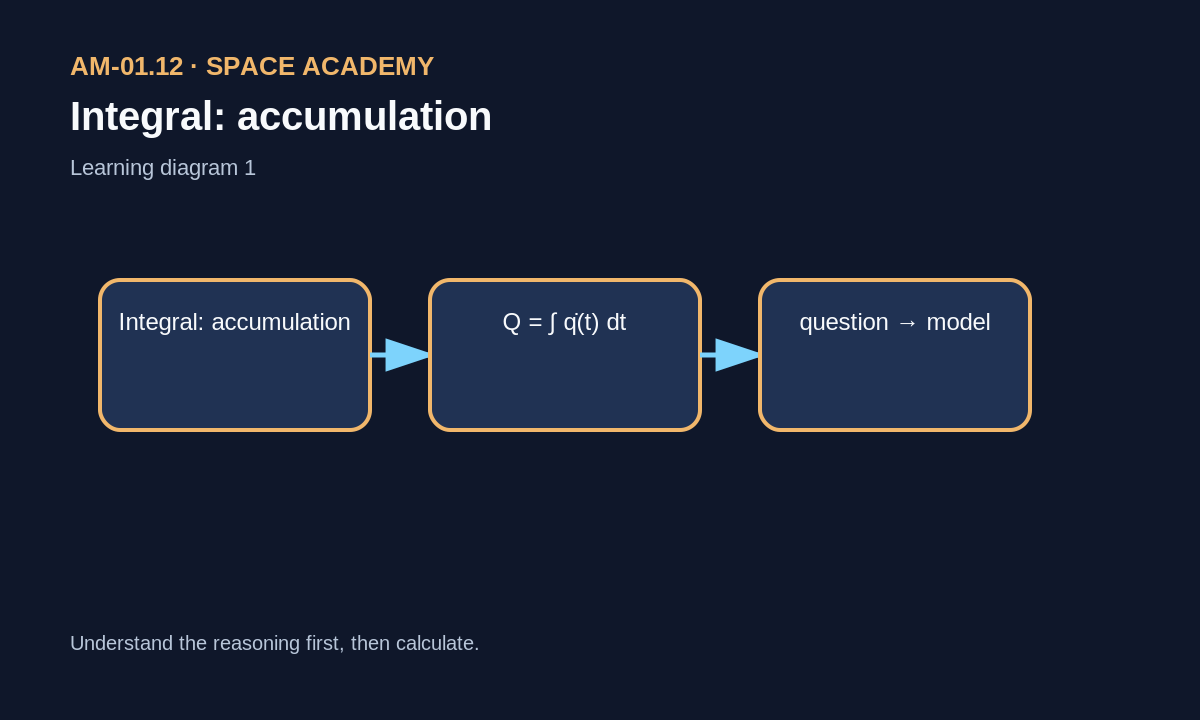
2 — How do we read ∫, dt and the limits?
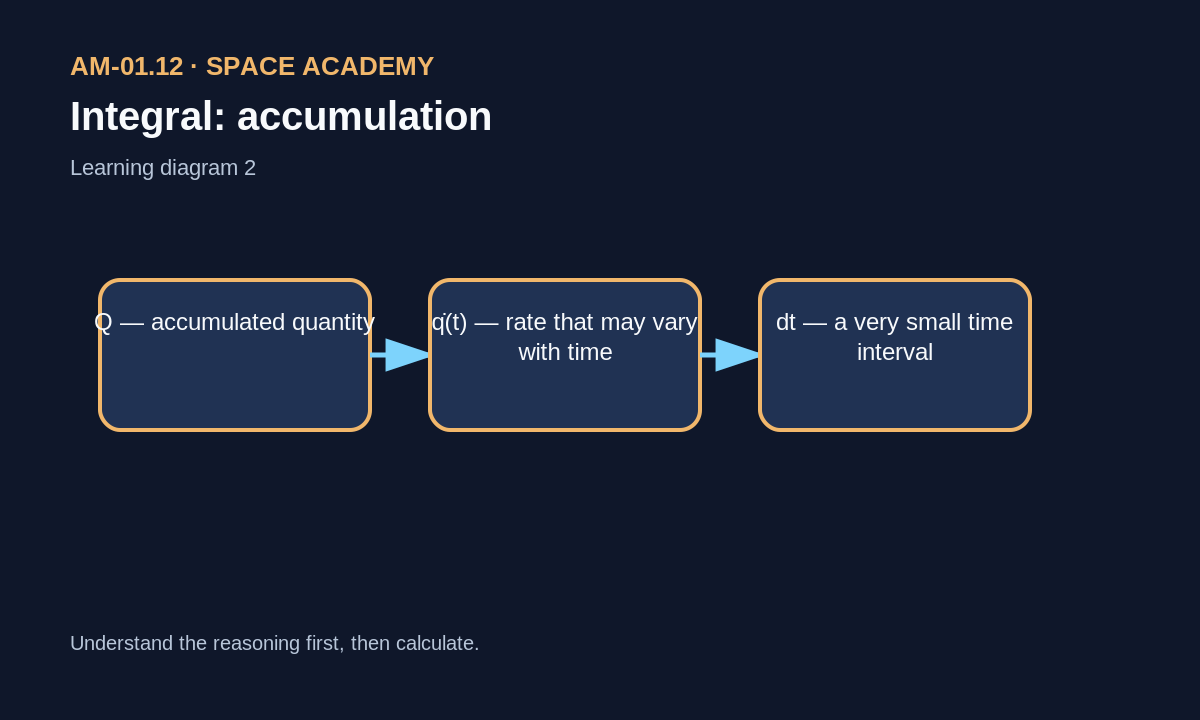
∫ is read “integral”. ∫ q(t) dt is read “the integral of q of t, d t”.
∫₀⁴ q(t) dt accumulates from t=0 to t=4. The small dt reminds us that the sum is made from very small pieces of time.
3 — Complete example 1: constant flow
A unit produces 2 kg of water per hour for 5 h.
rate = 2 kg/h
time = 5 h
total = 2 × 5 = 10 kg
On a graph this is a rectangle: height 2 kg/h, width 5 h, area 10 kg.
(kg/h)×h=kg.
4 — Complete example 2: two flow levels
For 2 h the system produces 3 kg/h; for the next 3 h it produces 1 kg/h.
first period: 3×2=6 kg
second period: 1×3=3 kg
total=9 kg
The integral adds the two contributions.
5 — Complete example 3: gradually increasing flow
Take the simple model q(t)=t kg/h from 0 to 4 h. The graph is a triangle with base 4 h and height 4 kg/h.
area = 4×4÷2 = 8 kg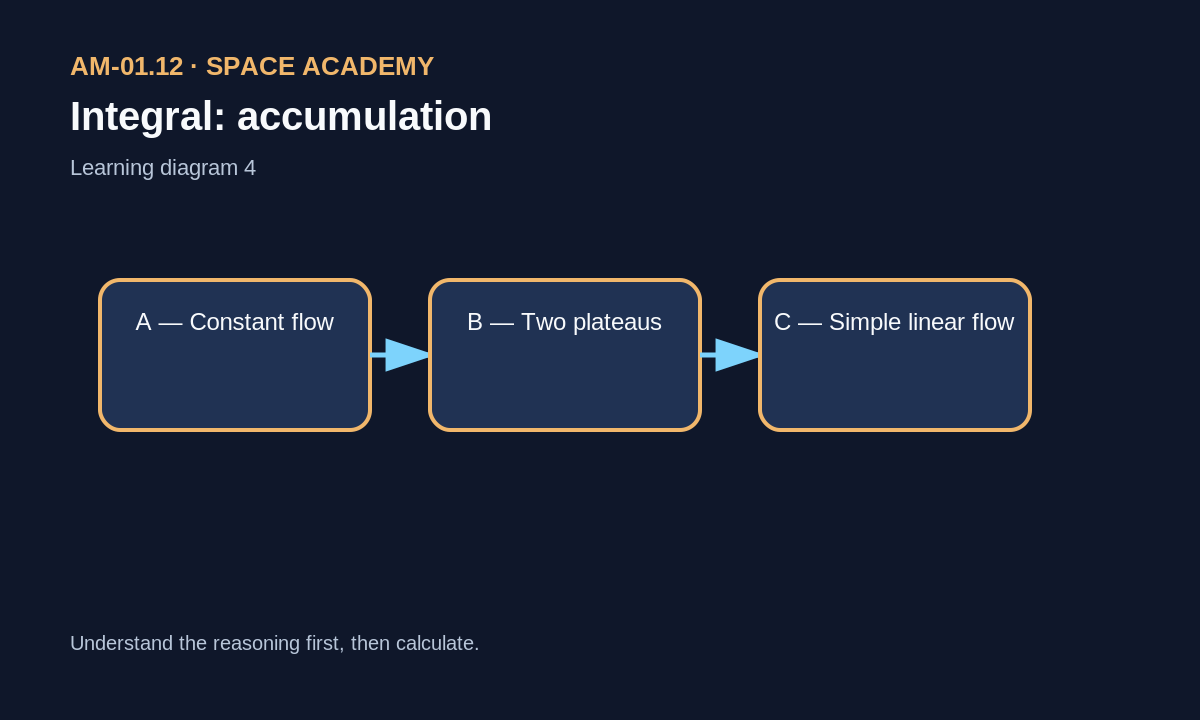
6 — Why “sum of small rectangles”?
For an irregular rate, split time into small intervals. On each interval:
Add all small amounts. The integral formalizes the limit of this idea.
7 — Integral and derivative answer opposite questions
The derivative asks: how fast is the total changing now? The integral asks: if I know the rate, how much has accumulated?
If the derivative of stored water is water flow, integrating the flow over time recovers the change in stored water.
8 — Real data often mean a numerical sum
A computer may receive one flow measurement every second rather than a perfect function. It then uses rectangles, trapezoids or other numerical methods.
Missing samples, sensor noise and timing errors can accumulate into a significant error in the total.
9 — Three cases to recognize
- Constant rate: rate × time.
- Steps: compute each rectangle and add.
- Simple curve: use a known area formula or an integral function once the model is defined.
10 — What to remember
- An integral calculates accumulation.
- ∫ is read “integral”.
- dt indicates accumulation over tiny pieces of time.
- Area under a flow-rate curve represents a total amount.
- Units must work: (kg/h)×h=kg.
- Derivative and integral answer inverse questions.
Exercises and answers
Exercise 1
4 kg/h for 3 h: total?
Exercise 2
2 kg/h for 2 h then 5 kg/h for 1 h: total?
Exercise 3
Why does integrating kg/s over seconds give kg?