Course compass
Guiding question : Why can the same force rotate an object strongly or barely at all depending on where it acts?
1 — The physical question
Why can the same force rotate an object strongly or barely at all depending on where it acts?
2 — Symbols, reading and units
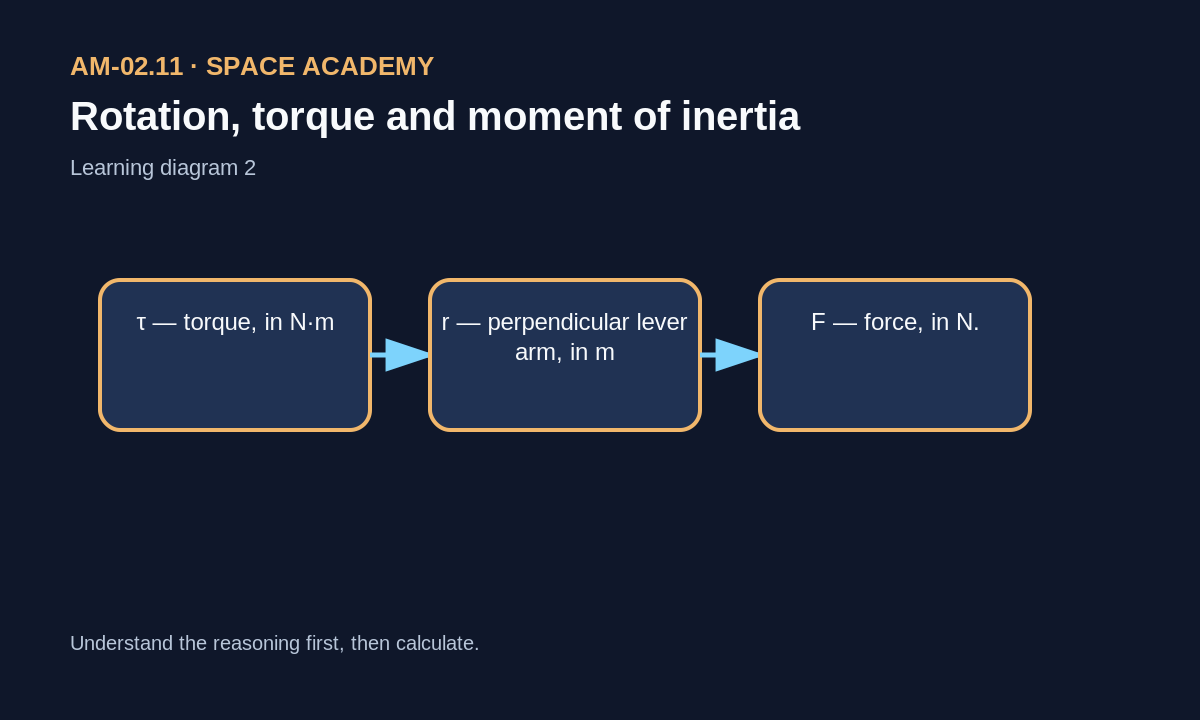
τ — torque, in N·m; r — perpendicular lever arm, in m; F — force, in N.
3 — Where does the relation come from?
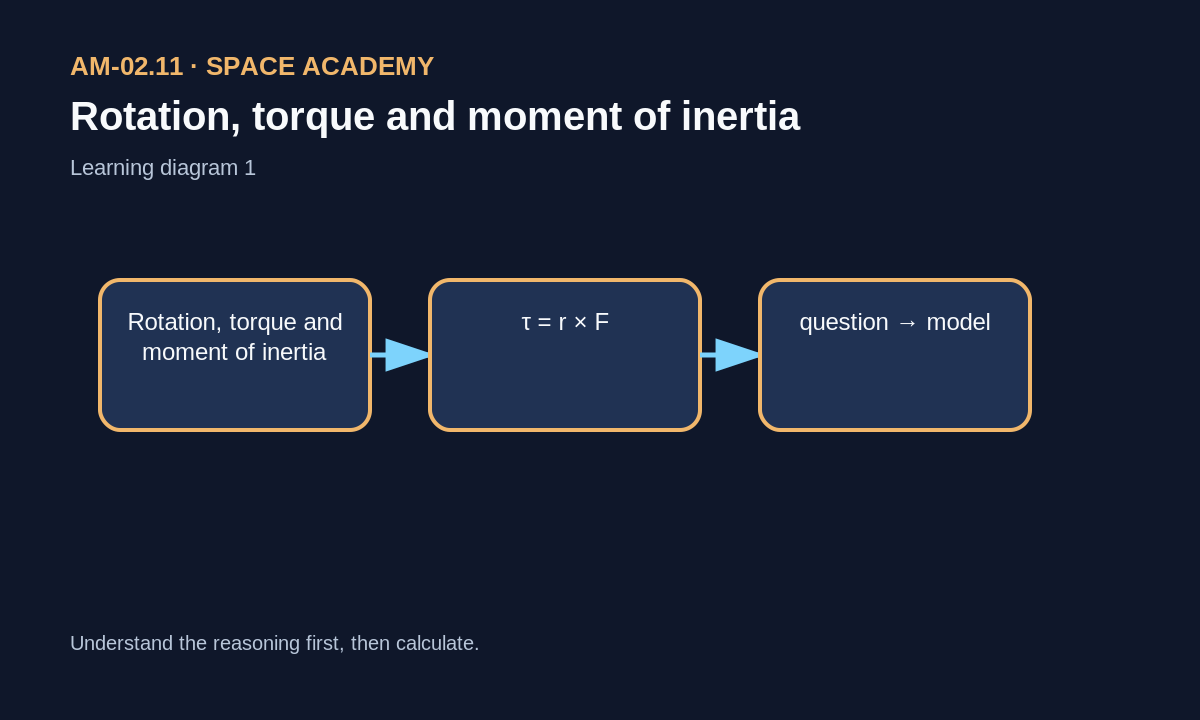
A force applied at the rotation center does not have the same rotational effect as the same force applied far from it. Torque measures the ability to produce rotation. In the simple perpendicular case, τ=rF.
4 — A — Same force, 1 m arm
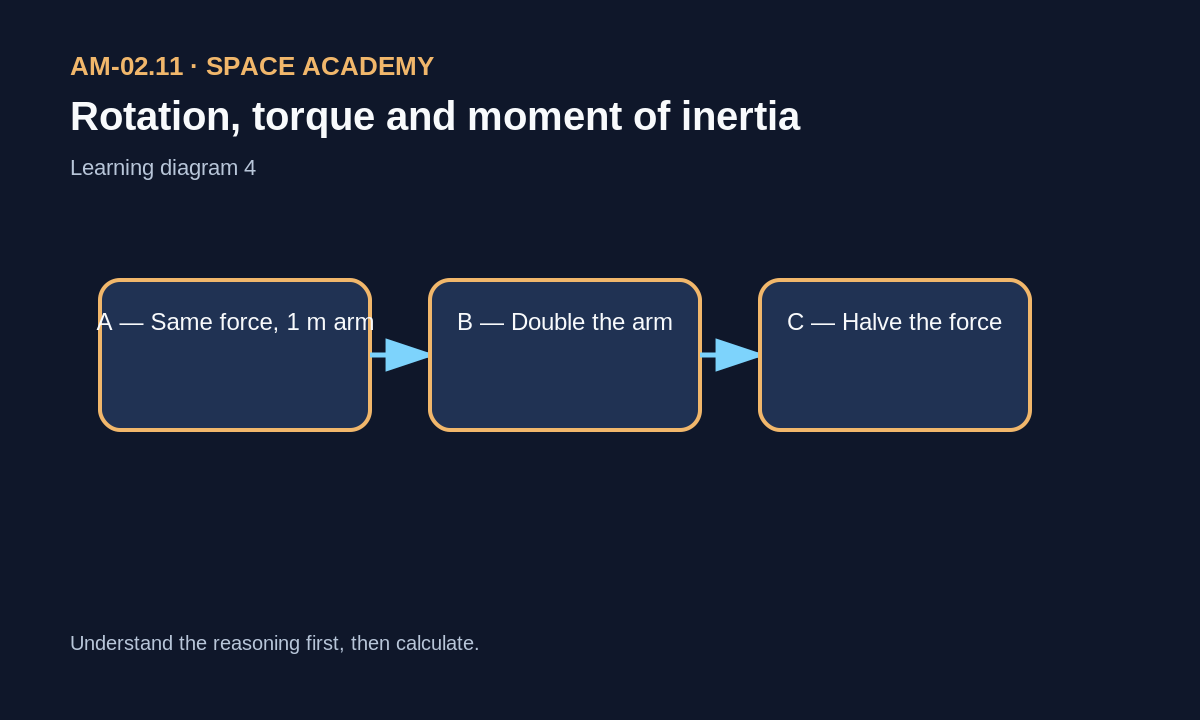
100 N applied at 1 m gives 100 N·m.
5 — B — Double the arm
100 N at 2 m gives 200 N·m. Force is unchanged; rotational effect doubles.
6 — C — Halve the force
50 N at 2 m still gives 100 N·m. Different force-arm combinations can create the same torque.
7 — Go deeper
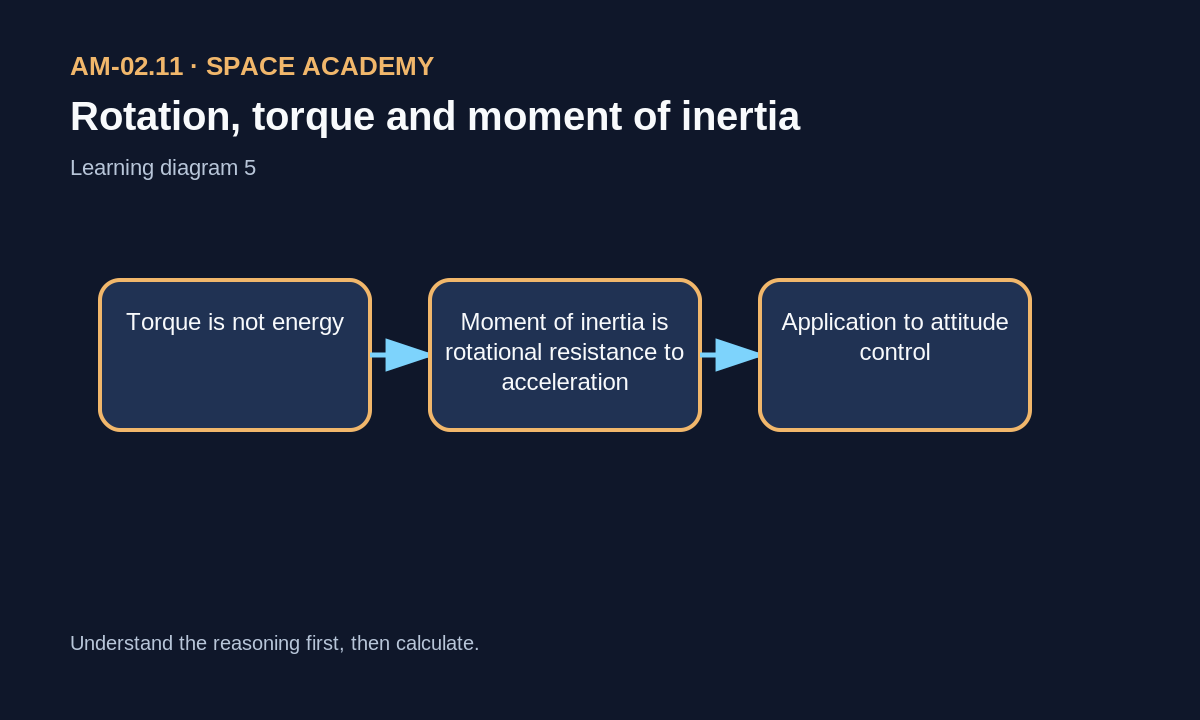
Torque is not energy
Newton-metre also appears dimensionally in the joule, but torque and energy are different physical quantities. Context and definition matter as much as unit dimensions.
Moment of inertia is rotational resistance to acceleration
Two objects with the same mass can be easier or harder to spin depending on how mass is distributed around the axis. Moving mass farther from the axis increases moment of inertia strongly.
Application to attitude control
Reorienting a spacecraft means creating torque, managing angular acceleration, then stopping rotation. Gimballed engines, reaction wheels or attitude thrusters create torque, but response depends on the inertia of the entire vehicle.
Torque also has an axis and direction
Torque is more than F×r. Its direction is associated with the axis about which rotation is produced. In vector form τ = r × F, where × is a vector cross product rather than ordinary multiplication. At beginner level, the first important idea is that a force parallel to a lever arm does not create the same turning effect as a perpendicular force.
Moment of inertia depends on mass distribution
Two objects with the same total mass can be very different to rotate. Placing more mass farther from the axis increases moment of inertia. Moving a tank, battery or payload can therefore change a vehicle’s attitude dynamics even when total mass stays unchanged.
Torque and angular acceleration
The rotational analogue of F=ma is τ=Iα. Torque τ produces angular acceleration α, but the response depends on moment of inertia I. With the same torque, a vehicle with a larger I changes rotational speed more slowly. Units and assumptions must be understood before treating the equation as a recipe.
Rotation contains kinetic energy
A rotating object stores kinetic energy. Accelerating a reaction wheel, turbopump or flywheel requires energy; slowing or exchanging that motion changes the energy balance. The mere ability to produce torque therefore says nothing by itself about power, duration or thermal limits.
Application to attitude control
A spacecraft can create torque using thrusters, reaction wheels or thrust-vectoring of a main engine. The choice depends on mission phase and available hardware. Torque calculation is only the first layer; GNC must then measure attitude, estimate motion and close the control loop.
8 — Exercises and answers
Challenge 1
A — Same force, 1 m arm: repeat the reasoning with the stated values, then explain the physical meaning of the result.
Challenge 2
B — Double the arm: repeat the reasoning with the stated values, then explain the physical meaning of the result.
Challenge 3
C — Halve the force: repeat the reasoning with the stated values, then explain the physical meaning of the result.