Course compass
Guiding question: What does a chemical formula tell you, and what does it still leave out?
Markers: 📏 MEASURED · 📐 CONVENTION · 🧮 CALCULATED · 🎓 TEACHING ASSUMPTION · ⚠️ APPROXIMATION
- read H₂O
- distinguish subscript and coefficient
- count atoms
- prepare for chemical reactions
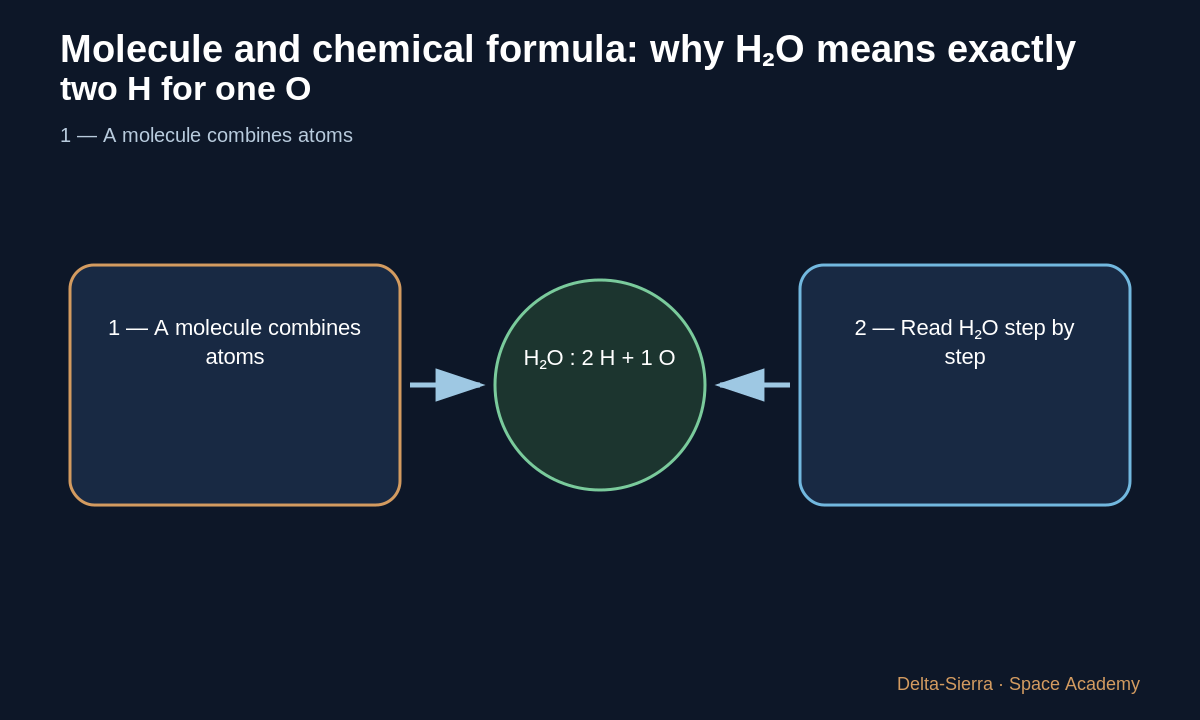
1 — A molecule combines atoms
A molecule is a bonded set of atoms. A formula states which elements are present and, in a simple molecular formula, how many atoms of each kind.
The small lower number is a subscript.
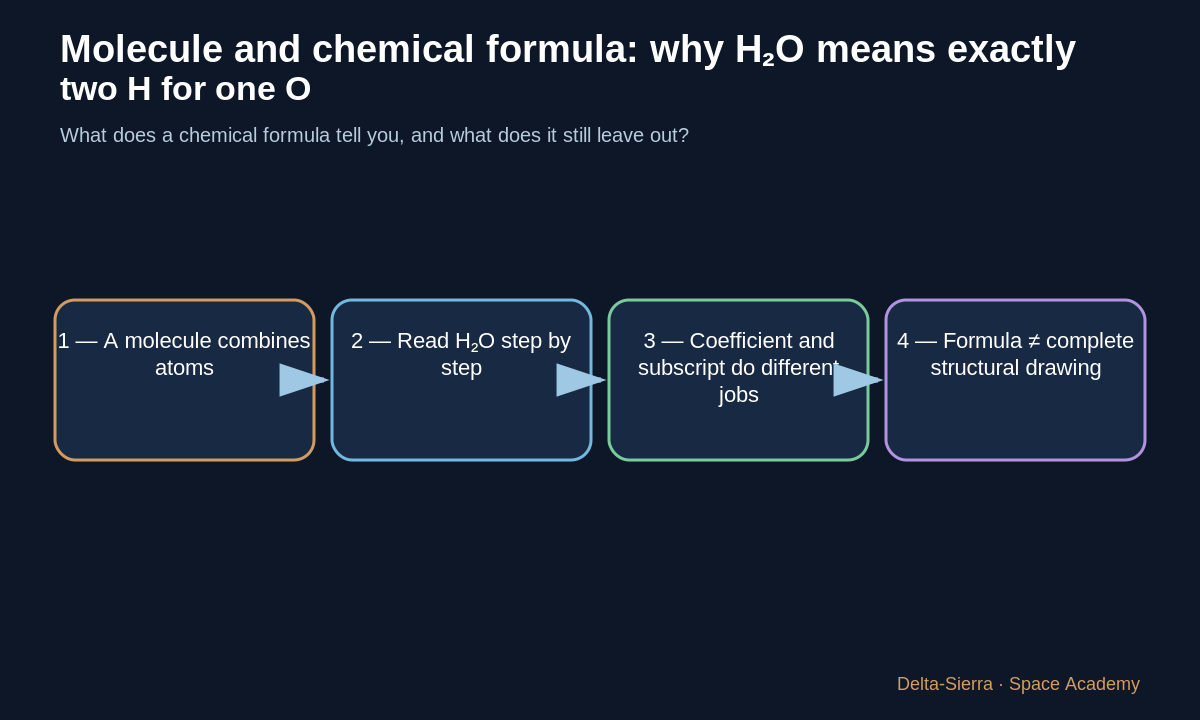
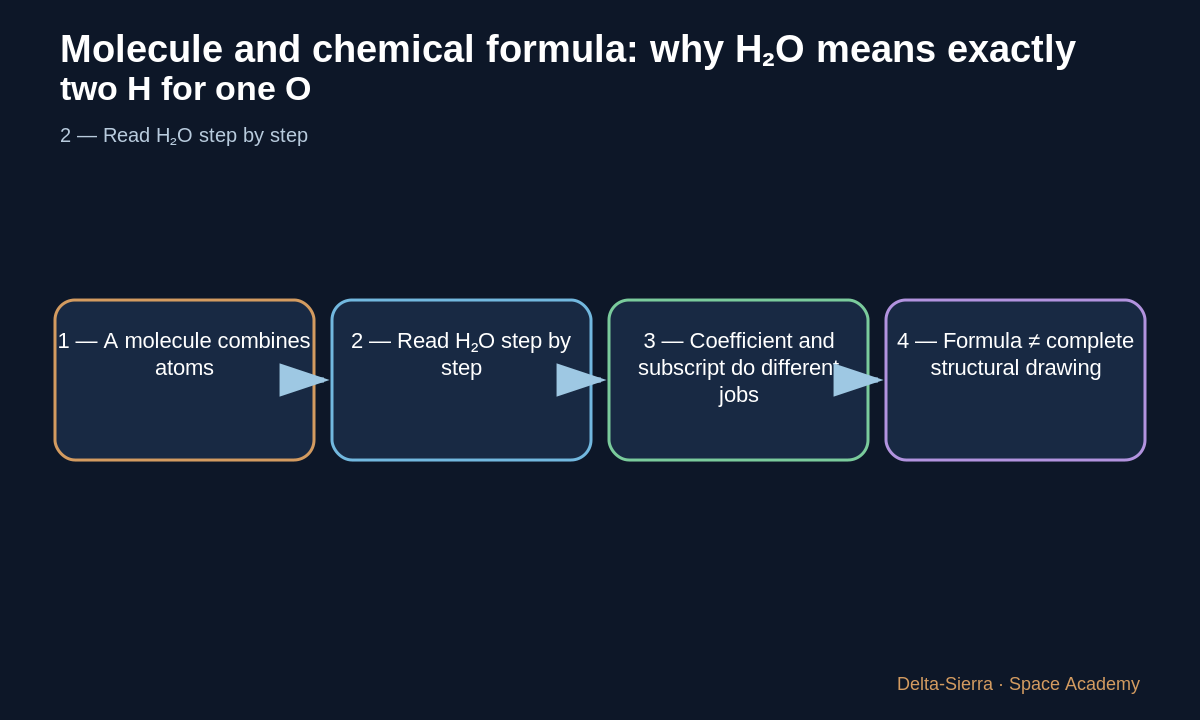
2 — Read H₂O step by step
H = hydrogen; subscript 2 = two H atoms; O = oxygen; no subscript after O = one O atom.
The formula does not mean “two hydrogen molecules plus oxygen”.
3 — Coefficient and subscript do different jobs
2 H₂O means two water molecules. Coefficient 2 multiplies the entire formula; subscript 2 belongs only to H inside each molecule.
This becomes essential when balancing reactions.
4 — Formula ≠ complete structural drawing
A molecular formula does not always show geometry, bond energy, or physical state.
It is compact notation, not a photograph.
Three complete examples: change one assumption to understand
Before each calculation, identify where every number comes from and whether it is measured, conventional, assumed, or calculated.
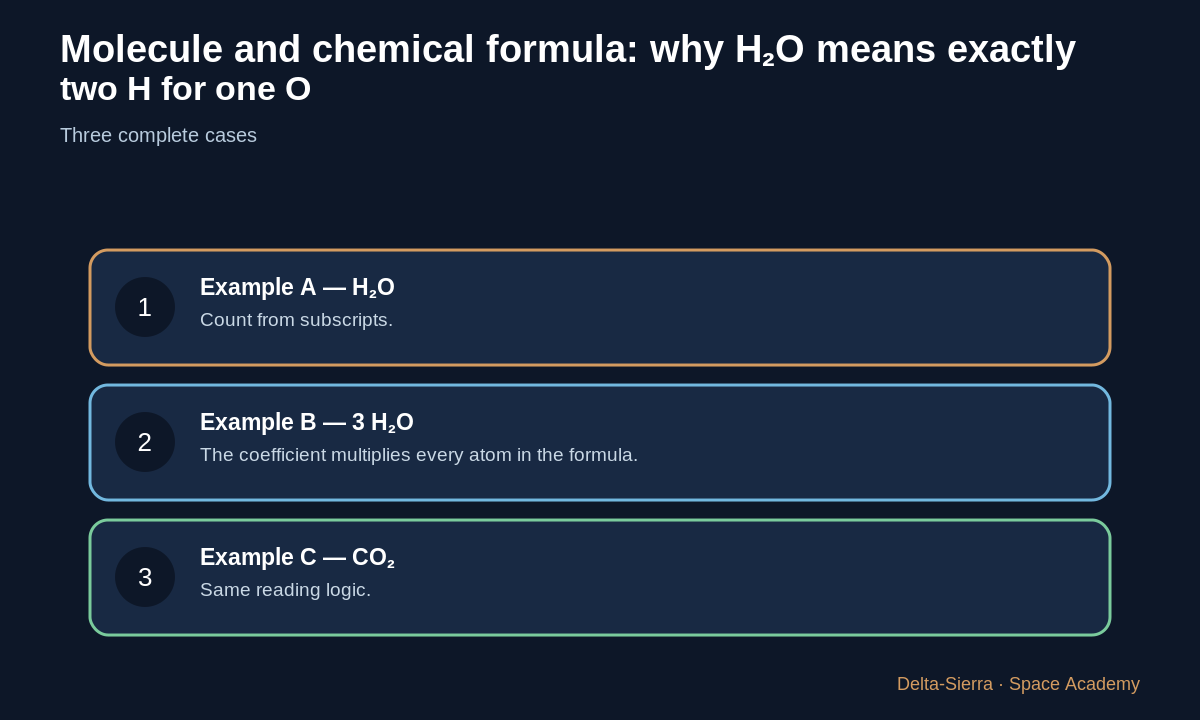
Example A — H₂O
One molecule: 2 H + 1 O = 3 atoms total.
Count from subscripts.
Example B — 3 H₂O
Three molecules: 3×2=6 H and 3×1=3 O.
The coefficient multiplies every atom in the formula.
Example C — CO₂
1 C + 2 O = 3 atoms per molecule. Two CO₂ molecules contain 2 C and 4 O.
Same reading logic.
Inverse calculation
If a collection contains 8 H atoms as H₂O molecules, the corresponding molecule count is 8/2=4, so it also contains 4 O atoms.
Common trap and result check
Trap: changing a subscript to balance a reaction. Changing a subscript changes the substance; coefficients are adjusted instead.
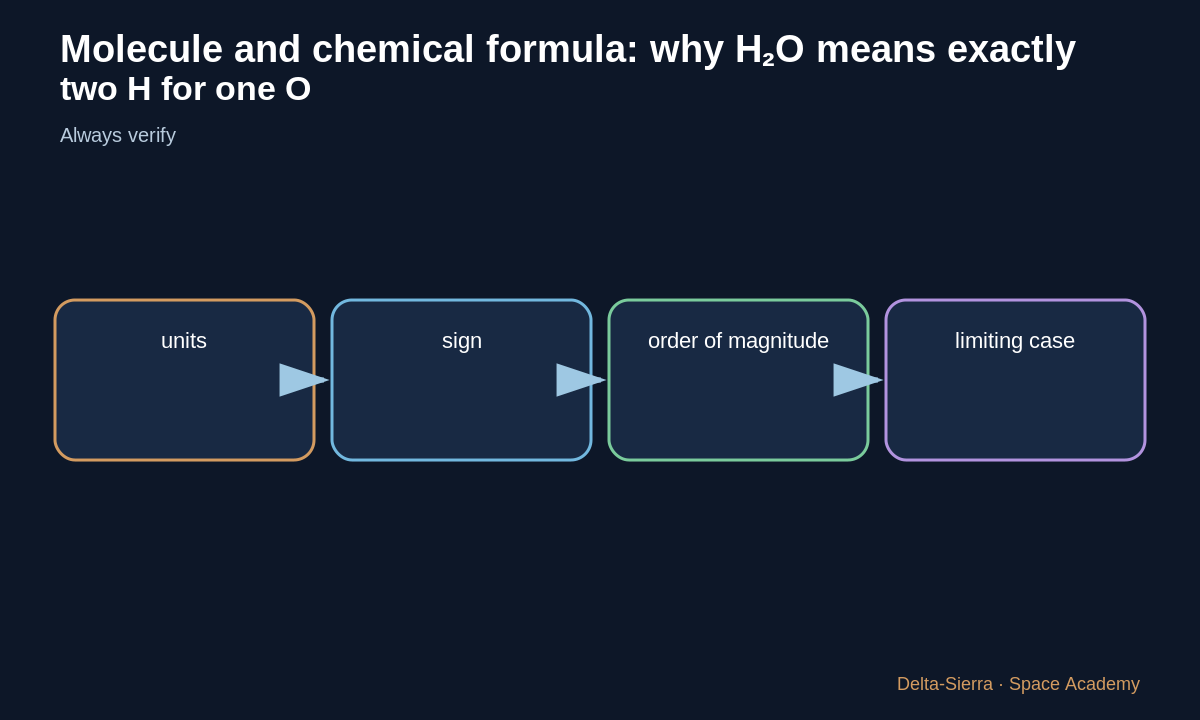
Check units, sign, order of magnitude, and consistency with a limiting case.
Exercises and answers
Restate
Explain in your own words what the equation connects.
Vary
Halve one input and predict the result before calculating.
Check
What independent check can you perform?