Course compass
Goal: understand every word, symbol, unit and operation before using the formula.
Method: concrete situation → vocabulary → step-by-step calculation → three examples → check.
1 — A 10 kg crate does not lose mass on Mars
The crate still has a mass of 10 kg on Earth or Mars. Its weight changes because weight is a gravitational force.
2 — Kilograms and newtons are different units
- kg: kilograms, mass;
- N: newtons, force;
- N/kg: newtons per kilogram, gravitational field strength.
Near the Martian surface, beginner calculations commonly use g ≈ 3.71 N/kg.
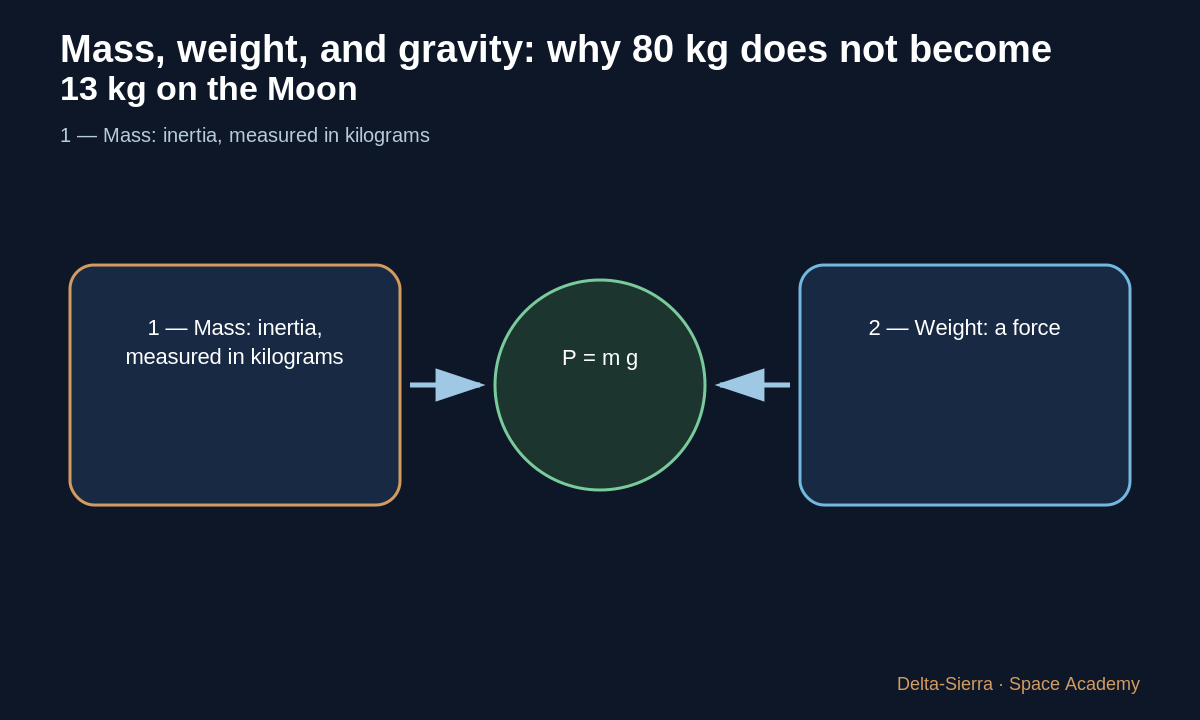
3 — Weight formula: W = m × g
Read it: “W equals m times g”. Here W means weight, m mass, g gravitational field strength.
W = 10 × 3.71 = 37.1 N
4 — Earth and Mars comparison
For a mass of 80 kg:
Mars: W ≈ 80 × 3.71 = 296.8 N
Earth: W ≈ 80 × 9.81 = 784.8 N
The mass stays 80 kg.
5 — What is a newton?
One newton gives a 1 kg mass an acceleration of 1 m/s² if it is the net force along that direction.
6 — Three examples
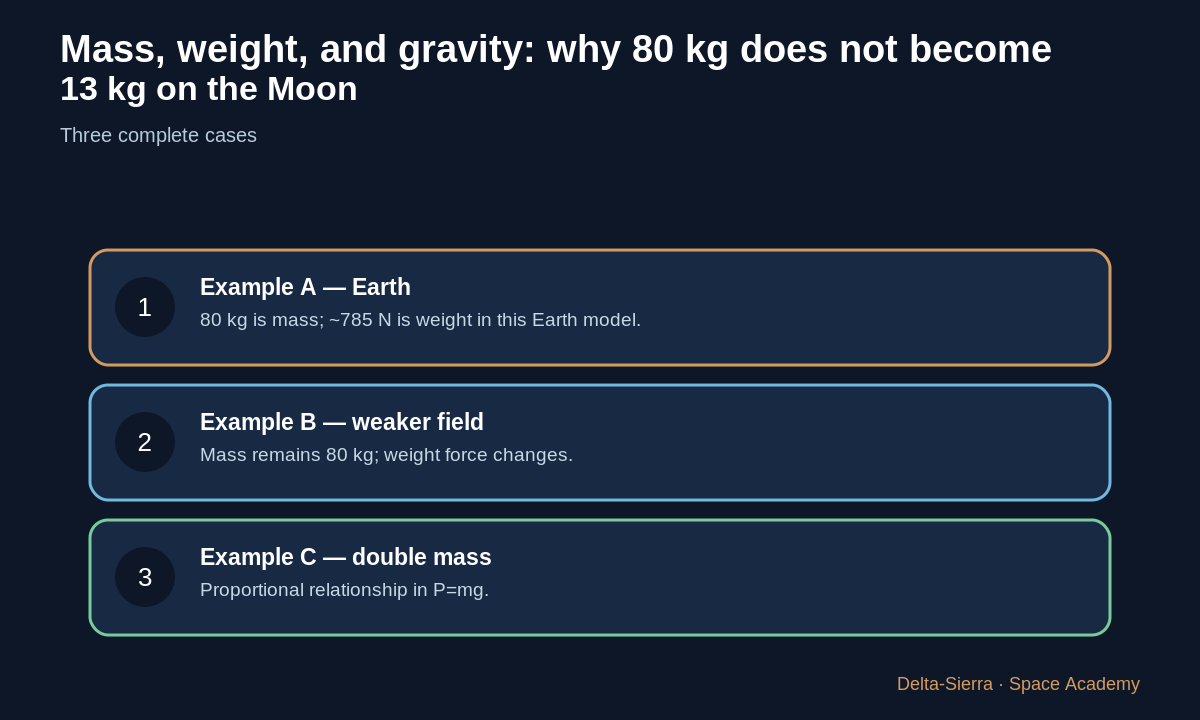
Example A — 10 kg tool
W Mars = 37.1 NExample B — 120 kg astronaut plus suit
W Mars = 120 × 3.71 = 445.2 NExample C — Find mass from weight
Weight = 185.5 N.
m = W ÷ g = 185.5 ÷ 3.71 = 50 kg7 — g is not universal
It varies with the celestial body and position. Use a value appropriate to the model and required precision.
Beginner checkpoint — which quantity is the number describing?
If the value is in kilograms, it is a mass. If it is in newtons, it is a force and may be a weight. If it is in newtons per kilogram, it describes gravitational field strength. Keeping the unit attached to every number prevents the common statement that an object “becomes 38% of its kilograms” on Mars.
For a 100 kg cargo item, the mass remains 100 kg. Near the Martian surface, its weight is about 371 N using g = 3.71 N/kg. The lower weight helps with lifting and support loads, but the 100 kg mass still determines inertia. That distinction matters for vehicle braking, robotic arms, cranes and collision safety.
8 — Corrected exercises
Exercise 1
25 kg battery on Mars?
Exercise 2
Does 100 kg become 38 kg on Mars?