Course compass
Goal: understand every word, symbol, unit and operation before using the formula.
Method: concrete situation → vocabulary → step-by-step calculation → three examples → check.
1 — A rover moves, then brakes
A rover covers 120 m in 20 s, then slows to a stop. Speed/velocity tells how fast position changes. Acceleration tells how fast velocity changes.
2 — Average speed: distance divided by time
m/s is read “metres per second”.
120 m ÷ 20 s = 6 m/s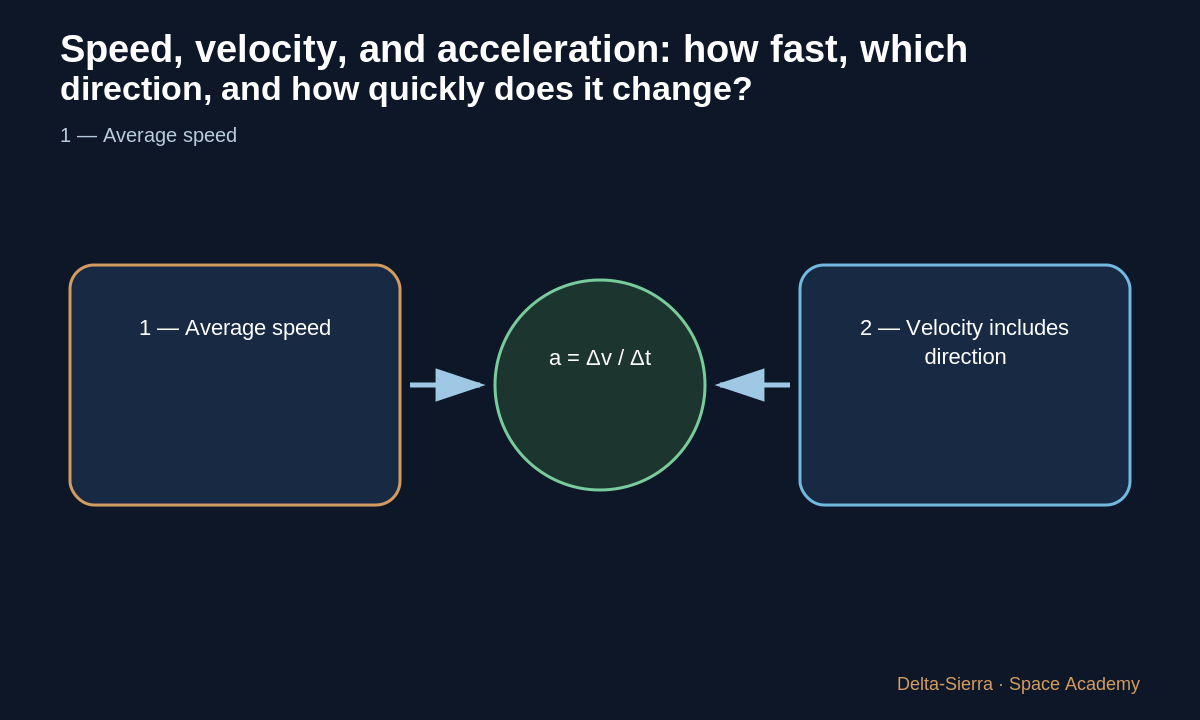
3 — From m/s to km/h
Multiply m/s by 3.6 to obtain km/h; divide by 3.6 for the reverse conversion.
6 × 3.6 = 21.6 km/h4 — Direction matters
Choose east positive. +4 m/s means 4 m/s east; −4 m/s means 4 m/s west. Speed magnitude answers “how fast”; velocity includes direction.
5 — Acceleration: velocity change per second
Δv is “delta v”, change in velocity. Δt is “delta t”, elapsed time. m/s² is read “metres per second squared”.
initial v = 2 m/s
final v = 8 m/s
Δv = 6 m/s
time = 3 s
a = 6 ÷ 3 = 2 m/s²
6 — Braking can give a negative acceleration
v changes from +10 to 0 m/s in 5 s
Δv = −10 m/s
a = −10 ÷ 5 = −2 m/s²
The sign comes from the chosen axis.
7 — Three Mars examples
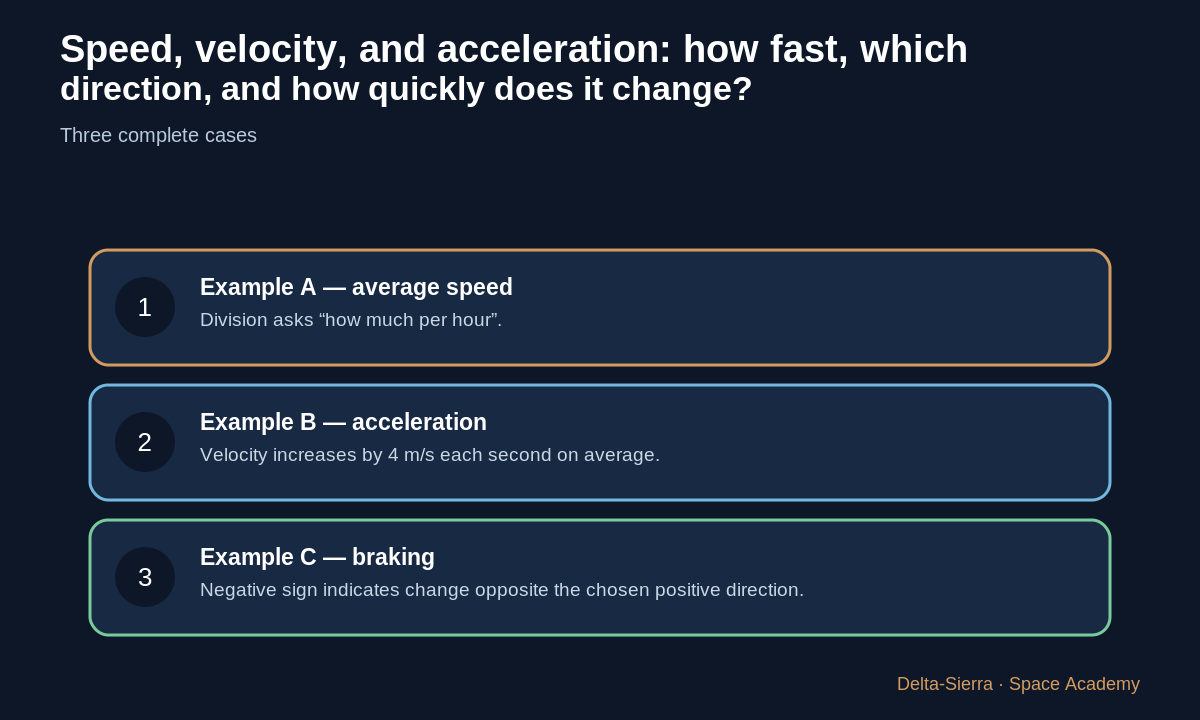
Example A — Exploration rover
300 m ÷ 50 s = 6 m/s = 21.6 km/hExample B — Winch starts
0 to 1.5 m/s in 3 s → a = 0.5 m/s²Example C — Lander descent
Up is positive. Vertical velocity changes from −20 to −5 m/s in 5 s.
Δv = +15 m/s
a = +3 m/s²
Acceleration is upward, reducing the descent speed.
8 — Reading graphs
On a position-time graph, steeper slope means greater velocity. On a velocity-time graph, slope represents acceleration.
Beginner checkpoint — what is changing?
Before using a formula, identify the level of change. Distance tells how much path was covered. Velocity tells how quickly position changes. Acceleration tells how quickly velocity changes. If the question says “metres every second”, it is talking about velocity. If it says “the velocity increases by two metres per second every second”, it is talking about acceleration.
The sign also belongs to the chosen direction. A descending lander can have a negative vertical velocity while having a positive acceleration upward during braking. That is not contradictory: the craft is still moving downward, but its downward velocity is becoming smaller in magnitude. Reading signs as directions, rather than as “good” or “bad” numbers, prevents many beginner mistakes.
9 — Corrected exercises
Exercise 1
200 m in 40 s?
Exercise 2
Velocity changes from 4 to 10 m/s in 3 s.