Course compass
Question directrice : What is a vector, what do its components mean, and how can directed displacements or forces be combined?
Markers: 📏 MEASURED · 📐 CONVENTION · 🧮 CALCULATED · 🎓 TEACHING ASSUMPTION · ⚠️ APPROXIMATION
- understand the concept
- do a simple calculation
- explain every symbol
- check a result
1 — A vector is an arrow carrying two pieces of information
The word vector sounds technical, but the mental picture is simple: a vector is an arrow.
It carries two things: size and direction. Size answers “how much?” Direction answers “which way?”
Number or vector?
“10 metres” gives only a distance. “10 metres east” gives distance plus direction. “50 newtons upward” similarly gives both force magnitude and direction.
2 — Scalar versus vector, without jargon
A scalar is described by a value without a particular direction, such as a mass of 10 kg or a temperature of 20 °C.
A vector needs direction as well as size. Displacement, directed velocity and force are common examples.
The term magnitude means the size of the vector — the length of the arrow in the model.
3 — x and y: describing the same arrow with two numbers
In a two-dimensional diagram we often choose x for horizontal and y for vertical.
The x-component tells how much the arrow goes right or left. The y-component tells how much it goes up or down.
A component is not a new object. It is one part of the description of the same vector.
4 — Master example: a rover moves 6 m right and 8 m up
On a local map a rover moves 6 m to the right and 8 m upward. Its components are x = 6 m and y = 8 m.
The direct displacement forms the hypotenuse of a right triangle.
Pythagoras explained
For a right triangle, the square of the longest side equals the sum of the squares of the other two sides:
distance² = 6² + 8² = 36 + 64 = 100.
The symbol ² means “squared”: 6² means 6 × 6. To return from 100 to the distance, take the square root, written √. √100 = 10.
The displacement vector therefore has a magnitude of 10 m.
5 — Adding vectors: chaining directed actions
Adding vectors means combining actions that have directions.
Two successive moves
5 m east plus 3 m east gives 8 m east. If the second move is 3 m west, choose east as positive: the second move is −3 m, so 5 + (−3) = 2 m east.
The minus sign does not mean an impossible negative distance. It encodes the opposite direction on the chosen axis.
6 — Three complete examples
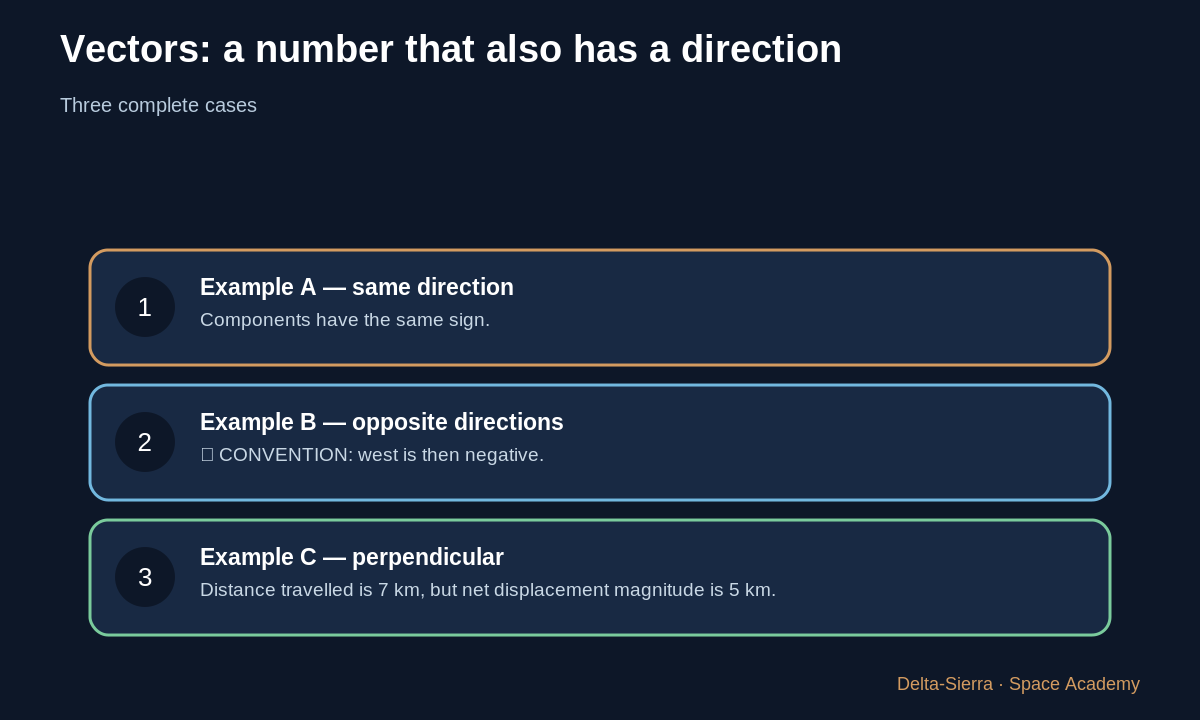
Example A — Rover displacement
4 m east and 3 m north give a direct displacement of √(4²+3²)=5 m.
Example B — Two lateral thrusters
20 N right and 5 N left give 20 + (−5)=15 N to the right.
Example C — Vehicle velocity
A rover moving at 2 m/s north has both a speed magnitude and a direction. If it turns around while remaining at 2 m/s, its vector velocity has changed even though the displayed speed is unchanged.
7 — Resultant and zero vector
The resultant is the vector obtained after combining several vectors. Two equal forces acting exactly opposite each other can have a zero resultant on that axis.
Balanced forces
10 N right and 10 N left give 0 N resultant on the axis. This does not mean no forces exist; it means their directed effects cancel on that axis.
8 — Calculator: finding vector magnitude
For 6 m and 8 m components: calculate 6 × 6 = 36; 8 × 8 = 64; add to get 100; press √ to obtain 10.
9 — Why vectors matter in missions
Navigation cannot rely on “how fast” alone. It needs the direction of motion, the direction of thrust, and how corrections combine. The mathematics becomes more advanced in three dimensions, but the core idea remains size + direction.
10 — Common traps
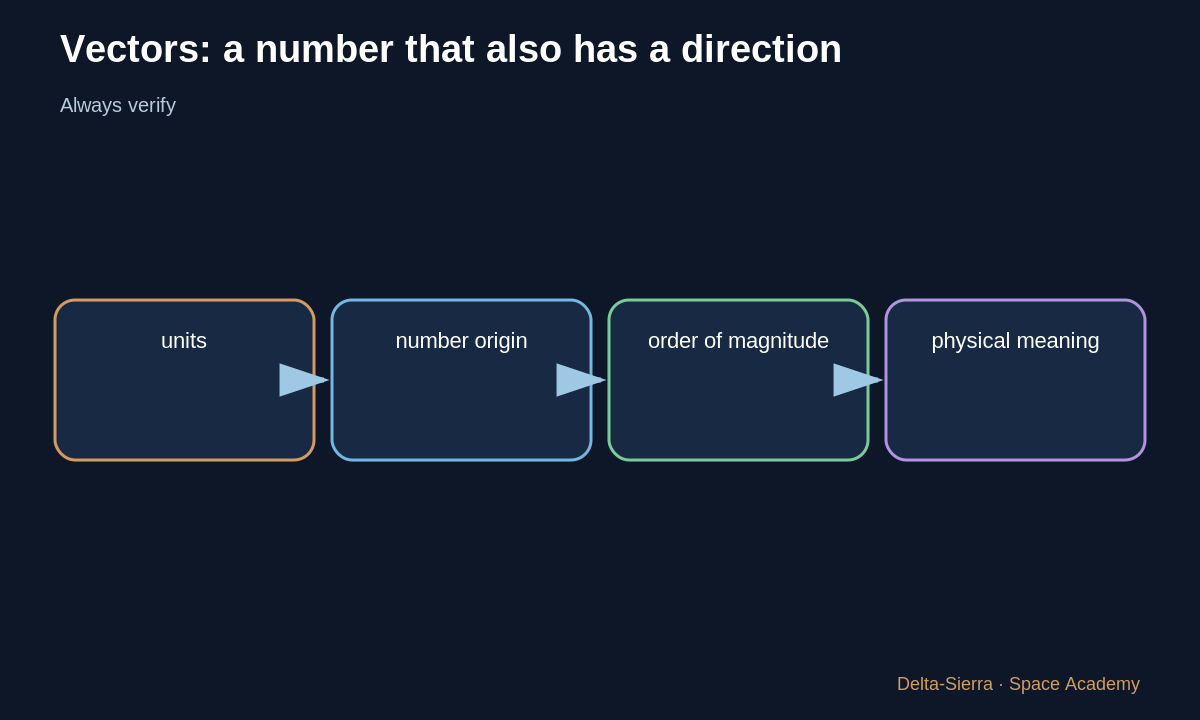
- Giving directions without defining the convention.
- Adding magnitudes while ignoring opposite directions.
- Confusing distance travelled with direct displacement.
- Dropping the unit.
- Using terms such as magnitude, component or resultant without translating them into plain language.
Exercises and answers
Exercise 1
A rover moves 3 m east and 4 m north. Direct displacement?
Exercise 2
12 N right and 7 N left act on one axis. Resultant?
Exercise 3
Why can 10 m/s be incomplete information?