Course compass
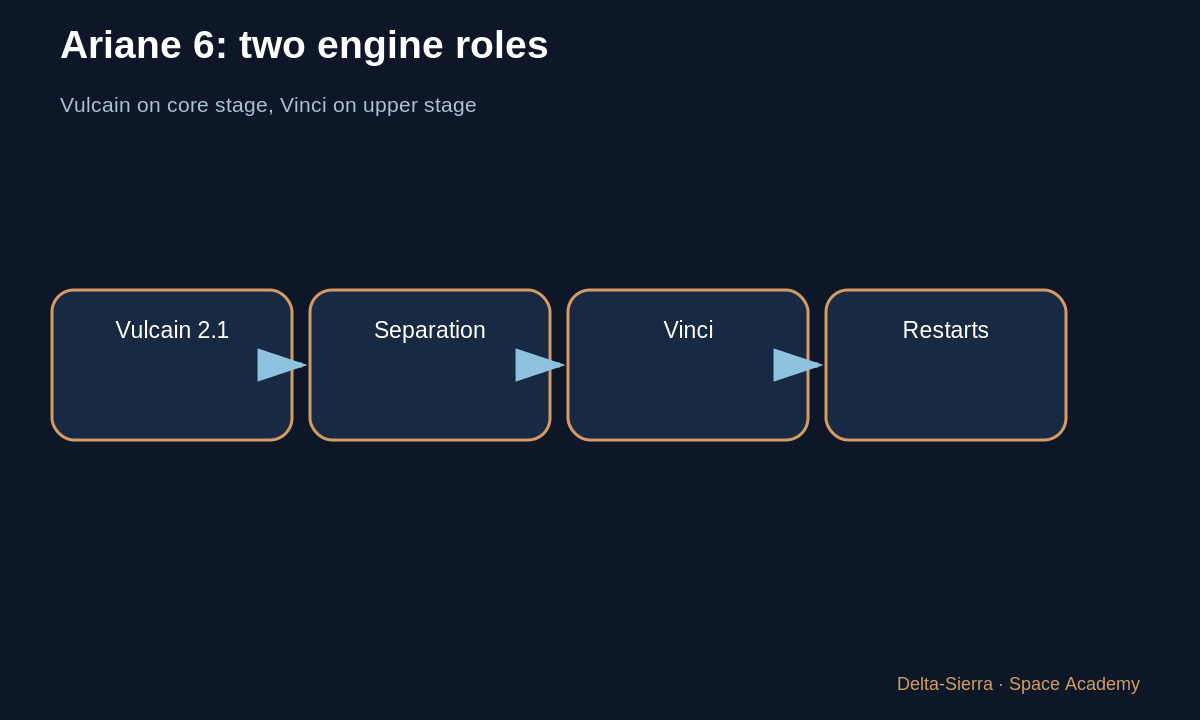
Guiding question : Why does Ariane 6 use Vulcain 2.1 and then Vinci instead of one engine for everything?
Evidence tags : 📏 MEASURED · 📐 CONVENTION · 🧮 CALCULATED · 🎓 LEARNING ASSUMPTION · 🚀 MISSION DATA · 🏭 MANUFACTURER DATA · ⚠️ APPROXIMATION
Objectives :
- compare core and upper stages
- understand LOX/LH2
- read flow rate and turbopump power
- understand Vinci restart
- understand Vulcain gimbaling
1 — Engines are optimized for mission phases
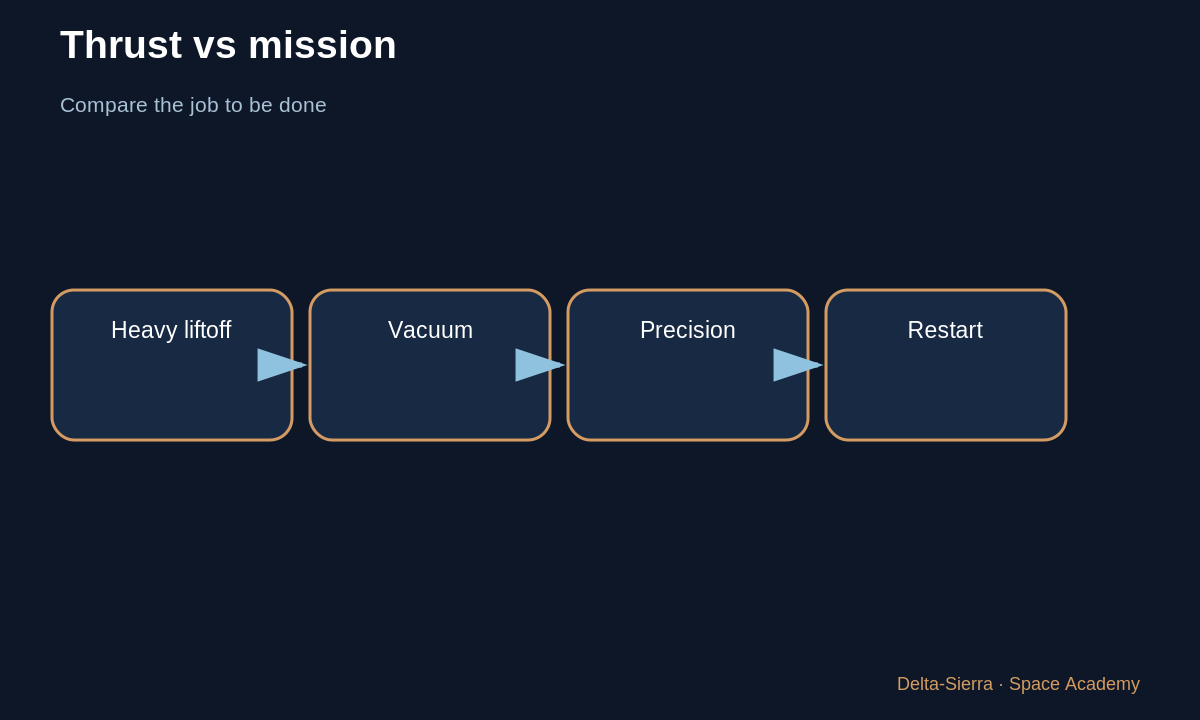
At liftoff the vehicle is heavy and crosses the atmosphere. Later the upper stage operates in vacuum with much less mass and values injection precision, restart, and efficiency.
“Best” therefore means nothing without mission context. A powerful sea-level engine is not automatically the best upper-stage engine.
2 — Vulcain 2.1: feed a huge chamber for minutes
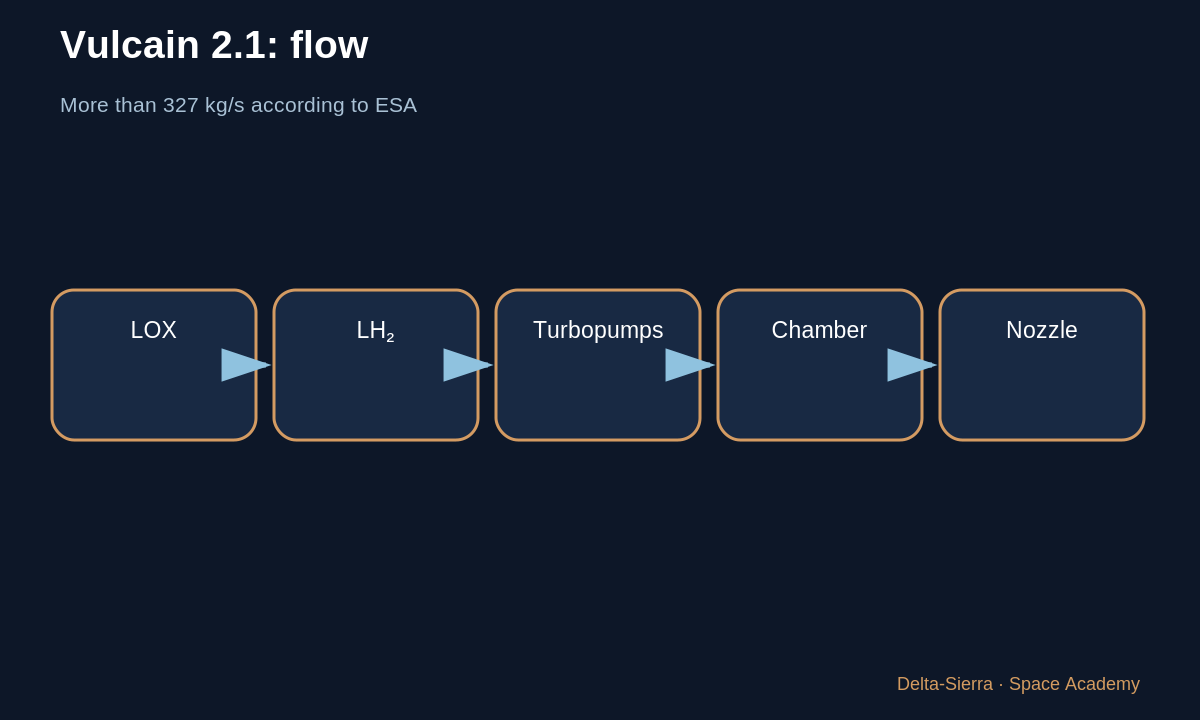
ESA reports more than 327 kg of propellant per second for Vulcain 2.1 and roughly 1,371 kN of thrust. The hydrogen turbopump runs near 33,000 rpm and produces about 15 MW.
These numbers show why a rocket engine is fundamentally a flow machine: a few seconds already move, accelerate, and burn tonnes of material.
3 — Convert flow rate into consumed mass
MANUFACTURER DATA: 327 kg/s. If we hold that flow for a simple 10-second estimate, mass through the engine is 327 × 10 = 3,270 kg.
This does not reproduce the full real sequence; it teaches what kg/s means.
4 — Vinci: why restart changes the mission
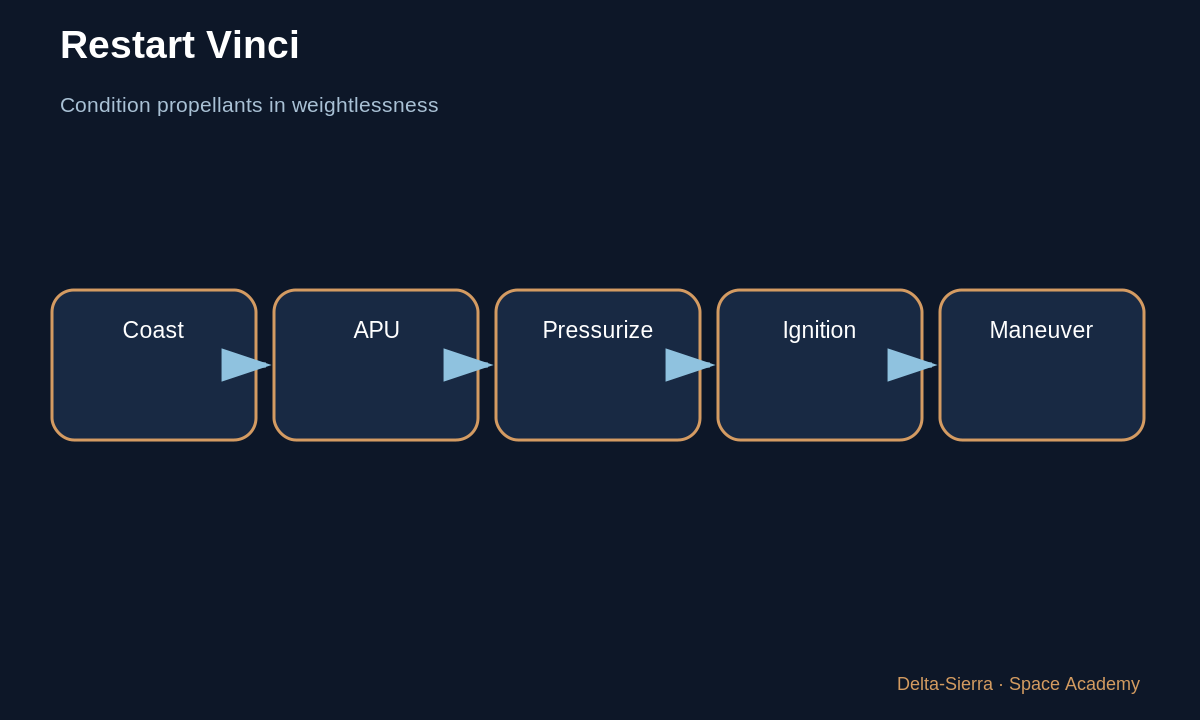
ESA describes Vinci as a cryogenic upper-stage engine that can restart multiple times. That separates maneuvers instead of requiring one continuous burn.
In space, apparent weightlessness complicates propellant feed. Ariane 6’s APU helps pressurize tanks and condition propellant for restarts.
5 — Steering Vulcain: thrust becomes an invisible rudder
Electrical commands from avionics act through a hydraulic system that moves servo-actuators. They rotate the engine slightly in pitch and yaw.
The nozzle does not simply “bend”; the engine assembly pivots around a joint designed to carry enormous loads.
6 — What Europe already controls, and what differs from SpaceX
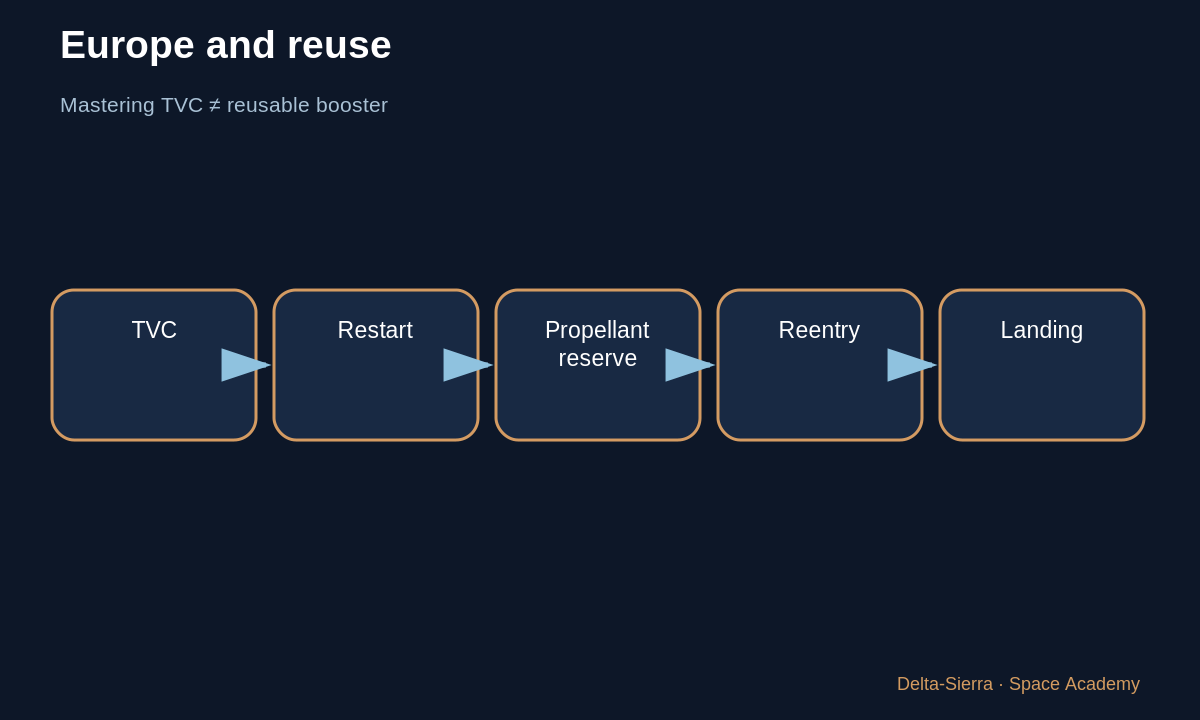
Ariane already masters cryogenic propulsion, guidance, TVC, upper-stage restart, light structures, and qualification. The difference with Falcon 9 is not “Europe cannot steer an engine”.
Falcon 9’s distinction is the integrated first-stage recovery architecture: propellant margins, return sequences, navigation, grid fins, engine relights, and landing legs designed into the system.
7 — First-stage and upper-stage engines want different things
At liftoff the vehicle needs high thrust while operating in atmosphere, vibration and a long acceleration phase. Later an upper stage works much closer to vacuum and may value different qualities: efficiency, restart capability, precise orbital placement or operation after a coast period.
Comparing Vulcain and Vinci only by thrust is therefore like comparing two vehicles by horsepower while ignoring their jobs. They are optimized for different mission phases. Proper analysis begins with the mission and works backward to engine requirements.
8 — Reuse changes the hierarchy of trade-offs
An expendable engine can accept choices that may be costly for hardware intended to fly repeatedly. Reuse adds fatigue, inspection, turnaround, access, repeated start and operational-cost questions. It does not remove performance requirements; it adds another dimension to them.
Comparing Ariane and SpaceX therefore requires separating architecture, program goals and generation. A program does not necessarily “lack” a technology because it uses another solution; it may have been given a different set of requirements. The useful question is which requirements lead to which architecture.
Exercises and answers
Flow
At 327 kg/s for 20 s, how much mass flows through?
Mission
Why is restart useful?
Comparison
Why is Vinci not “worse” because its thrust is lower?