Course compass
Guiding question: Why can a small fast mass be as hard to stop as a large slow mass?
1 — The physical question
Why can a small fast mass be as hard to stop as a large slow mass?
We start from the concrete problem before notation. The goal is to understand what we seek, then why mathematics becomes useful.
2 — How to read the symbols and units
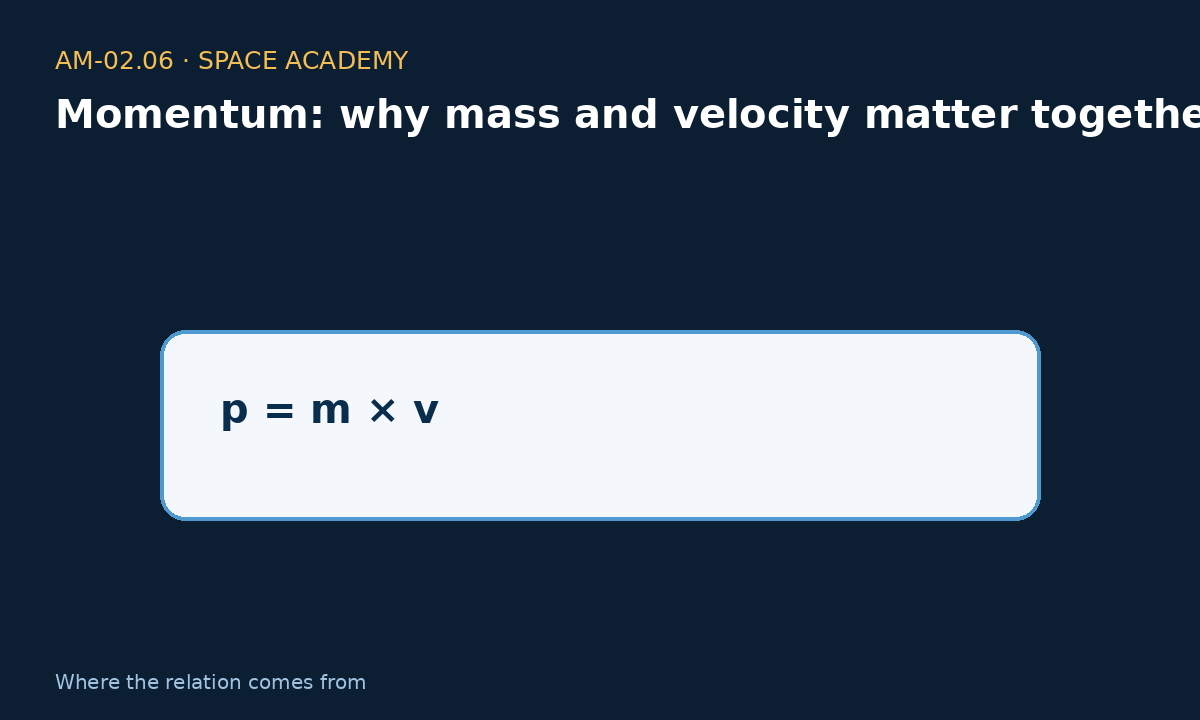
p = m × v. Read: “p equals m times v”.
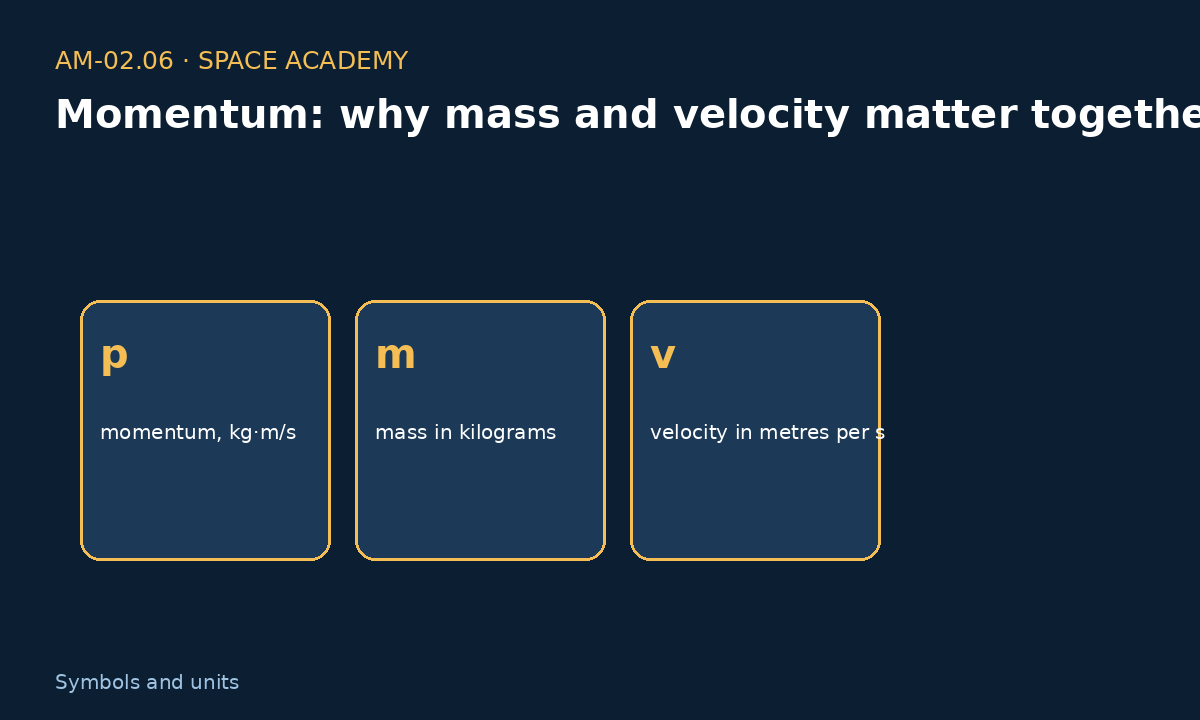
p — momentum, kg·m/s ; m — mass in kilograms ; v — velocity in metres per second
3 — Where does the relation come from?
Momentum p combines mass and velocity. Newton’s second law can be expressed through change in momentum: a force applied over time changes p.
Every number used below is explicitly treated as data, convention, learning assumption, or calculated result.
4 — A — Cart
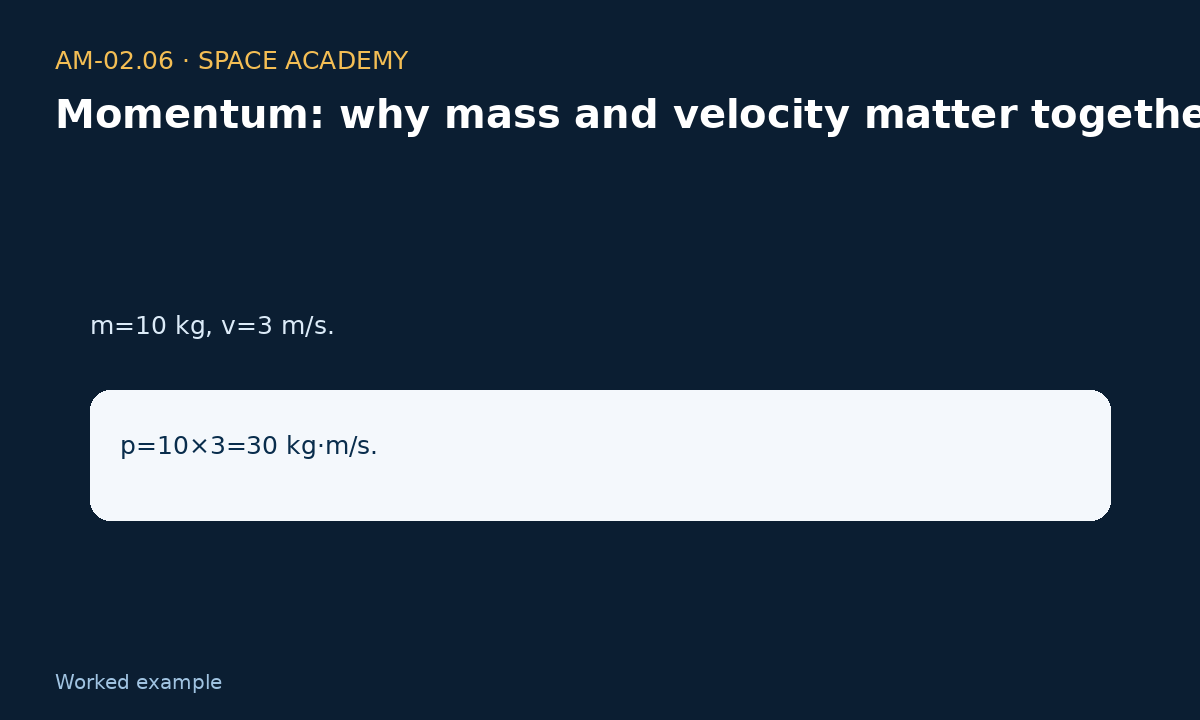
Where do the numbers come from? m=10 kg, v=3 m/s.
Step-by-step calculation: p=10×3=30 kg·m/s.
Doubling speed doubles p.
5 — B — Same momentum
Where do the numbers come from? 20 kg at 2 m/s versus 10 kg at 4 m/s.
Step-by-step calculation: 20×2=40; 10×4=40 kg·m/s.
Different masses and speeds can give the same momentum.
6 — C — Gas jet
Where do the numbers come from? 5 kg/s expelled at 2,000 m/s for 1 s.
Step-by-step calculation: Expelled mass=5 kg; p=5×2000=10,000 kg·m/s.
The rocket receives an opposite momentum change.
7 — Sensitivity, inverse calculation, and sanity check
Change one input, predict the direction of the result, calculate, then check units, sign, order of magnitude, and limits.
Essential limit for Momentum: why mass and velocity matter together: the displayed relation is a learning model. A real system adds detailed geometry, variable properties, sensors, uncertainty, transients, and testing.
8 — Why this matters in a mission
In a space mission, why can a small fast mass be as hard to stop as a large slow mass? The useful skill is not reciting the formula but knowing which data are needed, which are measured, and when the model becomes insufficient.
10 — Go deeper: from calculation to physical understanding
Why mass and velocity appear together
Mass alone does not tell us how hard an object is to stop: a massive stationary vehicle has zero momentum. Speed alone is also insufficient: a dust grain and a truck at the same speed do not have the same effect. The product m×v combines the two properties. That is why doubling mass or doubling velocity doubles momentum in the classical model.
Velocity has direction, so momentum does too
In one dimension, the sign of v can represent direction. Two identical objects travelling at +3 m/s and -3 m/s have opposite momenta. In space, p becomes a vector. This property explains how bodies can exchange momentum while the total of an isolated system remains conserved.
The connection to propulsion
A rocket engine does not “push against the air.” It accelerates a mass of gas in one direction and the vehicle receives a momentum change in the other. A complete engine calculation adds pressure and fluid dynamics, but momentum provides the conceptual bridge between Newton’s laws and the thrust equation studied later.
Conservation does not mean nothing moves
Conservation of total momentum in an isolated system means internal changes balance each other. Two objects initially at rest can move away in opposite directions with equal and opposite momenta. The total remains zero even though both objects are now moving.
9 — Exercises and answers
Challenge 1
m=10 kg, v=3 m/s.
Challenge 2
20 kg at 2 m/s versus 10 kg at 4 m/s.
Challenge 3
5 kg/s expelled at 2,000 m/s for 1 s.