Course compass
Guiding question: Why is it not enough to place the tank above the engine and let liquid fall into it?
Markers: 📏 MEASURED · 📐 CONVENTION · 🧮 CALCULATED · 🎓 TEACHING ASSUMPTION · ⚠️ APPROXIMATION
- distinguish pump and turbine
- connect pressure flow power
- read rpm without overinterpreting
- identify limits
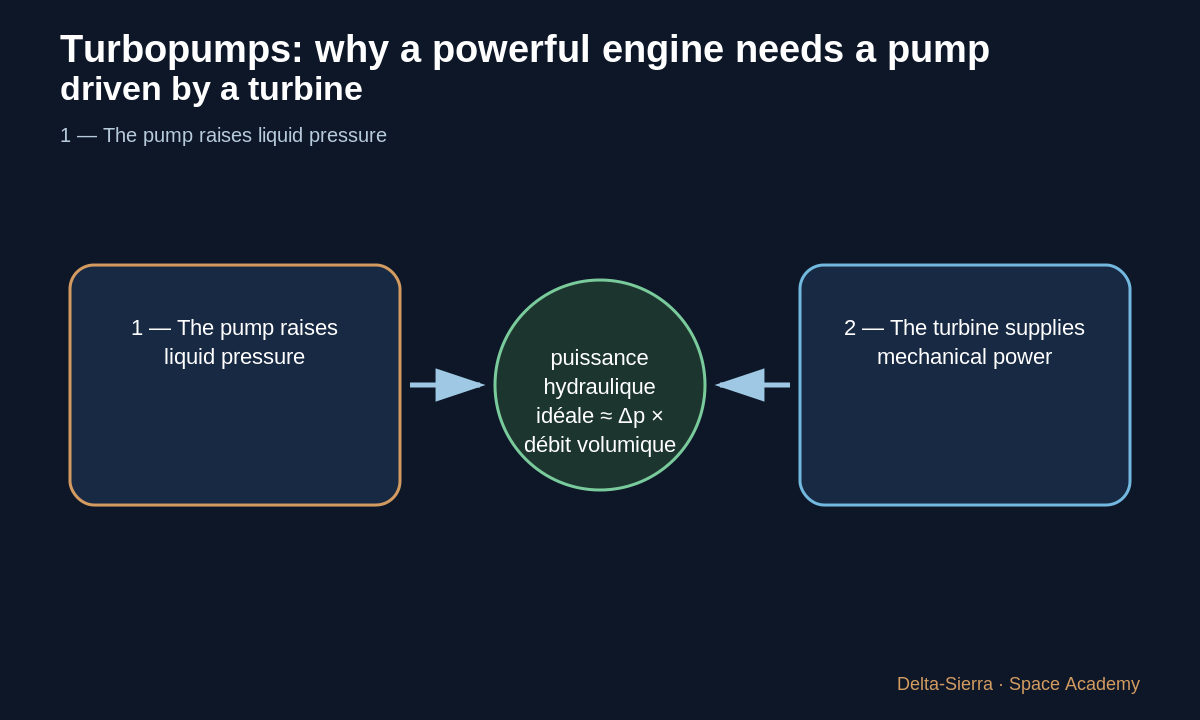
1 — The pump raises liquid pressure
A high-pressure chamber requires feed pressure above downstream pressure and losses. A pump transfers mechanical energy to the fluid.
The greater the flow and pressure rise, the greater the required power.
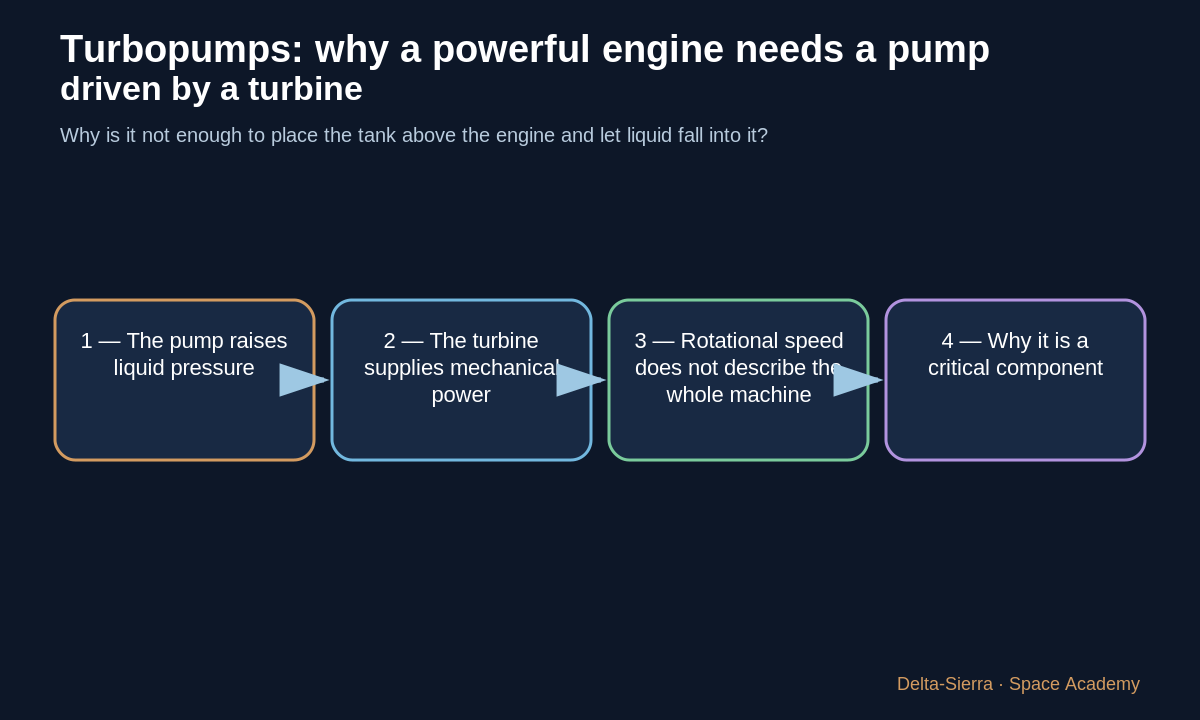
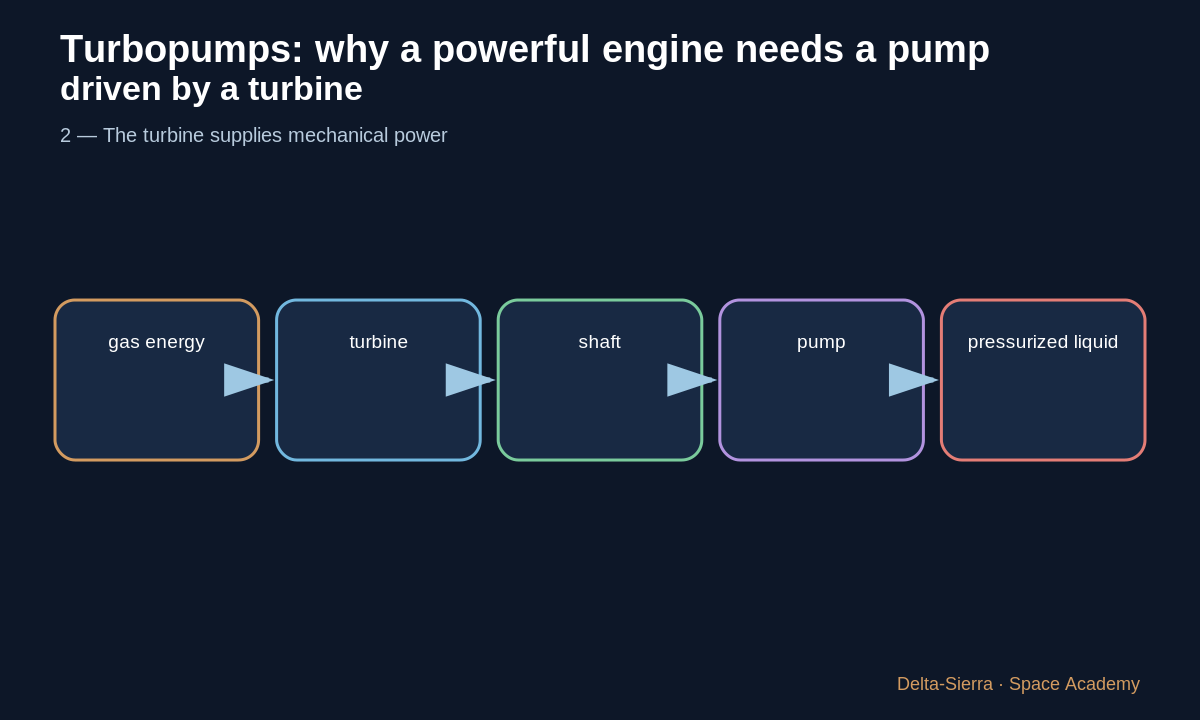
2 — The turbine supplies mechanical power
A turbine extracts energy from a gas flow and turns it into shaft rotation. That shaft can drive a pump.
The word turbopump combines two different functions: driving turbine and fluid pump.
3 — Rotational speed does not describe the whole machine
Two turbopumps at the same rpm can produce very different flow and pressure depending on geometry and fluid.
Distinguish rotational speed, torque, power, flow, and pressure.
4 — Why it is a critical component
Temperature, vibration, seals, bearings, cavitation, and start transients make turbomachinery demanding.
A functional diagram teaches the energy chain without manufacturing geometry.
Three complete examples: change one assumption to understand
Before each calculation, identify where every number comes from and whether it is measured, conventional, assumed, or calculated.
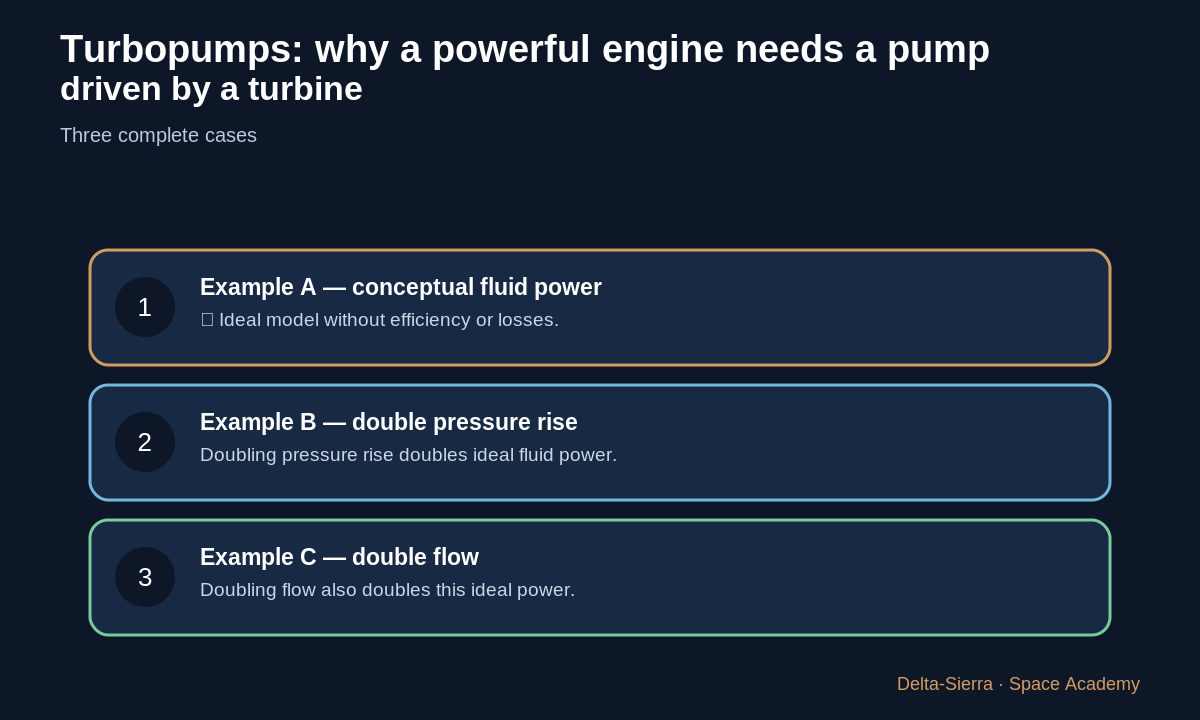
Example A — conceptual fluid power
Δp=1 MPa=1,000,000 Pa and Q=0.01 m³/s: P≈Δp×Q=10,000 W=10 kW.
🎓 Ideal model without efficiency or losses.
Example B — double pressure rise
Same Q, Δp=2 MPa: ideal P≈20 kW.
Doubling pressure rise doubles ideal fluid power.
Example C — double flow
Δp=1 MPa, Q=0.02 m³/s: P≈20 kW.
Doubling flow also doubles this ideal power.
Inverse calculation
If target ideal fluid power is 20 kW at Δp=2 MPa, Q=P/Δp=20,000/2,000,000=0.01 m³/s.
Common trap and result check
Trap: confusing ideal fluid power with real shaft power. Efficiency, losses, and dynamics make the real requirement different.
In a real engine system, a conceptual result must later be checked against fluid properties, margins, tests, and qualification.
Exercises and answers
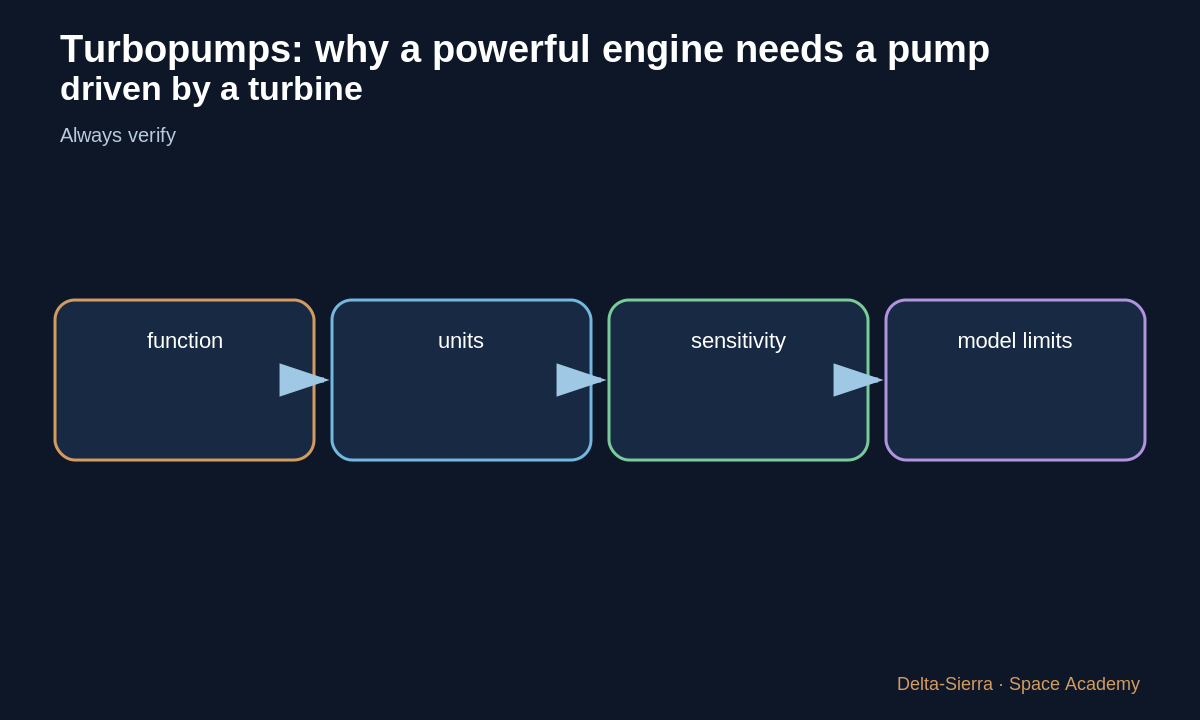
Function
Explain the function of each block without jargon.
Sensitivity
Halve one assumption and predict the consequence.
Limit
Name one reason the teaching model is insufficient for a real engine.