Course compass
Guiding question: Why can a pump malfunction even when the tank still contains plenty of liquid?
Markers: 📏 MEASURED · 📐 CONVENTION · 🧮 CALCULATED · 🎓 TEACHING ASSUMPTION · ⚠️ APPROXIMATION
- define cavitation
- understand pump inlet
- reason in margin
- connect temperature and pressure
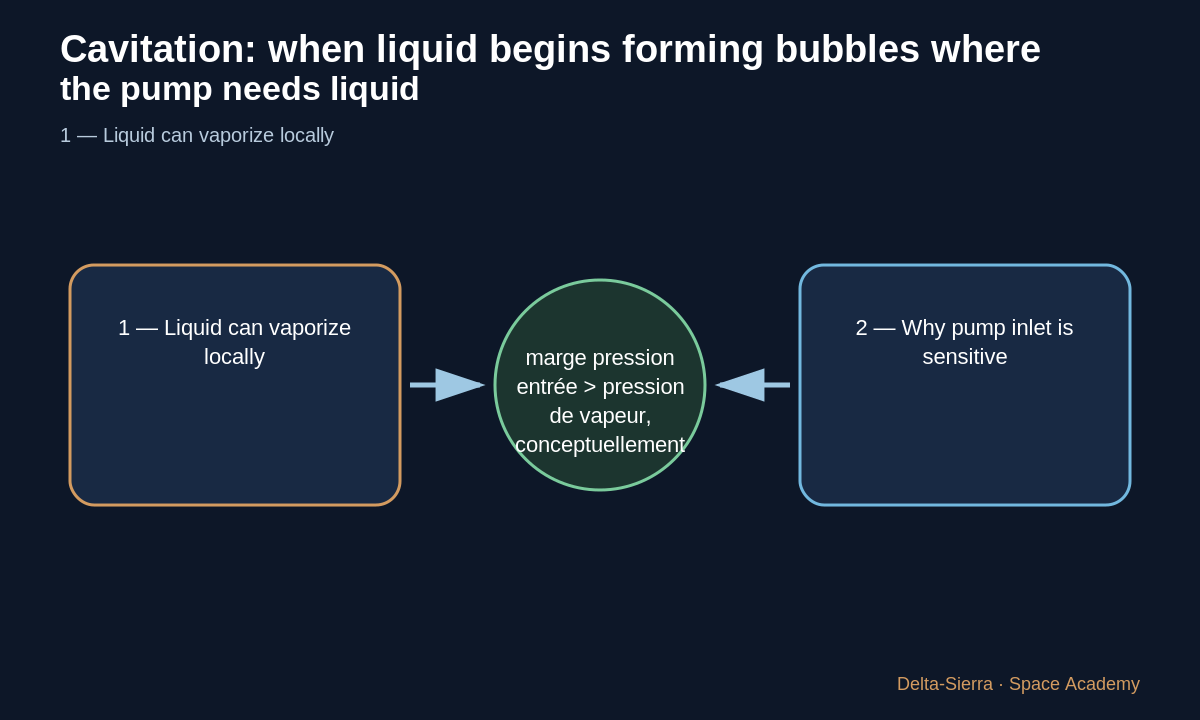
1 — Liquid can vaporize locally
If local pressure falls sufficiently relative to the fluid’s thermodynamic state, some liquid can form vapor.
In a pump, vapor pockets may appear and later collapse in higher-pressure regions.
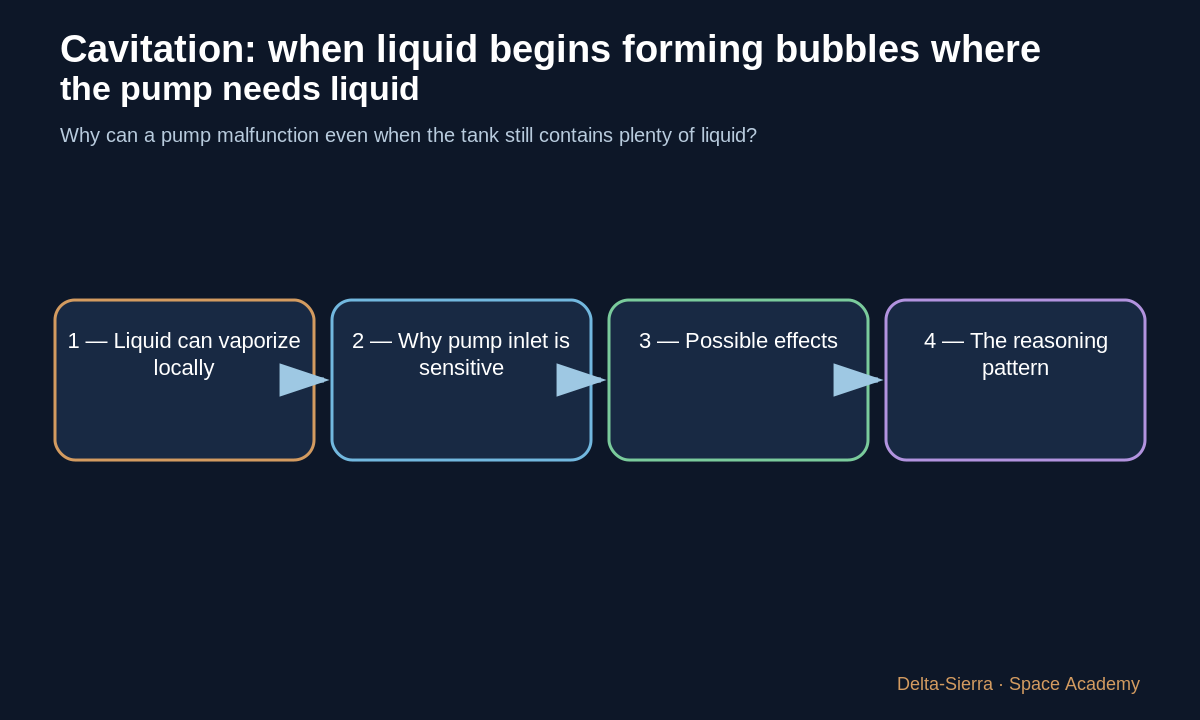
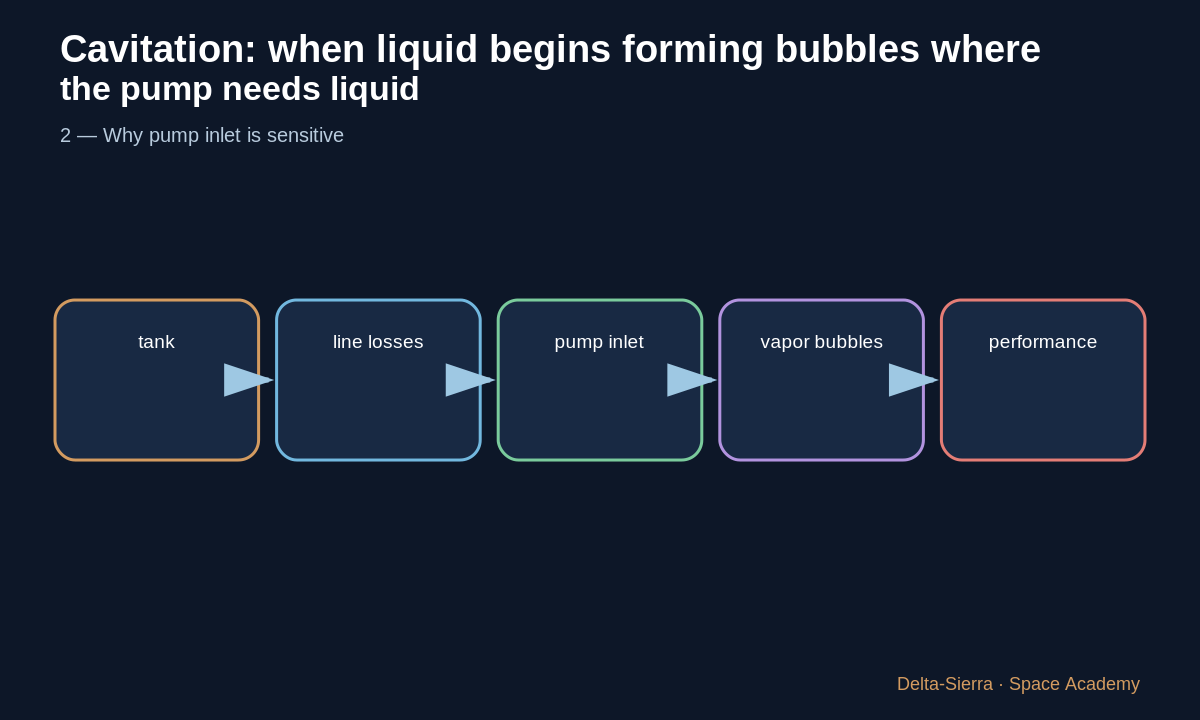
2 — Why pump inlet is sensitive
The pump must receive and accelerate fluid. Tank pressure, line losses, vehicle acceleration, and temperature all affect inlet state.
Simply having liquid remaining does not guarantee adequate margin.
3 — Possible effects
Cavitation can degrade performance and create vibration, noise, and local loads. In demanding turbomachinery it must be considered in design and test.
This lesson remains qualitative and does not provide operating thresholds for a real engine.
4 — The reasoning pattern
Compare inlet conditions with fluid properties and preserve margin. If temperature rises, vapor pressure can change; if losses rise, pressure available to the pump can fall.
This is a coupled fluid-thermal-dynamic problem.
Three complete examples: change one assumption to understand
Before each calculation, identify where every number comes from and whether it is measured, conventional, assumed, or calculated.
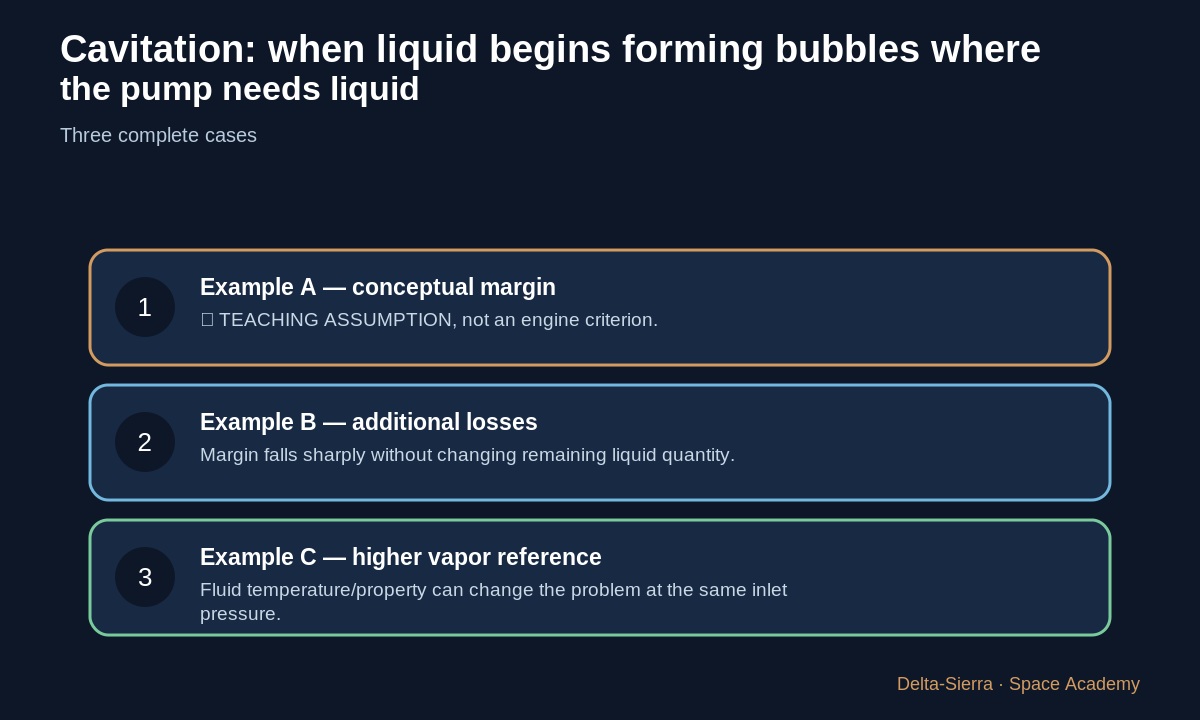
Example A — conceptual margin
Inlet pressure 300 kPa, reference vapor value 200 kPa: simple margin=100 kPa.
🎓 TEACHING ASSUMPTION, not an engine criterion.
Example B — additional losses
If 60 kPa extra loss lowers inlet to 240 kPa, simple margin=40 kPa.
Margin falls sharply without changing remaining liquid quantity.
Example C — higher vapor reference
Inlet 300 kPa but vapor reference 260 kPa: margin=40 kPa.
Fluid temperature/property can change the problem at the same inlet pressure.
Inverse calculation
If a conceptual exercise margin is 80 kPa and vapor reference is 200 kPa, inlet pressure would need at least 280 kPa in this simplified model.
Common trap and result check
Trap: turning the lesson’s simple pressure difference into a sizing rule. Real criteria use specific definitions, properties, and tests.
In a real engine system, a conceptual result must later be checked against fluid properties, margins, tests, and qualification.
Exercises and answers
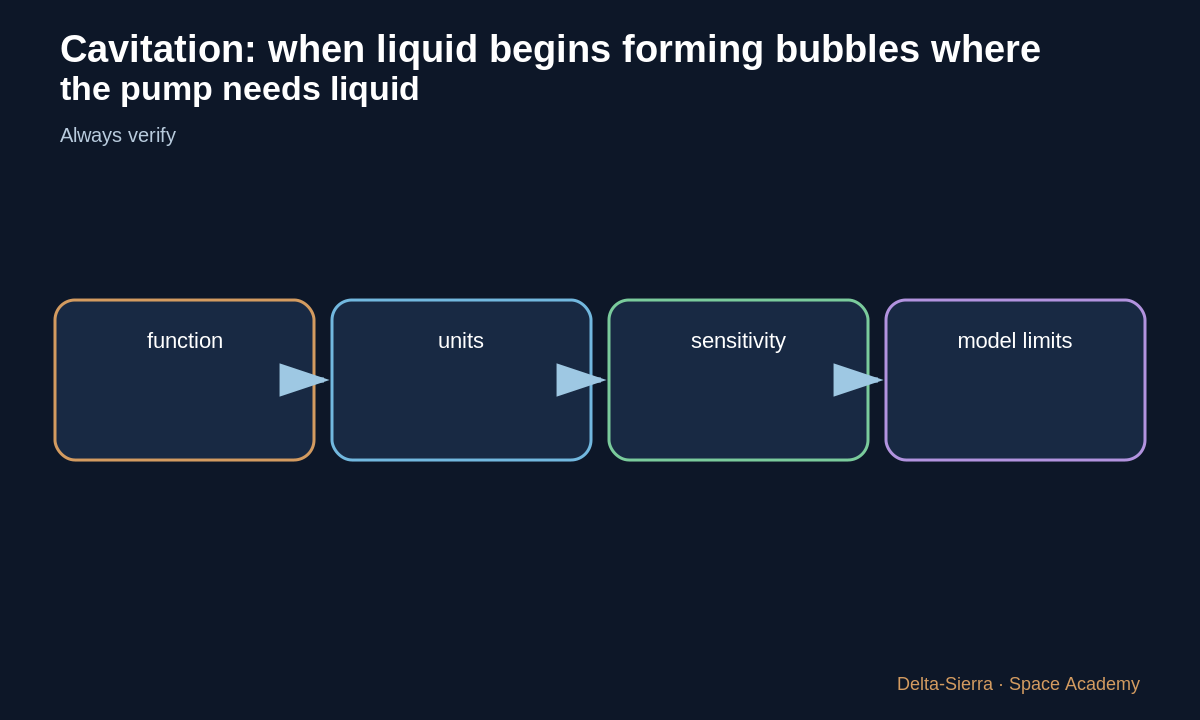
Function
Explain the function of each block without jargon.
Sensitivity
Halve one assumption and predict the consequence.
Limit
Name one reason the teaching model is insufficient for a real engine.