Course compass
Guiding question: How do you use a calculator without handing your reasoning over to it?
Markers: 📏 MEASURED · 📐 CONVENTION · 🧮 CALCULATED · 🎓 TEACHING ASSUMPTION · ⚠️ APPROXIMATION
- understand the concept
- do a simple calculation
- explain every symbol
- check a result
1 — A calculator obeys; it does not understand
It can evaluate 3.2 × 10^5 or sin(30°), but it does not know whether you chose the wrong unit, sign, or equation.
Scientific work begins before the equals key: define what is being asked and which quantities are known.
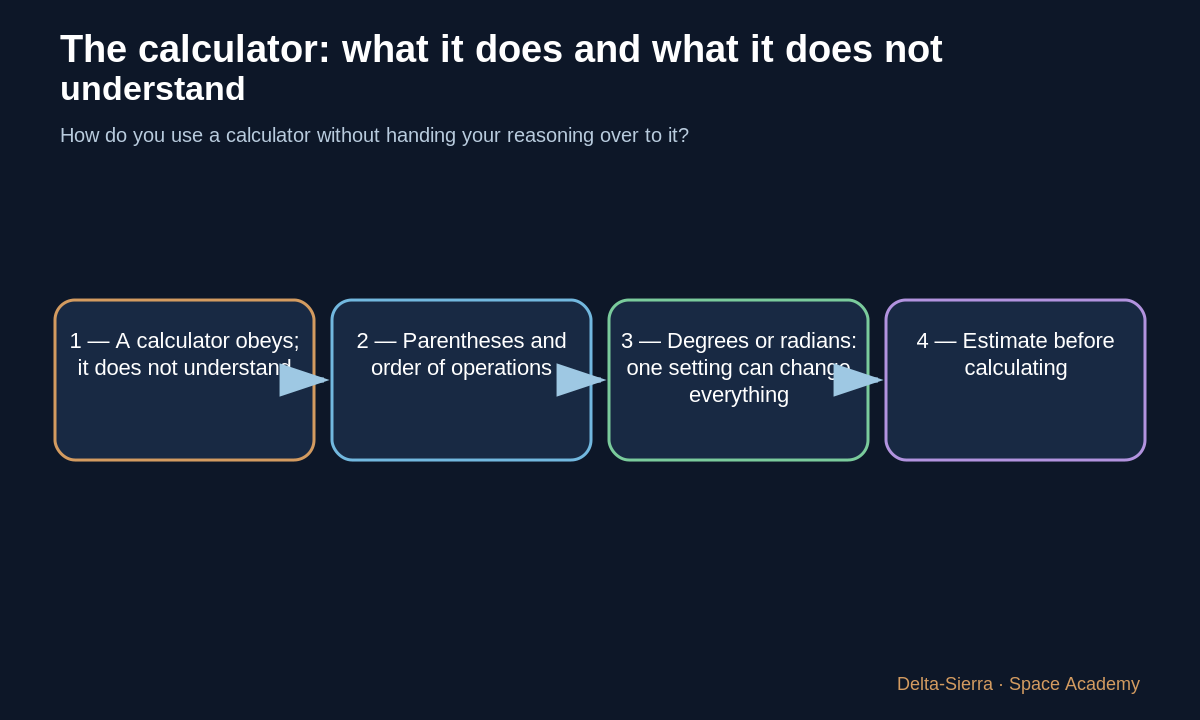
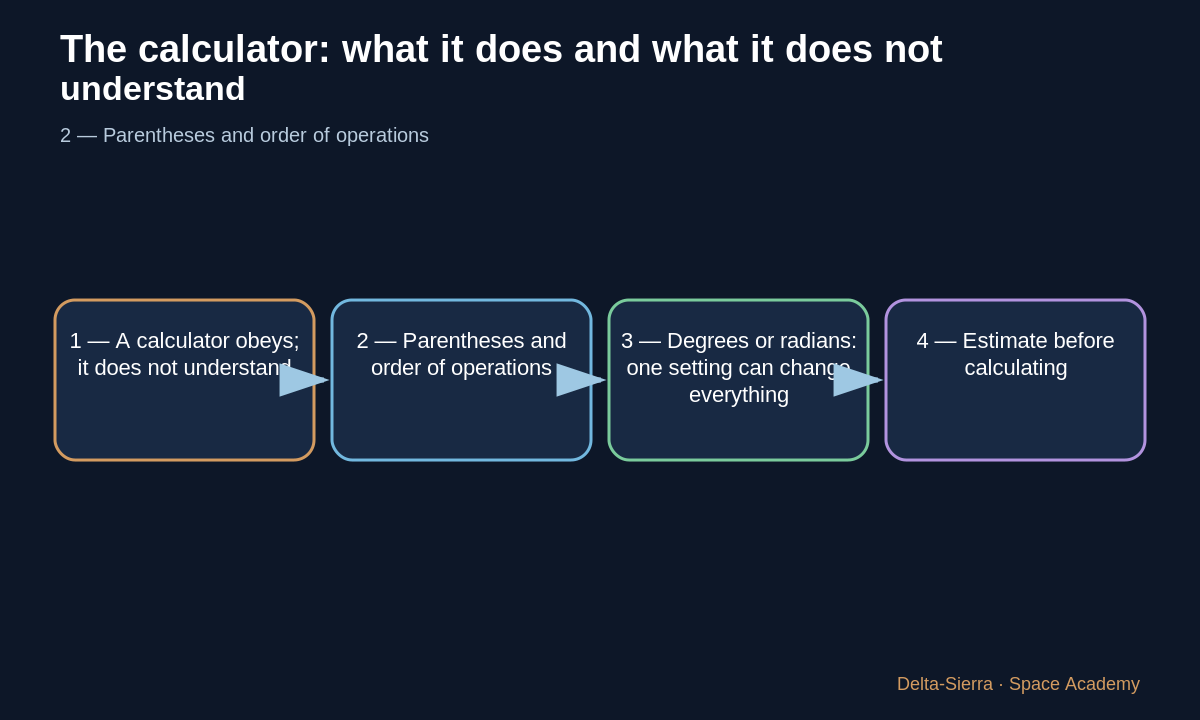
2 — Parentheses and order of operations
An expression such as 2,000,000 ÷ (330 × 9.81) changes if the denominator is entered incorrectly. Parentheses group operations.
The lesson also introduces powers of ten, roots, and scientific notation without turning the calculator into a black box.
3 — Degrees or radians: one setting can change everything
Trigonometric functions depend on angular units. sin(30°) is 0.5, while sin(30 radians) is a different question.
Before an angle calculation, check DEG or RAD and connect it to the problem’s unit.
4 — Estimate before calculating
If you expect “about 600” and the display shows 0.0006 or 600,000, do not copy it blindly; investigate.
Mental estimation need not be precise; it is a guardrail.
Three complete examples: change one assumption to understand
Before each calculation, identify where every number comes from and whether it is measured, conventional, assumed, or calculated.
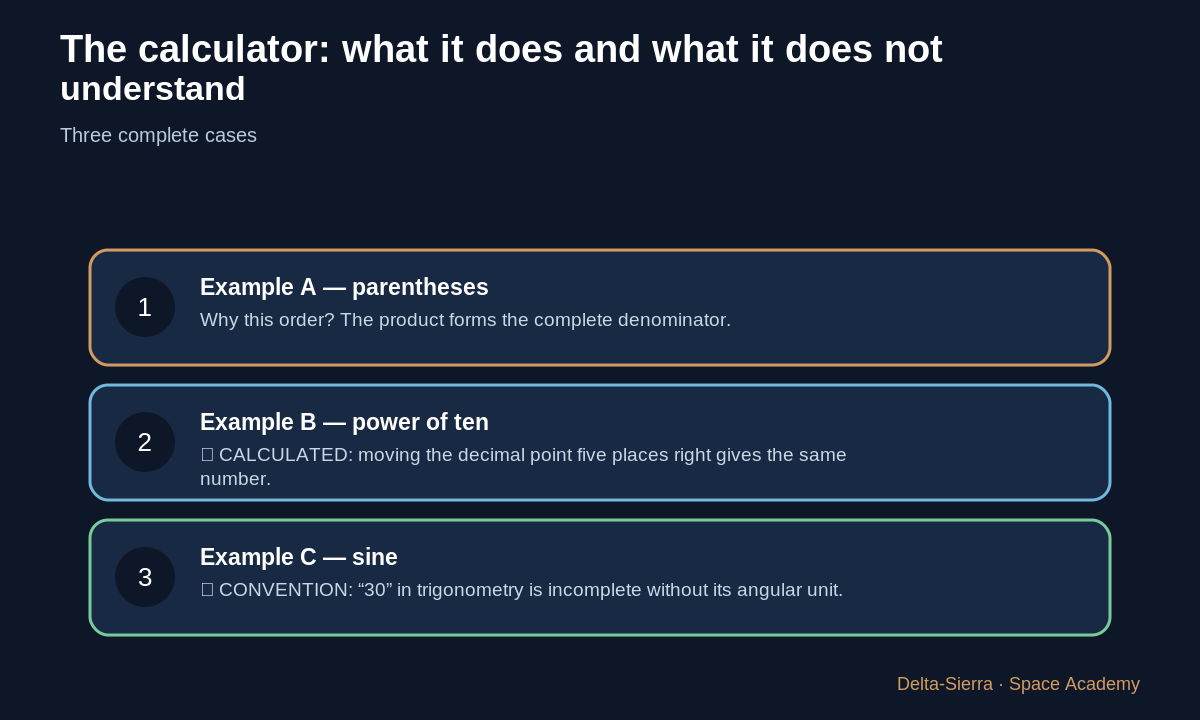
Example A — parentheses
330 × 9.81 = 3,237.3. Then 2,000,000 ÷ 3,237.3 ≈ 618.
Why this order? The product forms the complete denominator.
Example B — power of ten
3.2 × 10^5 = 320,000. The notation means ten multiplied by itself five times.
🧮 CALCULATED: moving the decimal point five places right gives the same number.
Example C — sine
In degree mode, sin(30°)=0.5. In a reference right triangle, the opposite/hypotenuse ratio is 0.5 for that angle.
📐 CONVENTION: “30” in trigonometry is incomplete without its angular unit.
Inverse calculation
If 618 = 2,000,000 ÷ D, then D = 2,000,000 ÷ 618 ≈ 3,236. The inverse calculation checks the denominator’s magnitude.
Common trap and result check
Trap: copying eight decimal places simply because the calculator shows them. Display precision cannot create information that the input data do not contain.
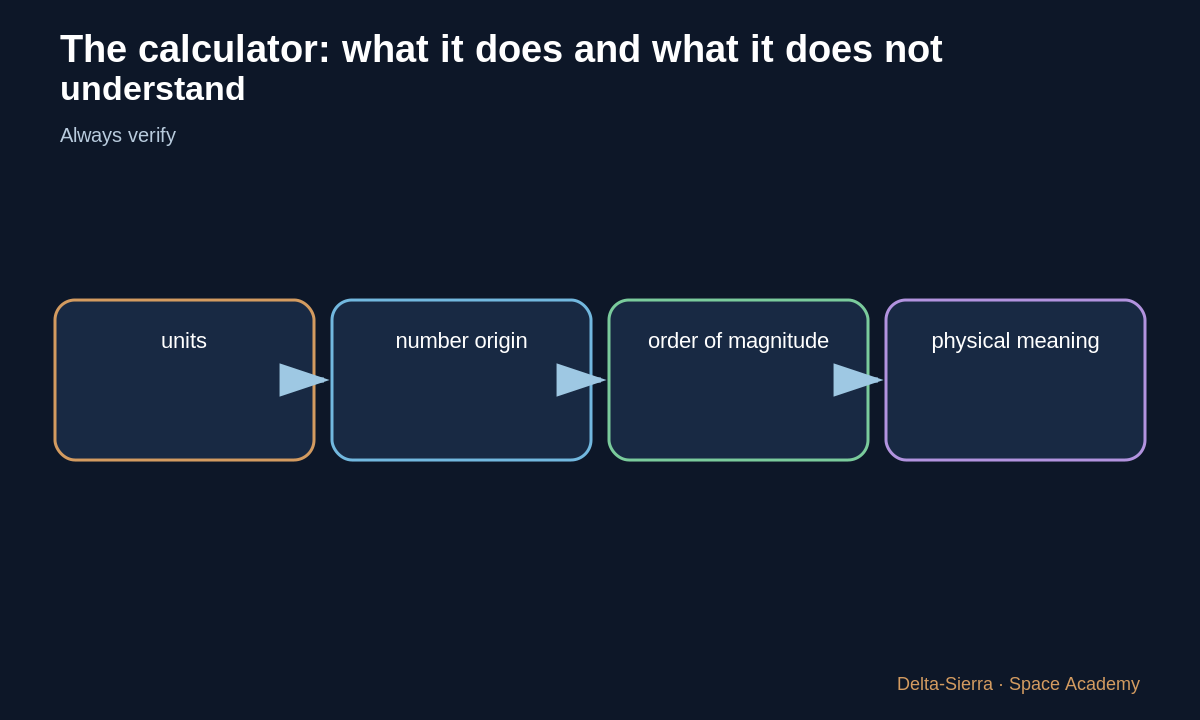
Always check units, order of magnitude, and physical meaning before accepting a result.
Exercises and answers
Understand
Explain the relationship in your own words.
Change an assumption
Modify one input and predict the direction of change before calculating.
Verify
Name two checks after a calculation.