Course compass
Guiding question: What does the letter H actually mean before discussing H₂O or methane?
Markers: 📏 MEASURED · 📐 CONVENTION · 🧮 CALCULATED · 🎓 TEACHING ASSUMPTION · ⚠️ APPROXIMATION
- read a chemical symbol
- define element
- distinguish nucleus and electron
- prepare for H₂O and O₂
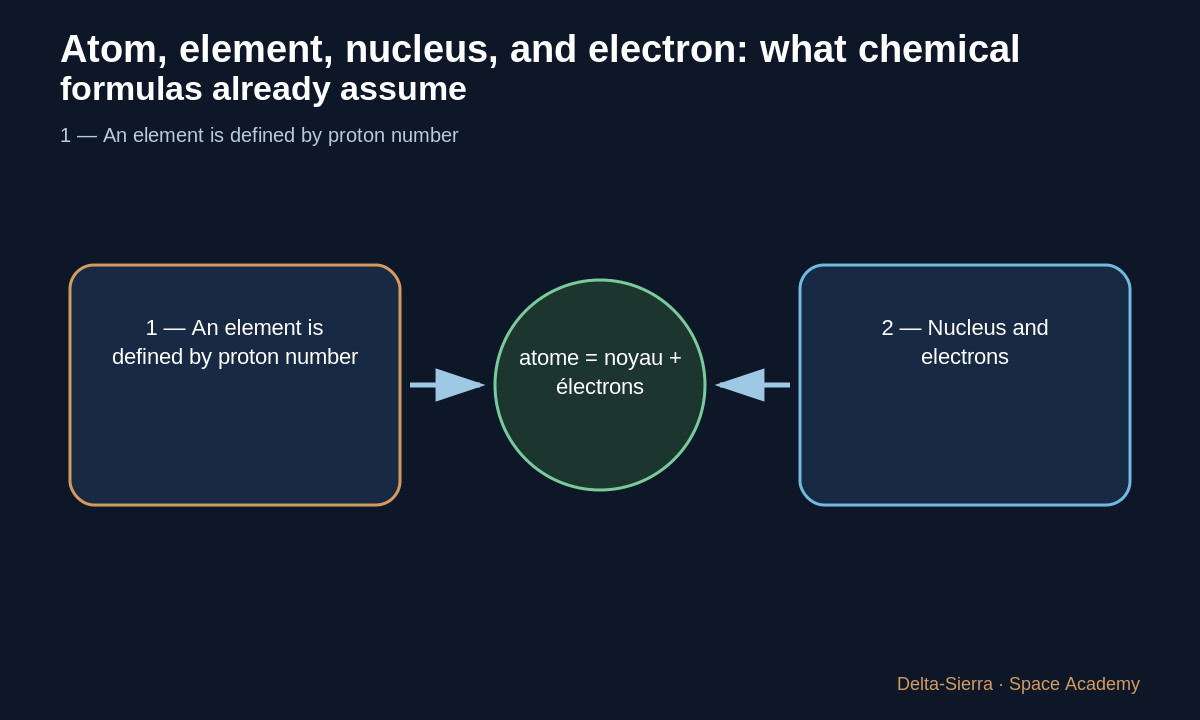
1 — An element is defined by proton number
Hydrogen, oxygen, and carbon are chemical elements. Each element corresponds to a specific number of protons in the nucleus.
H and O are standardized element symbols.
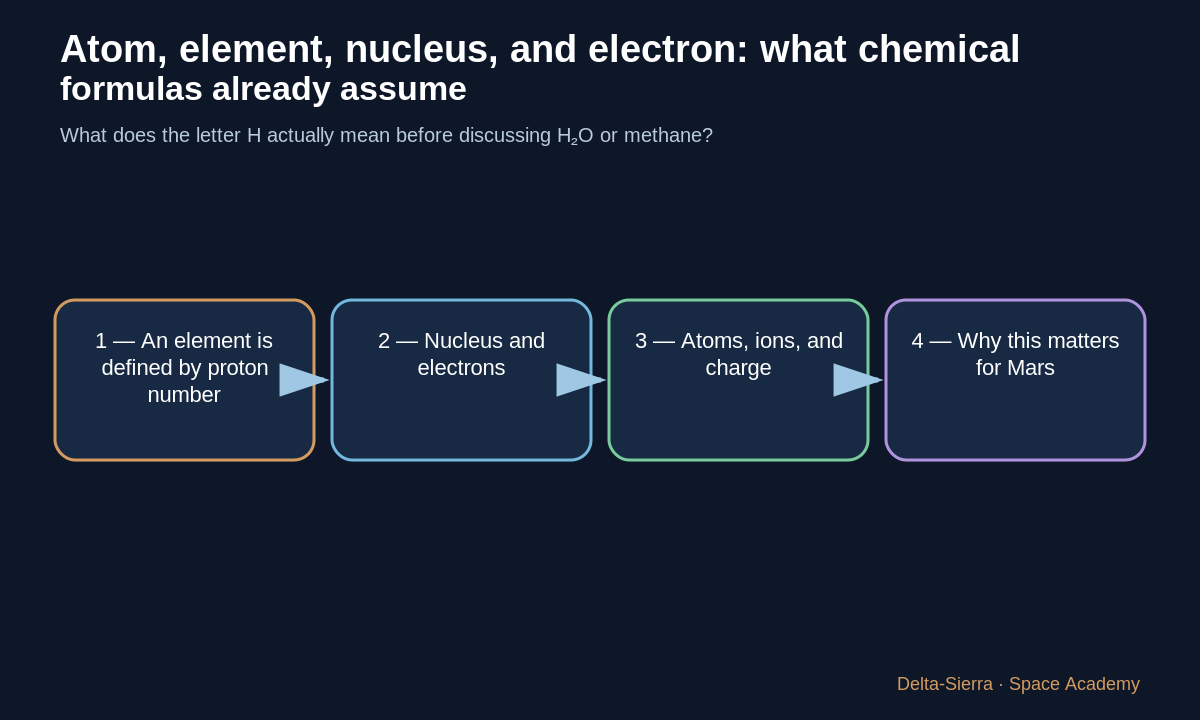
2 — Nucleus and electrons
The nucleus contains protons and neutrons; electrons occupy quantum states around it. Tiny planets on rigid tracks are only an old metaphor.
For this starting level, it is enough to know electrons strongly participate in chemical bonding.
3 — Atoms, ions, and charge
A neutral atom has equal numbers of protons and electrons. Gaining or losing electrons creates a charged ion.
This later matters for electrochemistry, sensors, and plasmas.
4 — Why this matters for Mars
Water, CO₂, O₂, H₂, and CH₄ use element symbols. Understanding them prevents Sabatier and electrolysis equations from becoming mysterious recipes.
Useful chemistry begins with the language of matter.
Three complete examples: change one assumption to understand
Before each calculation, identify where every number comes from and whether it is measured, conventional, assumed, or calculated.
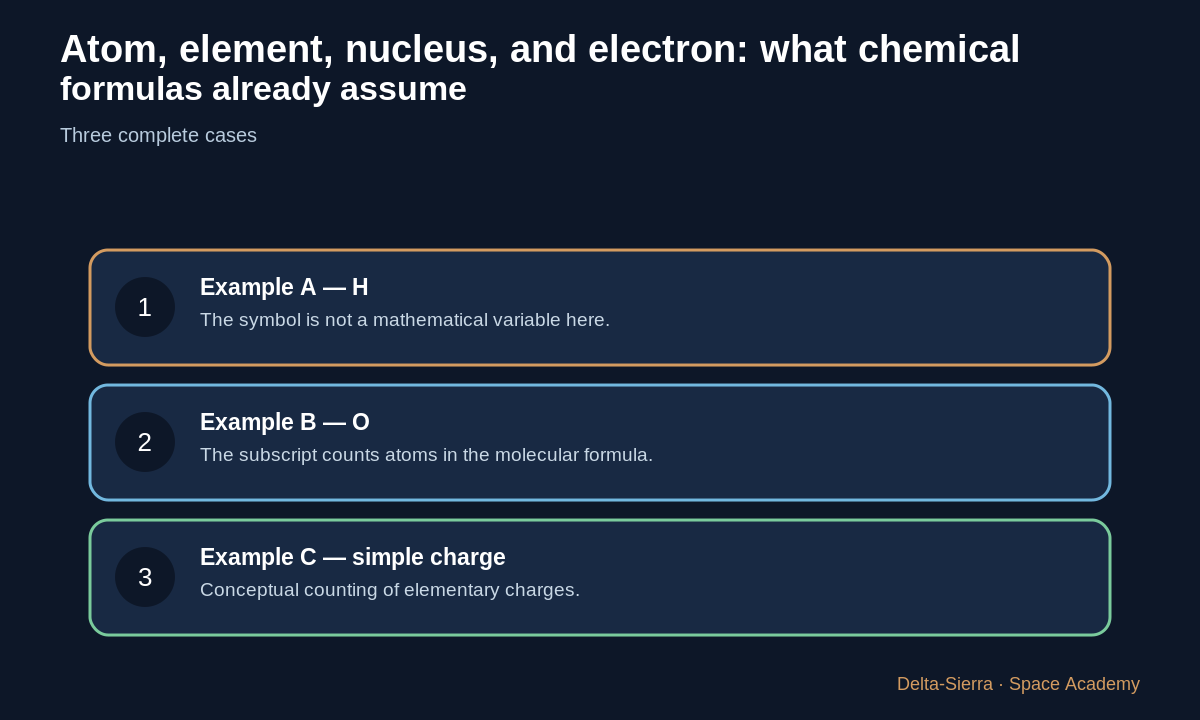
Example A — H
H denotes hydrogen, whose most common nucleus contains one proton.
The symbol is not a mathematical variable here.
Example B — O
O denotes oxygen. Two oxygen atoms in O₂ are indicated by subscript 2.
The subscript counts atoms in the molecular formula.
Example C — simple charge
A neutral atom with 8 protons has 8 electrons; if it gains one electron, net charge becomes −1.
Conceptual counting of elementary charges.
Inverse calculation
If an ion has charge +1 because one electron is missing, adding one electron conceptually restores net charge to 0.
Common trap and result check
Trap: treating the atom as an exact miniature solar system. The picture identifies components; it is not a faithful quantum-mechanical model.
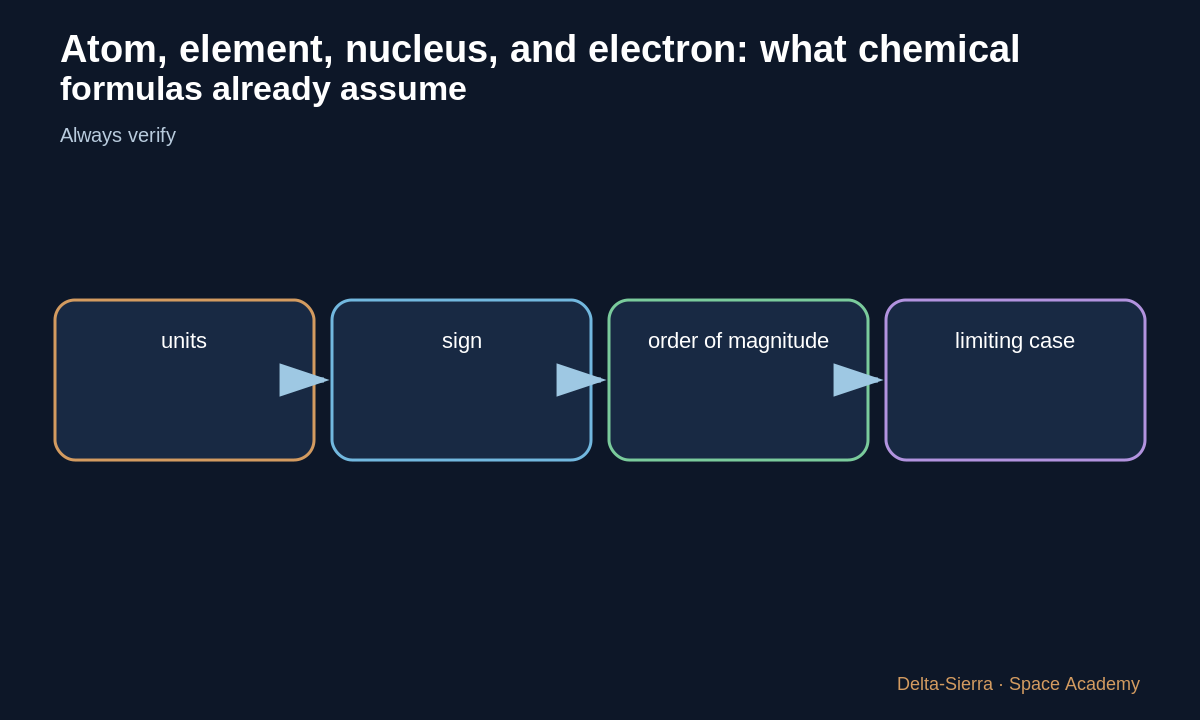
Check units, sign, order of magnitude, and consistency with a limiting case.
Exercises and answers
Restate
Explain in your own words what the equation connects.
Vary
Halve one input and predict the result before calculating.
Check
What independent check can you perform?