Lesson compass
AM-10.03 — Link budget: add gains and losses all the way to the receiver. The lesson starts with a concrete scene, defines every word and symbol, and only then introduces equations and mission decisions.
1 — Start from a concrete scene
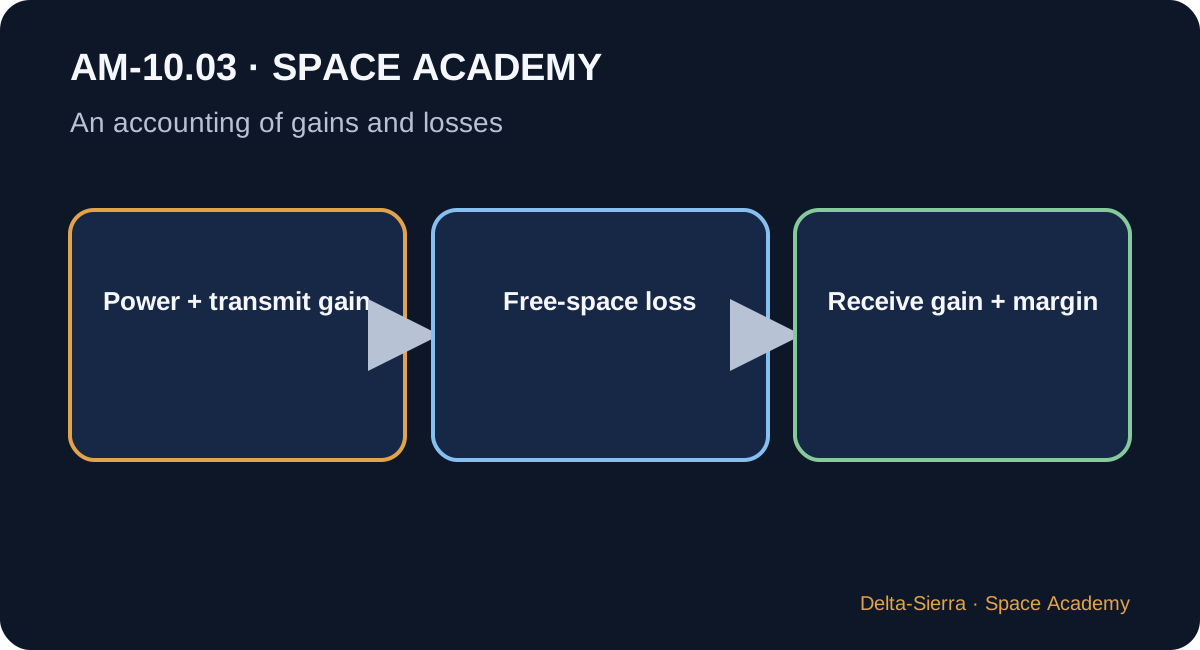
A Mars radio can transmit correctly yet deliver nothing useful to Earth if the signal arrives below receiver noise. A link budget is an energy accounting exercise: start with transmitted power, add gains, subtract losses, then check what remains at the receiver with margin.
Engineers use decibels because the ratios are enormous. Instead of multiplying and dividing numbers spanning many orders of magnitude, gains and losses become additions and subtractions.
2 — Essential vocabulary before going further
None of these words should remain mysterious. A short definition is better than unexplained jargon.
- Link budget
- Accounting of signal power from transmitter to receiver, including gains, losses, and margin.
- Decibel
- Logarithmic unit expressing a ratio. For power, dB = 10 log10 of the ratio.
- dBW
- Power in decibels relative to 1 watt.
- dBm
- Power in decibels relative to 1 milliwatt.
- Free-space path loss
- Reduction in power density mainly due to geometric spreading with distance.
- Link margin
- Difference between available performance and the required minimum.
3 — See the system before calculating
Convert watts to decibels
1 W = 0 dBW; 10 W = 10 dBW; 100 W = 20 dBW. The logarithmic scale turns factors of ten into 10 dB steps.
Add the path
A simplified form is received power = transmit power + transmit antenna gain + receive antenna gain − losses, with each term expressed in compatible logarithmic units.
Distance is expensive
In free space, doubling distance increases path loss by about 6 dB because energy density spreads over an area proportional to distance squared. Mars communications are therefore fundamentally different from local links.
4 — The formulas, only now
A formula is a compressed sentence. We unpack it before using it.
How to read it : “power in dBW equals ten times log base ten of power in watts divided by one watt.”
This expresses absolute power on a logarithmic scale referenced to 1 W.
How to read it : “free-space loss equals twenty times log base ten of four pi d divided by lambda.”
This ideal formula captures geometric spreading versus distance d and wavelength λ in consistent units. It does not include all real losses.
How to read it : “P r equals P t plus G t plus G r minus L total,” using compatible decibel units.
Once values are consistently expressed, the accounting becomes addition of gains and subtraction of losses.
5 — What the units tell us
Plain dB describes a ratio; dBW and dBm describe absolute power by reference. Antenna gains are often dBi. In a budget line, dBW power can be combined with gain/loss ratios in dB/dBi, but every column must be interpreted correctly.
6 — Three concrete demonstrations
Example 1 — Convert 20 W
Convert a teaching transmitter power.
P_dBW = 10 log10(20)
log10(20) ≈ 1.301
P ≈ 13.0 dBW
Example 2 — Simplified budget
Take Pt = 13 dBW, Gt = 20 dBi, Gr = 60 dBi, and total losses = 250 dB.
Pr = 13 + 20 + 60 − 250
Pr = −157 dBW
Example 3 — Double distance
Because Lfs contains 20 log10(d), double d.
ΔL = 20 log10(2)
log10(2) ≈ 0.301
ΔL ≈ 6.02 dB
7 — Deepening: what the summary hides
The budget does not end at received power
Decoding bits also depends on noise, bandwidth, symbol rate, coding, and signal-to-noise ratio. Later lessons should introduce C/N0, Eb/N0, and bit error rate.
Additional losses
Cables, connectors, polarization, pointing, Earth atmosphere, rain at some frequencies, ageing, and implementation margin can add to ideal path loss.
Why lower data rate helps
At the same received power, sending fewer bits per second generally allows more energy per bit and stronger coding redundancy, improving robustness.
Margin as insurance
A link calculated with only 0.1 dB margin may work on paper and fail as real parameters vary. Margin absorbs uncertainty, degradation, and manufacturing spread.
8 — Why this matters for Mars
Earth-Mars distance changes enormously over the planets' orbits; a link must be designed for unfavorable geometry, not just the day the planets are close.
The role of the DSN, large orbiter antennas, and relays becomes clear in the budget: gaining receive aperture, integration time, coding, or antenna gain may be more practical than dramatically increasing rover transmitter power.
9 — Common traps and bad intuitions
- Confusing dB, dBW, dBm, and dBi.
- Adding watts and decibels.
- Forgetting that path loss is a positive loss subtracted from the budget.
- Thinking received power alone predicts data rate without noise or coding.
- Using distance in km and wavelength in m without consistent conversion.
10 — Guided exercises and answers
Question : How many dBW is 100 W?
Question : Loss increases by 6 dB. About what power factor is that?
Question : Why can a large receive antenna compensate part of the distance penalty?
11 — What I should be able to explain at the end
- Distinguish dB, dBW, dBm, and dBi.
- Convert simple power to dBW.
- Build a Pt + gains − losses budget.
- Explain why doubling distance costs about 6 dB in free space.
- Define link margin and explain why it is needed.
12 — NASA / JPL sources for further study
Primary institutional sources used to check concepts and orders of magnitude.