Lesson compass
AM-08.09 — GNC: the complete loop that observes, decides and acts. The lesson starts with a concrete scene, defines every word and symbol, and only then introduces equations and mission decisions.
1 — Start from a concrete scene
A Mars lander descends toward the surface. It has a desired trajectory, but disturbances, model errors, and dispersions push it away. The system must repeatedly answer: where am I? where should I be? what correction should I command? did the actuators have the expected effect?
These questions correspond to GNC: Guidance, Navigation and Control. Navigation estimates the state; guidance constructs the desired path or command; control converts the error between actual and desired state into actuator commands.
2 — Essential vocabulary before going further
None of these words should remain mysterious. A short definition is better than unexplained jargon.
- Guidance
- Function determining where the vehicle should go or what attitude it should target.
- Navigation
- Function estimating where the vehicle is, how it moves, and how it is oriented.
- Control
- Function computing the action required to reduce error between command and estimated state.
- State
- Minimal set of variables needed by the model: position, velocity, attitude, angular rate, etc.
- Setpoint / command
- Desired value such as angle, velocity, trajectory, altitude, or other target.
- Feedback loop
- Architecture where the result of an action is measured again and fed back into the next command.
3 — See the system before calculating
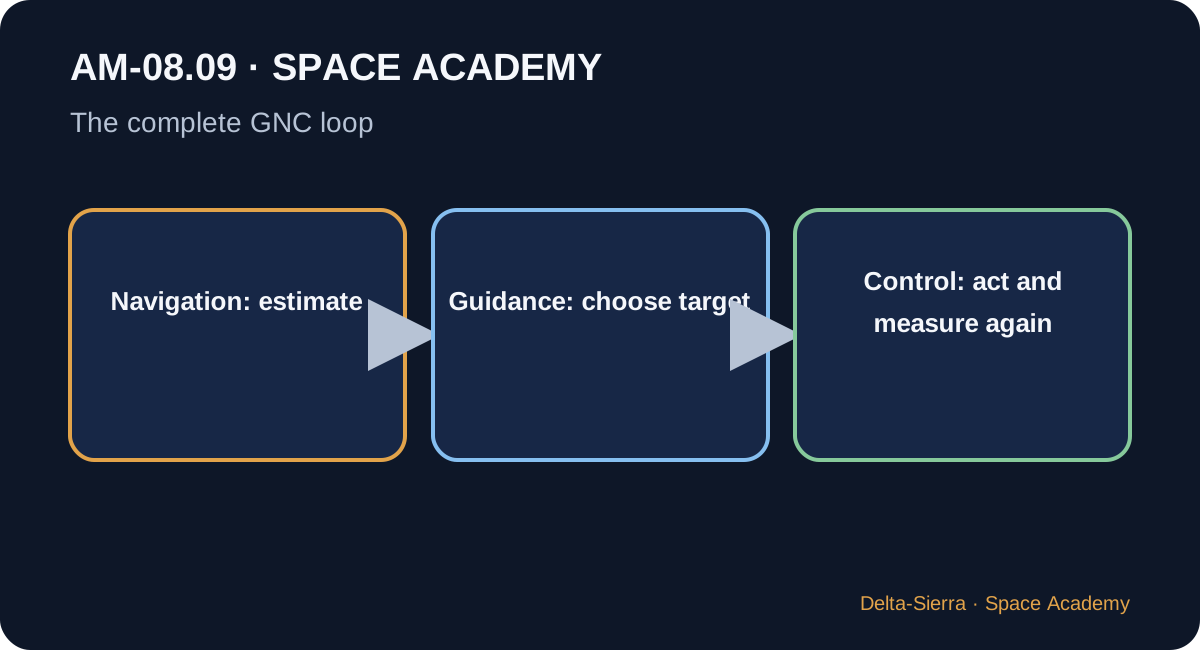
1. Measure and estimate
Radio tracking, IMU, stars, cameras, or altimeters produce observations. An estimator combines them into a consistent state with uncertainty.
2. Compare with mission need
Guidance supplies a desired trajectory or attitude. The system computes an error: for example 2° too far right or 15 m/s too fast.
3. Command then verify
The controller turns error into wheel, engine, aerodynamic, or thruster commands. The vehicle responds; new measurements arrive; the loop repeats. Stability depends on proper delays, gains, models, and limits.
4 — The formulas, only now
A formula is a compressed sentence. We unpack it before using it.
How to read it : “e equals command minus measurement.” e is the control error.
Subtract the estimated value from the target to determine correction direction and magnitude.
How to read it : “u equals K p times e.” u is a command and Kp a simple proportional gain.
In a basic proportional controller, twice the error gives twice the command. Real systems add limits, dynamics, and other terms.
5 — What the units tell us
A GNC loop can involve metres, m/s, degrees, rad/s, newtons, and newton-metres. Units must be consistent with the gain converting an error into a command. A control gain is therefore not always an arbitrary dimensionless number.
6 — Three concrete demonstrations
Example 1 — Proportional pointing
An antenna is 4° right of target. Convention: error is negative. Kp = 0.5 command unit per degree.
e = 0 − 4 = −4°
u = 0.5 × (−4)
u = −2 command units
Example 2 — Velocity guidance
Estimated vertical velocity is −65 m/s and command is −50 m/s.
e = −50 − (−65)
e = +15 m/s
Example 3 — Bad sensor
Two sensors agree while a third suddenly jumps from 2° to 80°.
plausibility check
isolate suspect measurement
continue in degraded mode if possible
7 — Deepening: what the summary hides
Stability
Too little gain can make correction slow; too much gain combined with delay and vehicle inertia can cause oscillation or instability. Tuning a loop is a dynamics problem.
Actuator saturation
The controller may request more than a motor, wheel, or valve can deliver. Software must know these limits and prevent impossible commands from corrupting estimation or integrators.
FDIR and degraded modes
Fault Detection, Isolation and Recovery means detecting a fault, identifying its likely source, and reconfiguring the system. A distant mission often must do this before Earth can respond.
Autonomous guidance
Guidance can be a fixed command or an algorithm continuously recomputing a trajectory, avoiding hazards, or selecting a landing target compatible with the actual state.
8 — Why this matters for Mars
Mars entry, descent, and landing compresses all GNC functions into minutes: rapid estimation, target guidance, attitude and velocity control, and fault detection.
A Mars base will also use GNC loops in drones, rovers, cranes, pressurized vehicles, and docking systems. Understanding the generic loop helps explain many different machines.
9 — Common traps and bad intuitions
- Using “guidance” as a synonym for all navigation.
- Connecting a sensor directly to an actuator with no estimation or checks.
- Ignoring loop delay.
- Choosing gain without considering units and dynamics.
- Assuming the loop stays stable when an actuator saturates or a sensor fails.
10 — Guided exercises and answers
Question : Command 10°, measurement 12°. What error e = command − measurement?
Question : With Kp = 0.4 command/°, what proportional command?
Question : Why should navigation and control remain conceptually distinct?
11 — What I should be able to explain at the end
- Clearly distinguish guidance, navigation, and control.
- Describe sensor → estimation → command → controller → actuator → vehicle → sensor feedback.
- Compute simple error and proportional command.
- Explain saturation, delay, and stability in ordinary language.
- Describe the role of FDIR in an autonomous mission.
12 — NASA / JPL sources for further study
Primary institutional sources used to check concepts and orders of magnitude.