Lesson compass
AM-08.04 — IMU, gyroscopes and accelerometers: sensing motion without GPS. The lesson starts with a concrete scene, defines every word and symbol, and only then introduces equations and mission decisions.
1 — Start from a concrete scene
A spacecraft crosses a region where no external beacon is available. It does not become blind: it carries internal sensors. A gyroscope measures rotation; an accelerometer measures specific acceleration associated with non-gravitational forces. Several such sensors are commonly packaged in an IMU.
The advantage of inertial sensing is autonomy and high update rate. Its weakness is equally important: small measurement errors are integrated over time. Without external updates, the estimate gradually drifts.
2 — Essential vocabulary before going further
None of these words should remain mysterious. A short definition is better than unexplained jargon.
- IMU
- Inertial Measurement Unit, usually combining multi-axis gyroscopes and accelerometers.
- Gyroscope
- A sensor measuring angular rate about an axis.
- Accelerometer
- A sensor measuring specific force: non-gravitational force per unit mass.
- Bias
- A small approximately constant offset in a measurement.
- Drift
- Error that grows over time when measurement errors are integrated.
- Integration
- Accumulation of a rate over time: acceleration to velocity, velocity to position.
3 — See the system before calculating
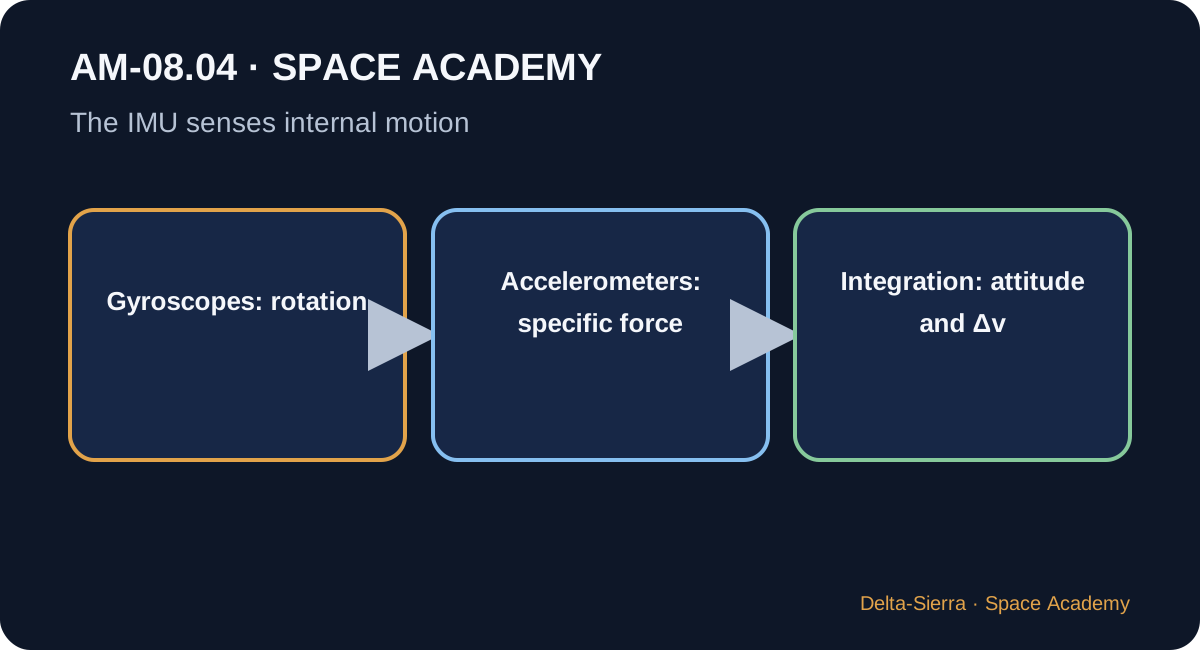
Three axes to describe space
An IMU commonly has three rotation axes and three acceleration axes. Their orientation relative to the vehicle must be known or the measurements cannot be interpreted correctly.
From angular rate to attitude
A gyro may report 2°/s about one axis. If the rate stays constant for 5 s, the angle changes by about 10°. Flight software repeats this reasoning at high frequency with changing measurements.
From acceleration to velocity
An accelerometer measures a rate of velocity change. Accumulating it over time estimates a velocity change. A second integration can estimate position change, but every integration magnifies bias effects.
4 — The formulas, only now
A formula is a compressed sentence. We unpack it before using it.
How to read it : “delta theta is approximately omega times delta t.” Omega is angular rate here.
Over a short interval with nearly constant angular rate, rate times duration gives angle change.
How to read it : “delta v is approximately a times delta t.”
For a short nearly constant acceleration interval, acceleration times duration gives the velocity change.
5 — What the units tell us
Gyros commonly use degrees per second or radians per second. Accelerometers use m/s², sometimes multiples of g. An acceleration bias may look tiny, but its position effect grows quickly after two integrations.
6 — Three concrete demonstrations
Example 1 — Simple rotation
The gyro reports 3°/s for 4 s about one axis.
Δθ ≈ 3 × 4
Δθ ≈ 12°
Example 2 — Measured burn
A thruster produces an average 0.5 m/s² acceleration for 20 s.
Δv ≈ 0.5 × 20
Δv ≈ 10 m/s
Example 3 — Small bias, large drift
Assume a simplified constant acceleration bias of 0.01 m/s² for 100 s with no external update.
velocity error ≈ 0.01 × 100 = 1 m/s
position error ≈ 1/2 × 0.01 × 100²
position error ≈ 50 m
7 — Deepening: what the summary hides
“Inertial” does not mean infallible
An IMU needs no external signal for its instantaneous readings. That makes it valuable during occultations or rapid manoeuvres, but it does not automatically know absolute position.
Calibration before and during flight
Bias, scale factor, axis misalignment, and temperature dependence are characterized. Flight software can estimate some errors when other sensors provide a reference.
Saturation and dynamics
Every sensor has a measurement range. Excessive rotation or acceleration can saturate it; a very wide range may reduce useful resolution for small changes.
Why sensors are fused
The IMU provides rapid continuity; star trackers, radio tracking, or vision provide slower absolute references. Fusion combines strengths rather than asking one sensor to do everything.
8 — Why this matters for Mars
An interplanetary burn, atmospheric descent, or docking manoeuvre cannot wait minutes for Earth. The IMU provides rapid information needed by control loops.
On Mars, rovers and aerial vehicles can combine inertial sensing, vision, and maps to keep navigating when Earth communications are slow or unavailable.
9 — Common traps and bad intuitions
- Thinking an accelerometer measures velocity directly.
- Thinking an IMU automatically provides absolute position.
- Ignoring bias: a small integrated error becomes large.
- Confusing specific force with gravity.
- Integrating measurements without expressing them in the correct frame.
10 — Guided exercises and answers
Question : A gyro reads 1.5°/s for 8 s. What simplified angle change?
Question : An acceleration of 0.2 m/s² lasts 15 s. What Δv?
Question : Why can a camera correct IMU drift?
11 — What I should be able to explain at the end
- Define IMU, gyroscope, accelerometer, bias, and drift.
- Convert angular rate to a simple angle change.
- Convert acceleration to a simple Δv.
- Explain why integration accumulates errors.
- Explain why IMUs are combined with external references.
12 — NASA / JPL sources for further study
Primary institutional sources used to check concepts and orders of magnitude.