Lesson compass
AM-10.07 — Modulation and error correction: how bits survive an imperfect signal. The lesson starts with a concrete scene, defines every word and symbol, and only then introduces equations and mission decisions.
1 — Start from a concrete scene
An antenna receives a very weak wave buried in noise, yet the computer must decide whether the transmitted sequence was 101101… The transmitter does not throw digits through space; it changes properties of a signal according to known rules. The receiver measures those changes and reconstructs symbols and bits.
Because some decisions will be wrong, systems add structured redundancy. Error-correcting codes let the receiver detect and sometimes correct corrupted bits. This costs some raw throughput but can avoid expensive retransmissions between Mars and Earth.
2 — Essential vocabulary before going further
None of these words should remain mysterious. A short definition is better than unexplained jargon.
- Carrier
- The base wave whose properties are varied to carry information.
- Modulation
- Rules for changing amplitude, phase, frequency, or another signal property to encode symbols.
- Symbol
- A transmitted state during an interval; one symbol can represent one or more bits depending on modulation.
- Bit
- Binary information unit, usually 0 or 1.
- BER
- Bit Error Rate: fraction of received bits that are wrong.
- Error-correcting code
- Mathematical redundancy that allows some transmission errors to be detected or corrected.
- Interleaving
- Temporary rearrangement of bits or symbols so burst errors are spread out.
3 — See the system before calculating
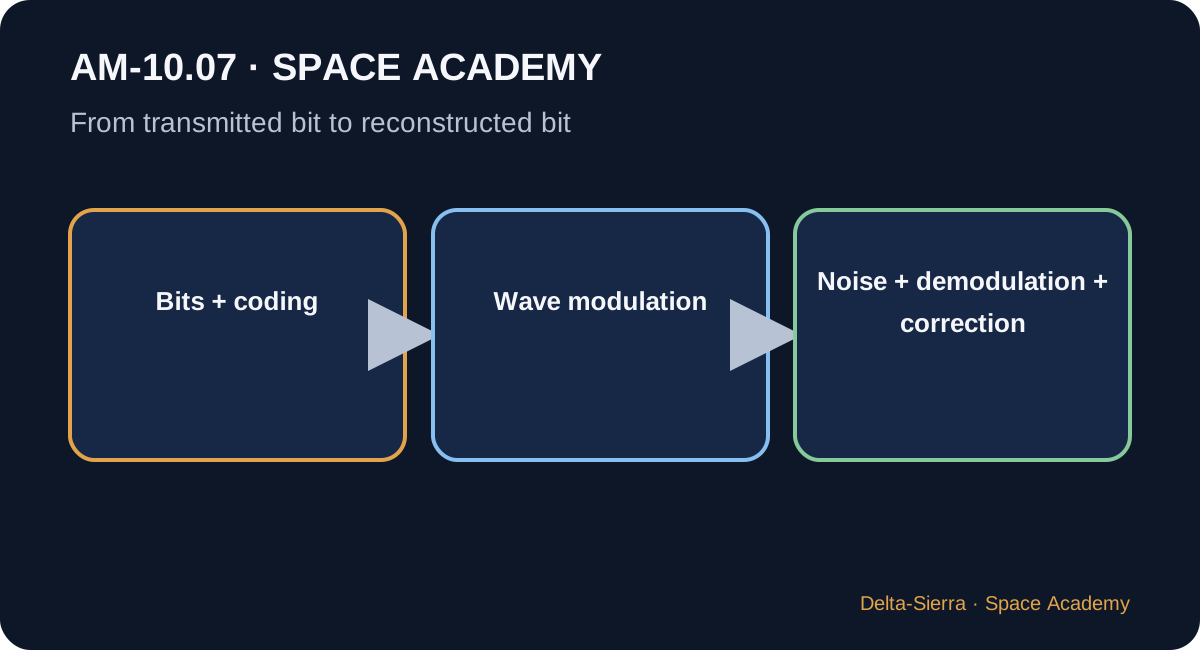
1 — Build symbols
The transmitter groups bits and maps each group to a signal state. In a simple modulation, two phases may represent 0 and 1; richer modulation can represent several bits per symbol.
2 — The channel adds noise and loss
Distance, electronics noise, interference and imperfections distort the signal. The receiver never gets a perfect copy of what left the transmitter.
3 — Decide, then verify
The demodulator selects the most likely symbol. The decoder then uses structured redundancy to identify implausible combinations and correct some errors.
4 — Adapt data rate
When the link worsens, reducing data rate or using stronger coding can improve correct reception. The “best rate” therefore depends on available margin.
4 — The formulas, only now
A formula is a compressed sentence. We unpack it before using it.
How to read it : “BER equals wrong bits divided by received bits.”
A rate is a fraction: compare the number of errors with the total number of observed bits.
How to read it : “useful data rate equals raw rate times code rate,” in a simple teaching model.
If some transmitted bits are coding redundancy, useful information rate is lower than raw channel rate.
5 — What the units tell us
Bit rate uses bit/s, kbit/s, Mbit/s, or Gbit/s. BER has no unit because it is a ratio. A code rate such as 1/2 means, in a simplified interpretation, that roughly half the transmitted bits represent useful information while the rest contribute protective redundancy.
6 — Three concrete demonstrations
Example 1 — Compute BER
Out of 1,000,000 received bits, 100 are wrong before correction.
BER = 100 ÷ 1,000,000
BER = 0.0001
BER = 10^-4
Example 2 — Code rate 1/2
The channel transmits 2 Mbit/s raw using a teaching code rate of 1/2.
useful rate ≈ 2 × 1/2
useful rate ≈ 1 Mbit/s
Example 3 — Why not retransmit everything
A 100 MB block takes a long time over a weak Earth-Mars link.
Without coding, an error may force retransmission.
With coding, some errors are corrected locally.
Propagation delay is not paid again for every small error.
7 — Deepening: what the summary hides
Richer modulation
Modulations carrying more bits per symbol can improve spectral efficiency but generally require better signal quality. Systems adapt complexity and data rate to margin.
Coding depth
Modern codes use sophisticated algorithms. The beginner need not start with matrices or graphs; the core idea is that redundancy is structured specifically so information can be recovered.
Burst errors
A disturbance may damage consecutive bits. Interleaving spreads them across several codewords so they become easier to correct.
Critical command
Life-critical commands can favor robustness and strict validation over throughput. A large science image and an emergency shutdown command do not have the same transmission requirements.
8 — Why this matters for Mars
A Mars network will change operating modes according to range, available antennas, optical-site weather and relay status. Understanding modulation and coding explains why data rate can change even when the transmitter is healthy.
This layer connects physical link budget with digital files: it explains how received signal power becomes reliable information.
9 — Common traps and bad intuitions
- Confusing symbol and bit.
- Thinking error correction can repair a link with no signal.
- Quoting BER without saying before or after decoding.
- Comparing data rates without distinguishing raw and useful rate.
- Assuming the most complex modulation is always best.
10 — Guided exercises and answers
Question : 10 wrong bits out of 100,000: BER?
Question : 4 Mbit/s raw with code rate 3/4: teaching useful rate?
Question : Why can lowering data rate help?
11 — What I should be able to explain at the end
- Explain how a wave carries bits.
- Distinguish bit and symbol.
- Compute a simple BER.
- Explain why error-correcting codes help.
- Distinguish raw and useful data rate.
12 — NASA / JPL sources for further study
Primary institutional sources used to check concepts and orders of magnitude.