Lesson compass
AM-10.02 — Antennas: gain, beamwidth and why a large dish must point accurately. The lesson starts with a concrete scene, defines every word and symbol, and only then introduces equations and mission decisions.
1 — Start from a concrete scene
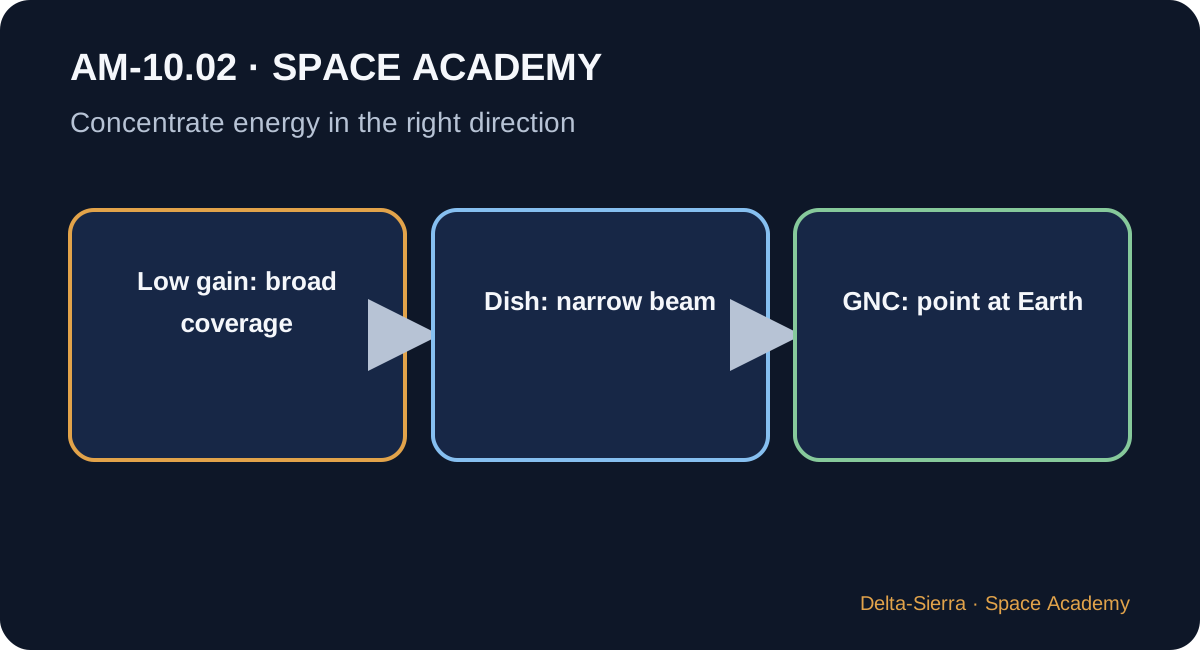
Early in a mission, a spacecraft may use a low-gain antenna because its orientation is not yet well known. The signal is weak but coverage is broad. Later, a high-gain dish concentrates energy into a narrow direction and receives weak signals better—provided it points correctly.
Antenna gain does not mean creating energy. The antenna redistributes available power by direction. More apparent power in the main beam comes at the cost of less elsewhere.
2 — Essential vocabulary before going further
None of these words should remain mysterious. A short definition is better than unexplained jargon.
- Antenna
- A device converting electrical signals into radiated waves, or vice versa in reception.
- Directivity
- Ability to concentrate radiation in selected directions.
- Gain
- Measure of directional antenna performance relative to a reference, often expressed in dBi.
- dBi
- Decibels relative to an ideal isotropic radiator.
- Beam
- Angular region where an antenna transmits or receives most effectively.
- Beamwidth
- Angle characterizing the main lobe width; a narrow beam generally requires more precise pointing.
3 — See the system before calculating
Low gain: pointing tolerance
A weakly directive antenna covers a large part of the sky. It is useful for backup or uncertain attitude but does not concentrate much energy toward Earth.
High gain: concentrated energy
A dish uses its aperture to form a narrow beam. At the same transmitter power, energy density in the useful direction rises, improving the link budget.
Diameter and wavelength
At a given frequency, larger aperture generally means narrower beam. At fixed diameter, shorter wavelength also allows a finer beam. Size, frequency, and pointing accuracy are therefore linked.
4 — The formulas, only now
A formula is a compressed sentence. We unpack it before using it.
How to read it : “theta is approximately seventy times lambda divided by D.” Here θ is an approximate beamwidth in degrees, λ wavelength, and D dish diameter.
This teaching approximation shows the trade: doubling D roughly halves angular width. Exact coefficient depends on beam definition and aperture illumination.
How to read it : “gain in decibels equals ten times log base ten of directional power ratio to the reference.”
The decibel compresses large ratios. Antenna dBi compares against an ideal isotropic source.
5 — What the units tell us
D and λ are both metres in the beamwidth approximation, so their ratio is dimensionless and the chosen coefficient yields degrees. Gain is often in dBi. A common error is adding dBi directly to linear watts without converting power to decibels.
6 — Three concrete demonstrations
Example 1 — Teaching beamwidth
Dish D = 3 m, λ = 0.036 m.
θ ≈ 70 × 0.036 ÷ 3
θ ≈ 0.84°
Example 2 — Large ground antenna
D = 34 m, same λ = 0.036 m.
θ ≈ 70 × 0.036 ÷ 34
θ ≈ 0.074°
Example 3 — Power ratio
One direction has 100 times the power density of the chosen reference.
gain = 10 log10(100)
log10(100) = 2
gain = 20 dB
7 — Deepening: what the summary hides
Gain in transmit and receive
The same directional antenna generally helps both directions: it concentrates transmitted power and efficiently collects waves arriving from the aimed direction.
Pointing and GNC
A high-gain antenna turns communication into an attitude-guidance-and-control problem. Link engineering and GNC cannot be designed independently.
Low-gain antenna as insurance
Missions often retain tolerant antennas that can recover basic communications after an attitude anomaly even though their data rate is low.
Frequency, aperture, and mechanics
Higher frequency can yield narrow beams from smaller antennas but tightens pointing, surface accuracy, electronics, and sometimes ground-atmosphere constraints.
8 — Why this matters for Mars
Earth-Mars communication operates with limited spacecraft power over enormous distances. Antenna gain is often a more efficient way to gain link margin than simply increasing transmitter power.
Mars relay orbiters have more power and more capable antennas than rovers, which helps explain their role as intermediaries for science data returning to Earth.
9 — Common traps and bad intuitions
- Saying antenna gain creates energy.
- Confusing gain with transmitter power.
- Ignoring pointing cost of a narrow beam.
- Adding dBi and watts without conversion.
- Treating θ ≈ 70λ/D as an exact universal law.
10 — Guided exercises and answers
Question : If D doubles at constant λ, what happens approximately to θ?
Question : Why is a low-gain antenna useful after an anomaly?
Question : A power ratio of 10 corresponds to how many dB?
11 — What I should be able to explain at the end
- Define directivity, gain, dBi, beam, and beamwidth.
- Explain why a dish does not create energy.
- Relate diameter, wavelength, and beamwidth qualitatively.
- Compute an approximate θ ≈ 70λ/D.
- Explain the gain-versus-pointing tradeoff.
12 — NASA / JPL sources for further study
Primary institutional sources used to check concepts and orders of magnitude.