Lesson compass
AM-10.06 — Optical communications: sending data with a laser through deep space. The lesson starts with a concrete scene, defines every word and symbol, and only then introduces equations and mission decisions.
1 — Start from a concrete scene
Imagine two lights. One illuminates an entire room; the other concentrates nearly all its energy into a narrow beam. Over enormous distance, concentrating energy is valuable, but it creates a new problem: if the beam misses the target by a tiny angle, the receiver may see nothing. Space laser communications exploit this tradeoff.
NASA demonstrated high-bandwidth deep-space optical communications with DSOC aboard Psyche. That does not make radio obsolete: acquisition, robust command, Earth weather, pointing, and degraded modes make the two technologies complementary.
2 — Essential vocabulary before going further
None of these words should remain mysterious. A short definition is better than unexplained jargon.
- Photon
- A quantum of light; here it can be thought of as an elementary packet of detected light energy.
- Laser
- A light source capable of producing a highly directional, coherent beam.
- Beam
- The region of space into which optical energy is concentrated.
- Acquisition
- The phase in which transmitter and receiver find one another and establish the link.
- Pointing
- Extremely precise orientation of the terminal toward its target.
- Optical ground station
- Ground telescope and equipment that transmit or receive the space laser.
- Photon counting
- Detection of extremely weak optical signals by counting photon events.
3 — See the system before calculating
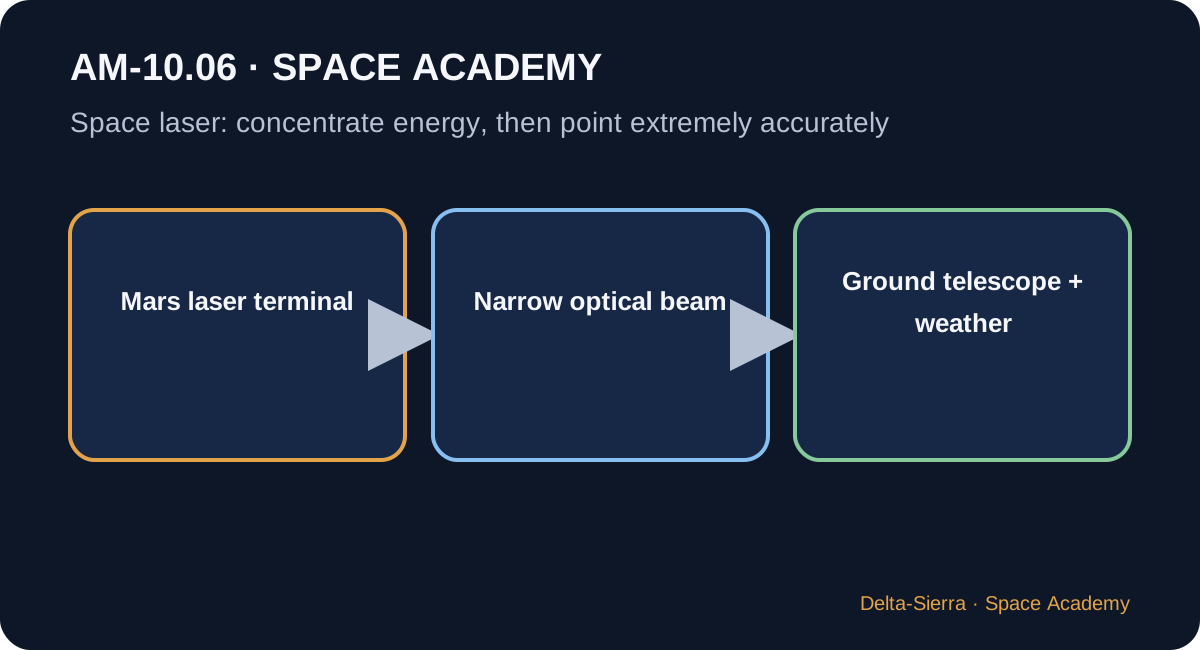
1 — Concentrate energy
A narrow optical beam sends more transmitted energy toward the target instead of spreading it over a wide angle, supporting very high potential data rate.
2 — Find the target
The tradeoff is precision. The terminal must know the distant station direction, compensate relative motion, and hold the beam despite vibration and attitude error.
3 — Detect very few photons
After millions of kilometres, the signal is extremely weak. Large telescopes, sensitive detectors, filtering and signal processing distinguish useful photons from noise.
4 — Deal with Earth atmosphere
Clouds can block optical downlinks to a ground station. Real architecture can use geographically diverse sites and retain radio links.
4 — The formulas, only now
A formula is a compressed sentence. We unpack it before using it.
How to read it : “theta is approximately lambda divided by D.” θ is a beam-angle order of magnitude, λ wavelength, and D aperture diameter.
This simplified relation shows why larger apertures and shorter wavelengths can produce narrower beams. Real terminals use detailed diffraction and optical models.
How to read it : “spot size is approximately angle times distance,” for a small angle in radians.
A tiny angle becomes a large spot over interplanetary distance; the same geometry means tiny pointing error can move the beam enormously at the target.
5 — What the units tell us
Optical wavelength is often expressed in nanometres or micrometres; pointing angles may use microradians; interplanetary range uses kilometres; data rate uses bit/s, Mbit/s, or Gbit/s. For spot ≈ θ×distance, angle must be in radians and distance units must remain consistent.
6 — Three concrete demonstrations
Example 1 — One microradian becomes huge
Take a teaching pointing error θ = 1 µrad over 100 million km.
1 µrad = 1 × 10^-6 rad
distance = 100,000,000 km
offset ≈ 1 × 10^-6 × 100,000,000 = 100 km
Example 2 — Reduce pointing error
If pointing error falls to 0.1 µrad over the same distance.
0.1 µrad = 1 × 10^-7 rad
offset ≈ 1 × 10^-7 × 100,000,000 km
offset ≈ 10 km
Example 3 — Why keep radio
An optical ground station is under thick cloud.
The laser cannot provide a useful path through opaque cloud.
Another optical site may be available elsewhere.
A radio link can preserve essential command and telemetry.
7 — Deepening: what the summary hides
DSOC as a technology demonstration
NASA/JPL’s DSOC experiment aboard Psyche demonstrated broadband optical communications in deep space and concluded after exceeding its technical goals. A technology demonstration does not mean every future Mars link will automatically be optical.
Acquisition before throughput
Before high-rate data transfer, terminals must find one another, establish geometry and lock tracking. Acquisition can use beacons, trajectory predictions and complementary radio channels.
Earth weather diversity
Mars may have clear sky while the intended Earth optical ground station is cloudy. Geographically separated optical sites reduce simultaneous weather outage risk.
Thermal and mechanical stability
A precise laser terminal must reject vibration and thermal deformation. GNC, structure and optical communications therefore become tightly coupled.
8 — Why this matters for Mars
A Mars city will generate far more data than a rover: medical imagery, 3D mapping, tele-science, industrial data, education, and backups. Optical links could become an important high-capacity layer.
Safety still requires fallback paths. Reference architecture should measure service availability and sustained capacity rather than treat a demonstration peak rate as a permanent guarantee.
9 — Common traps and bad intuitions
- Thinking a laser can be pointed approximately like a flashlight.
- Quoting high data rate without weather, acquisition, and availability.
- Claiming laser automatically replaces all radio.
- Confusing beam diameter with pointing error.
- Forgetting the Earth ground station is part of the system.
10 — Guided exercises and answers
Question : At 200 million km, what offset comes from 0.5 µrad?
Question : Why multiple optical ground stations?
Question : Why keep radio?
11 — What I should be able to explain at the end
- Explain the main benefit and main cost of a narrow laser beam.
- Compute a simple angle × distance offset.
- Distinguish radio and optical without falsely opposing them.
- Explain acquisition and pointing.
- Identify Earth weather as an availability constraint.
12 — NASA / JPL sources for further study
Primary institutional sources used to check concepts and orders of magnitude.