Lesson compass
AM-10.05 — Light time, latency and atomic clocks: why Mars can never be controlled in real time. The lesson starts with a concrete scene, defines every word and symbol, and only then introduces equations and mission decisions.
1 — Start from a concrete scene
An Earth operator sees a rover approaching a dangerous rock. Even if they click 'stop' immediately, the command must cross space; the rover receives it minutes later. Its confirmation then takes minutes to come back. This is not slow Internet: it is the finite speed of light.
The same limitation becomes a tool. Precisely measuring when a signal is sent and returned provides distance information from flight time. A stable clock is therefore both a synchronization device and an indirect geometry sensor.
2 — Essential vocabulary before going further
None of these words should remain mysterious. A short definition is better than unexplained jargon.
- Latency
- Delay between sending information and receiving it or observing its effect.
- One-way light time
- Time for a signal to cross the distance in one direction.
- Round trip
- Signal trip to the destination and a return response; often called RTT.
- Atomic clock
- Clock whose reference frequency is tied to an extremely stable atomic transition.
- Ranging
- Distance measurement using, among other methods, signal propagation time.
- Autonomy
- Ability to decide and act without waiting for distant human commands.
3 — See the system before calculating
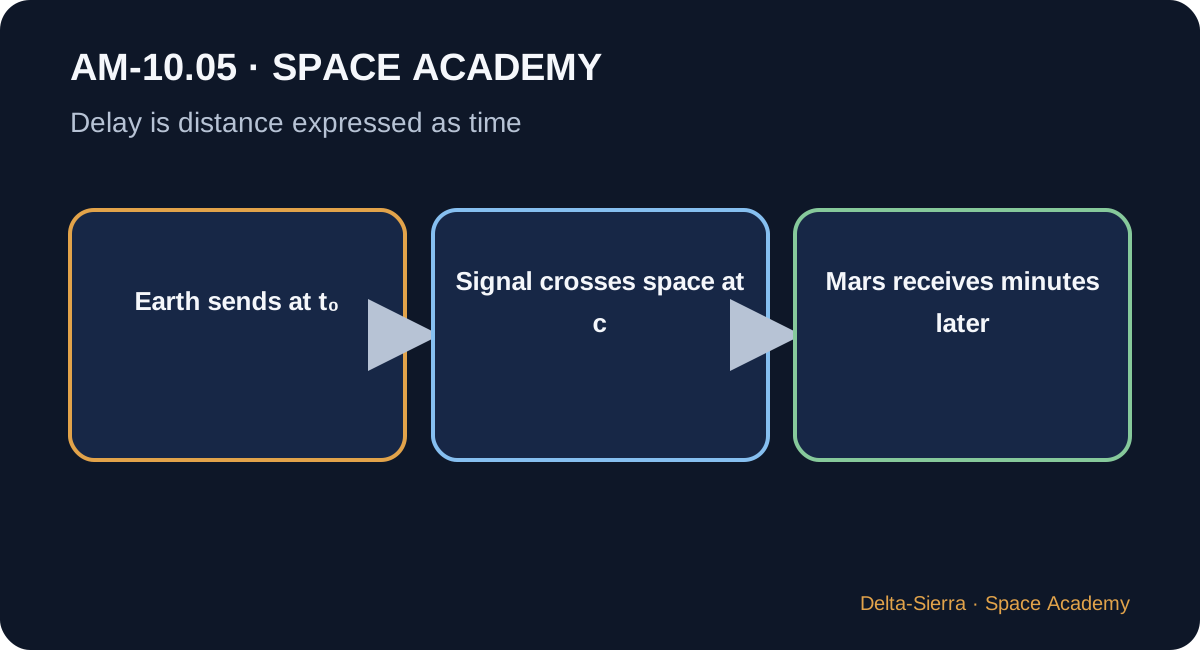
Geometry imposes delay
NASA’s 2026 Mars Relay Network page gives an Earth-Mars distance range of about 54.6 to 400.2 million km, corresponding to roughly 3 to 22.4 minutes one-way light time. Radio cannot abolish that distance.
Round trip: doubling is only the minimum
If one-way time is 20 min, a basic request-response cannot return in less than about 40 min, before processing, queueing, or protocol delay. Reflex teleoperation from Earth is impossible.
Measure distance with time
A station sends a time-tagged signal, the spacecraft retransmits or responds, and a stable clock measures elapsed time. After known delays are corrected, propagation time provides range information.
4 — The formulas, only now
A formula is a compressed sentence. We unpack it before using it.
How to read it : “t equals d divided by c.” t is propagation time, d distance, and c light speed.
Time equals distance divided by speed. For one-way free-space radio, c is the propagation speed.
How to read it : “d is approximately c times t,” for an isolated one-way propagation time.
The same relation supports ranging: distance is speed times propagation time once relevant delays are separated.
How to read it : “round-trip time is approximately two d divided by c.”
In a simplified symmetric model, the signal travels about twice the distance. Real geometry moves during the trip and is modeled more precisely.
5 — What the units tell us
Use distance units consistent with c. If c = 299,792 km/s, express d in kilometres to obtain seconds. Real navigation clocks and protocols use much finer timing precision, but teaching examples keep readable numbers.
6 — Three concrete demonstrations
Example 1 — Favorable distance
Take d = 54.6 million km.
t = 54,600,000 ÷ 299,792
t ≈ 182 s
182 s ≈ 3.0 min
Example 2 — Unfavorable distance
Take d = 400.2 million km.
t = 400,200,000 ÷ 299,792
t ≈ 1335 s
1335 s ≈ 22.3 min
Example 3 — Teaching range
An isolated one-way time is 600 s.
d ≈ 299,792 km/s × 600 s
d ≈ 179,875,200 km
7 — Deepening: what the summary hides
Why a clock is a sensor
If time error becomes range error through d = c×t, timing stability directly affects ranging quality. Clocks are not merely for displaying time.
Deep Space Atomic Clock
NASA demonstrated DSAC in Earth orbit from 2019 to 2021 to test a compact stable mercury-ion clock aimed at greater future deep-space navigation autonomy.
Operational autonomy
Delay forces Mars vehicles to detect obstacles, anomalies, and dangerous conditions locally. Earth provides objectives and plans but cannot close fast control loops.
Network time and science time
Instruments, cameras, IMUs, radios, and computers also need a coherent timeline. Good architecture separates mission time, measurement timestamps, and propagation time.
8 — Why this matters for Mars
Mars settlement cannot copy an Earth mission-control model that decides every action. Local crews and software will need real operational authority.
Interplanetary communication must be designed as asynchronous exchange: messages, packets, delayed synchronization, caches, pre-approved procedures, and systems able to continue through outages.
9 — Common traps and bad intuitions
- Treating delay as an Internet ping that can be optimized to zero.
- Confusing one-way and round-trip time.
- Using c in m/s with distance in km.
- Thinking an atomic clock directly gives position without signals and geometry.
- Designing a safety loop that always waits for Earth approval.
10 — Guided exercises and answers
Question : At 150 million km, approximate one-way light time?
Question : If one-way time is 12 min, what is the minimum physical round trip?
Question : Why can DSAC support autonomy?
11 — What I should be able to explain at the end
- Compute simple light time with t = d/c.
- Distinguish one-way and round-trip time.
- Explain why Mars latency is physical, not merely computational.
- Explain how propagation time can measure distance.
- Relate precise clocks to navigation autonomy.
12 — NASA / JPL sources for further study
Primary institutional sources used to check concepts and orders of magnitude.