Lesson compass
AM-10.04 — Mars relay network: UHF to the orbiter, X-band to Earth. The lesson starts with a concrete scene, defines every word and symbol, and only then introduces equations and mission decisions.
1 — Start from a concrete scene
A rover has limited power, a relatively small antenna, and spends roughly half each Martian day without direct line of sight to Earth because Mars rotates. An orbiter periodically passes only hundreds or thousands of kilometres away. It is much easier to send data quickly to that orbiter and let the orbiter use larger power and antenna capability for Earth transmission.
NASA describes the Mars Relay Network as international infrastructure. In 2026, after NASA declared MAVEN ended on June 3, the NASA Science page lists four spacecraft in the relay network. The membership changes as missions age, so a durable architecture must plan replacement and redundancy.
2 — Essential vocabulary before going further
None of these words should remain mysterious. A short definition is better than unexplained jargon.
- Relay
- Equipment that receives data and retransmits it to another destination.
- UHF
- Ultra High Frequency, used for short-range rover-to-orbiter links around Mars.
- X-band
- Microwave band commonly used for deep-space communication.
- Direct-to-Earth
- Link where a surface vehicle communicates directly with Earth without an orbital relay.
- Relay pass / session
- Time window when rover and orbiter have line of sight and schedule a data exchange.
- DSN
- NASA Deep Space Network of large ground antennas communicating with distant missions.
3 — See the system before calculating
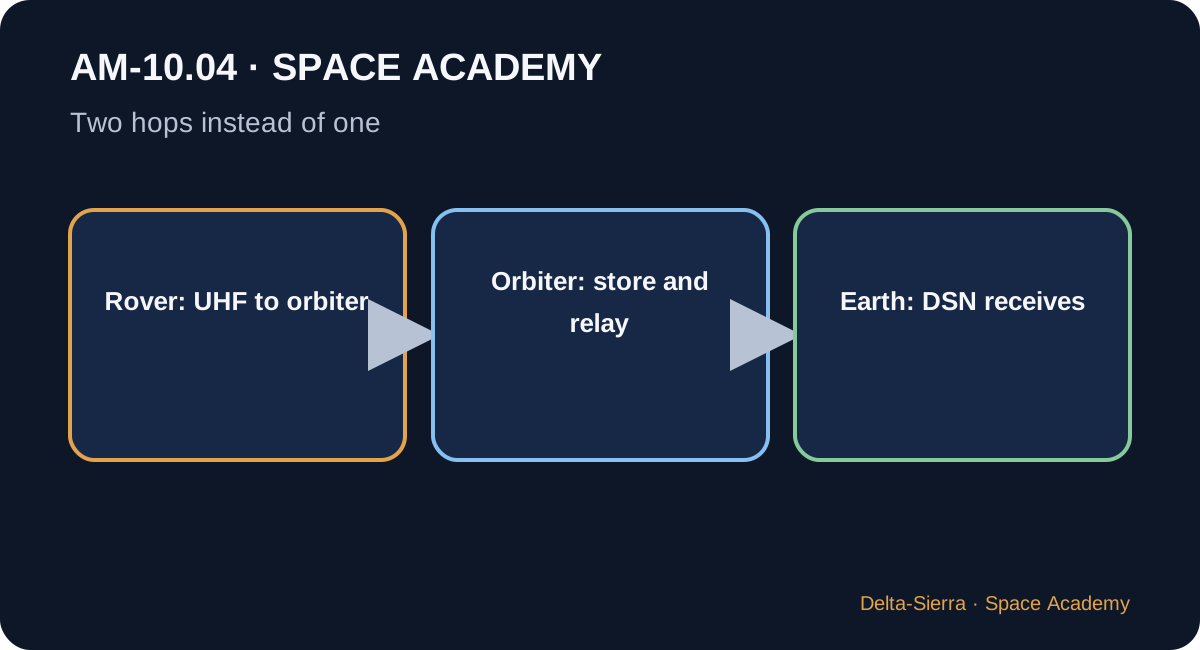
1. Rover to orbiter
Perseverance carries UHF around 400 MHz for orbiter links. NASA states rover-orbiter rates can reach about 2 Mbit/s under suitable conditions, far above the rover’s direct-to-Earth science-data capability.
2. Orbiter stores and forwards
The orbiter receives packets during a pass, stores them, then uses its deep-space link and favorable geometry to send them toward Earth.
3. Earth receives through large networks
Ground antennas including the DSN track the orbiters. The relay architecture separates the short local Mars surface-orbit link from the very long interplanetary link.
4 — The formulas, only now
A formula is a compressed sentence. We unpack it before using it.
How to read it : “data volume equals data rate times duration.”
A relay pass is not just an instantaneous rate; transferred volume also depends on how long the link is usable.
How to read it : “time equals volume divided by rate.”
To estimate how long it takes to empty stored data, divide data amount by useful throughput.
5 — What the units tell us
Data rate uses bit/s, kbit/s, or Mbit/s. Data volume uses bits or bytes; one byte equals eight bits. Convert both quantities into compatible units before calculating.
6 — Three concrete demonstrations
Example 1 — Ten-minute pass
Take an ideal teaching rate of 2 Mbit/s for 10 min.
10 min = 600 s
volume = 2 Mbit/s × 600 s
volume = 1200 Mbit ≈ 150 MB
Example 2 — Empty stored data
A rover has 600 Mbit to send at a useful 1.5 Mbit/s.
time = 600 ÷ 1.5
time = 400 s
400 s ≈ 6 min 40 s
Example 3 — Slow direct Earth link
If a teaching direct link provides only 1 kbit/s for an 80 Mbit file:
time = 80,000 kbit ÷ 1 kbit/s
time = 80,000 s
≈ 22.2 h
7 — Deepening: what the summary hides
The network changes over time
Orbiters age and can disappear. The loss of MAVEN reminds us that settlement infrastructure cannot treat relays as immortal; replacements must be launched before old assets fail.
Multiple partners
NASA and ESA already cooperate around Mars. A settlement architecture could extend this sharing while managing priorities, standards, and communication sovereignty.
Store to decouple
Store-and-forward lets a rover produce data without a permanent interplanetary link. The orbiter becomes a flying queue.
Relay and safety
Critical commands should not depend on a single relay. Serious architectures combine alternate paths, degraded direct Earth, multiple orbiters, and local autonomy.
8 — Why this matters for Mars
The Mars Relay Network already demonstrates the value of shared infrastructure: surface missions return more science because orbiters carry much of their data to Earth.
A Mars city would need far more than science return: maintenance, delayed telemedicine, software updates, archives, data synchronization, and fleet coordination require much larger and redundant relay capacity.
9 — Common traps and bad intuitions
- Confusing rover-orbiter UHF rate with end-to-end rate to Earth.
- Assuming an orbiter is always visible from the rover.
- Confusing Mbit/s with MB/s.
- Assuming today’s relay network would be enough for a human settlement.
- Designing a system with no direct-Earth or backup path.
10 — Guided exercises and answers
Question : At 1 Mbit/s for 5 min, how many ideal Mbit?
Question : Why can an orbiter reach Earth better than a rover?
Question : Why do four orbiters not imply perfect continuous coverage?
11 — What I should be able to explain at the end
- Describe rover UHF → orbiter → Earth chain.
- Explain why relay increases returned data volume.
- Convert Mbit/s, seconds, and data volume in simple examples.
- Distinguish direct-to-Earth from relay.
- Explain why settlement infrastructure must be redundant and renewed.
12 — NASA / JPL sources for further study
Primary institutional sources used to check concepts and orders of magnitude.