Lesson compass
AM-08.03 — Reference frames and time: state where and when before computing a trajectory. The lesson starts with a concrete scene, defines every word and symbol, and only then introduces equations and mission decisions.
1 — Start from a concrete scene
Imagine a Mars lander whose computer receives the statement 'velocity = 300 m/s'. The number looks precise, but the essential information is missing: 300 m/s relative to what? The Martian ground, the center of Mars, the Sun? And at what time? Numerical components change with the chosen frame even though the physical spacecraft is the same.
Navigation is therefore a discipline of context. Before adding vectors, software must know the origin, axes, orientation, and time attached to each datum. A frame error can be more dangerous than an arithmetic error because a calculation may be perfectly executed on incompatible data.
2 — Essential vocabulary before going further
None of these words should remain mysterious. A short definition is better than unexplained jargon.
- Reference frame
- A system defining an origin and axes so coordinates can be assigned.
- Origin
- The point assigned zero coordinates.
- Axis
- An oriented reference direction, such as x, y, or z.
- Inertial frame
- A frame chosen so the laws of motion are as simple as practical for the problem; it is not rotating with the spacecraft.
- Body frame
- A frame fixed to the vehicle; its axes rotate with it.
- Epoch / reference time
- The date and time at which a position, velocity, or attitude is valid.
- Light time
- The time an electromagnetic signal needs to cross a distance.
3 — See the system before calculating
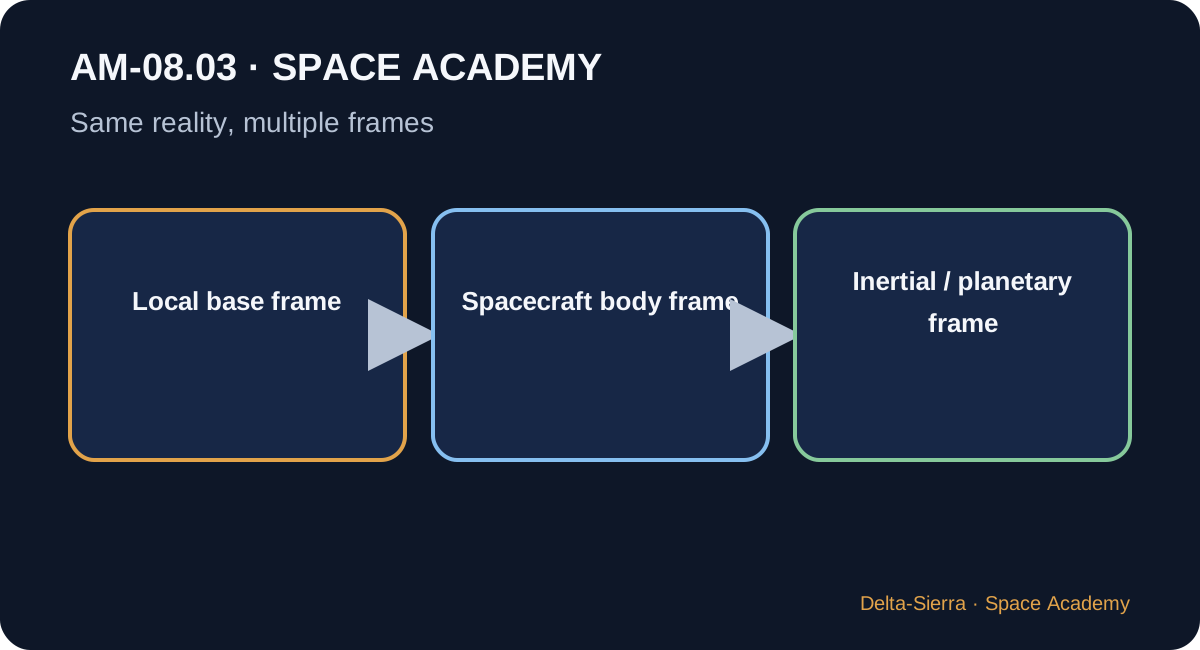
One point, several numbers
An antenna on Mars can have local coordinates relative to a base, planet-centered coordinates relative to Mars, and a heliocentric position relative to the Sun. These are not three antennas; they are three descriptions of the same object.
Time travels with geometry
Planets, orbiters, and vehicles move. A position valid at 12:00 may be wrong minutes later. Navigation data therefore carry a timestamp or epoch. The time is not decoration; it is part of the datum.
Transforming is not inventing
Changing frame means applying a known mathematical transformation: shift the origin, rotate the axes, and sometimes account for frame motion. The goal is not to change reality but to express the same reality in a compatible language.
4 — The formulas, only now
A formula is a compressed sentence. We unpack it before using it.
How to read it : “r in B equals the rotation matrix from A to B times r in A, plus the translation from A to B.” It means: rotate the axes, then shift the origin.
This general form expresses the same point in another frame. The beginner does not yet need to compute a full rotation matrix; the priority is understanding what it represents.
How to read it : “delta t equals t two minus t one.” The Greek letter delta means a difference here.
We subtract the start time from the end time to obtain a duration. An absolute date and a duration are not the same quantity.
5 — What the units tell us
Position coordinates may be in metres or kilometres, velocities in metres per second or kilometres per second, angles in degrees or radians, and time as seconds, minutes, or encoded dates. The main danger is not the choice itself but silently mixing incompatible units or time scales.
6 — Three concrete demonstrations
Example 1 — Local map
A rover is 120 m east and 50 m north of the habitat. In the local frame, the habitat is the origin.
x = +120 m
y = +50 m
distance = √(120² + 50²) = 130 m
Example 2 — Changing origin
An antenna is at x = 500 m in a frame whose origin is site A. Site B is at x = 300 m in that same frame.
x_antenna/B = 500 − 300
x_antenna/B = 200 m
Example 3 — Time-tagged data
A position estimate was computed at 12:00:00 and the vehicle moves at 20 m/s for 5 s in a straight-line example.
Δt = 5 s
Δx ≈ v × Δt
Δx ≈ 20 × 5 = 100 m
7 — Deepening: what the summary hides
Planetary or local frame?
A planet-centered frame is useful for global mapping; a local frame is more intuitive for rover driving or base construction. Real systems continually transform between them.
Why engineers care about epoch
A trajectory is a function of time. Giving six position-and-velocity numbers without a time is like handing over a photograph without saying when it was taken.
A rotating planet
A point fixed on Mars is stationary in a surface-fixed frame but rotates in a Mars-centered inertial frame. Both descriptions are correct in their own context.
Light time complicates the word “now”
When a ground station receives a measurement, it often describes the spacecraft at the time the signal was emitted, not at reception. Navigation therefore reconstructs time-tagged past events.
8 — Why this matters for Mars
A Mars mission connects solar, planetary, orbital, spacecraft-body, instrument, and landing-site frames. Frame compatibility is a safety requirement.
Future autonomy on Mars will require precise local maps, common frames shared by rovers and habitats, and sufficiently consistent clocks to fuse measurements from different systems.
9 — Common traps and bad intuitions
- Confusing altitude with distance from the planet centre.
- Adding vectors expressed in different frames.
- Forgetting that the body frame rotates with the spacecraft.
- Using an old position as if it described the current state.
- Confusing absolute date, elapsed duration, and signal propagation time.
10 — Guided exercises and answers
Question : Why is “x = 10 km” incomplete?
Question : Position changes from 200 m to 260 m between 10 s and 13 s. What is the average change rate?
Question : Why must a camera and an IMU share coherent time?
11 — What I should be able to explain at the end
- Define origin, axis, body frame, and inertial frame.
- Explain why position must carry both a frame and a time.
- Distinguish real motion from a coordinate change caused by changing frame.
- Compute a simple Δt and translation.
- Explain why light time requires precise measurement timestamps.
12 — NASA / JPL sources for further study
Primary institutional sources used to check concepts and orders of magnitude.