Lesson compass
AM-08.08 — Reaction wheels, thrusters and saturation: turning a spacecraft without translating its centre. The lesson starts with a concrete scene, defines every word and symbol, and only then introduces equations and mission decisions.
1 — Start from a concrete scene
In vacuum, a satellite cannot push on air, yet it must point a camera or antenna. One solution is to accelerate an internal wheel: when the wheel gains angular momentum one way, the spacecraft counter-rotates the other way. No external thrust is required for this internal exchange.
A wheel cannot accelerate forever. External disturbances make it accumulate momentum. Near its speed limit it becomes saturated. An external torque—thrusters or, near Earth, sometimes magnetic torquers—must then unload the stored momentum.
2 — Essential vocabulary before going further
None of these words should remain mysterious. A short definition is better than unexplained jargon.
- Reaction wheel
- An internal motor-driven flywheel used to exchange angular momentum with the spacecraft.
- Torque
- A rotational action; SI unit: newton-metre.
- Angular momentum
- A quantity describing rotational motion stored in a system.
- Saturation
- State where a wheel approaches its speed or momentum-storage limit and cannot absorb more effectively.
- Momentum unloading / desaturation
- Use of external torque to reduce momentum stored in reaction wheels.
- Attitude-control thruster
- A small thruster providing external torque and, depending on geometry, translational force.
3 — See the system before calculating
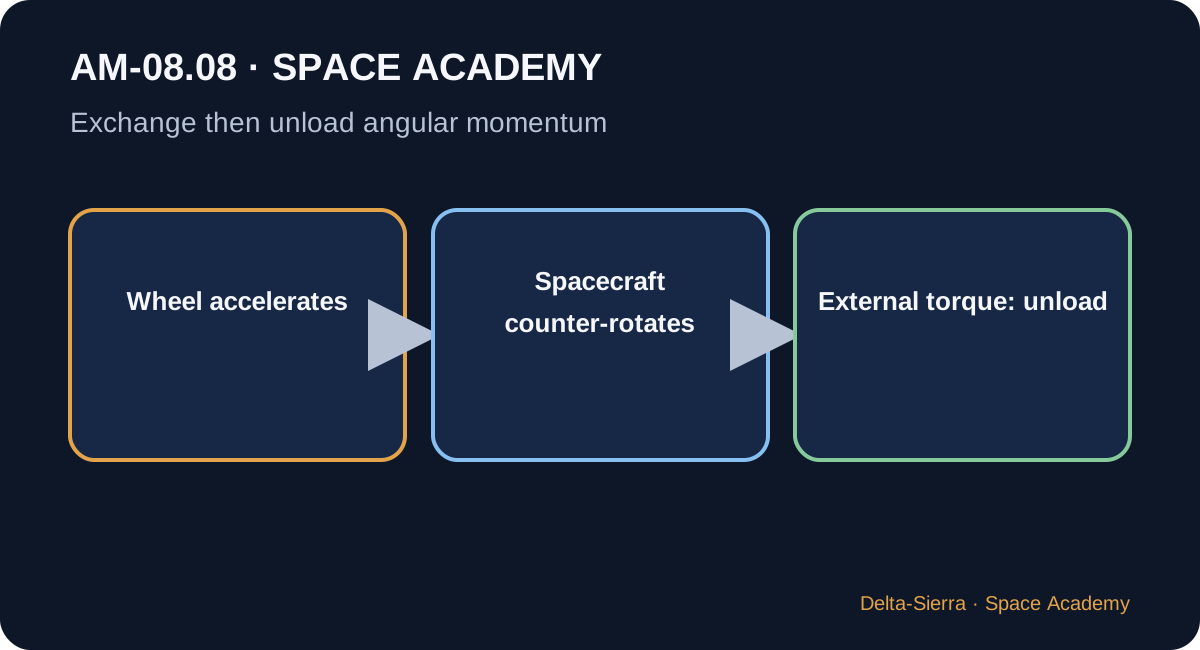
Internal action, opposite reaction
An electric motor accelerates the wheel. Torque on the wheel is accompanied by opposite torque on the spacecraft body. Total wheel-plus-spacecraft angular momentum follows external torques.
Three axes, often four wheels
Three independent wheels can control three axes. Many systems use a fourth skewed wheel to retain degraded capability after a wheel failure.
Unload with the outside world
A saturated wheel cannot simply “empty” without consequence. The system applies external torque. Thrusters work far from Earth; magnetic torquers depend on a sufficiently strong external magnetic field and are not a universal interplanetary solution.
4 — The formulas, only now
A formula is a compressed sentence. We unpack it before using it.
How to read it : “tau equals delta H divided by delta t.” Tau is torque; H is angular momentum.
Torque is the rate of angular-momentum change. Producing the same ΔH faster requires more torque.
How to read it : “wheel angular momentum plus spacecraft angular momentum is approximately constant,” when external torques are negligible.
This conservation principle explains why accelerating the wheel turns the spacecraft the opposite way.
5 — What the units tell us
Torque is measured in N·m. Reaction-wheel angular momentum is commonly given in N·m·s. Wheel speed may be reported in rpm, while control software uses consistent models of inertia, torque, and stored momentum.
6 — Three concrete demonstrations
Example 1 — Average torque
A wheel changes angular momentum by 0.02 N·m·s in 2 s.
τ = 0.02 ÷ 2
τ = 0.01 N·m
Example 2 — Same ΔH, faster
The same 0.02 N·m·s change must occur in 0.5 s.
τ = 0.02 ÷ 0.5
τ = 0.04 N·m
Example 3 — Saturation
A persistent solar disturbance nudges the spacecraft the same way and the wheel compensates day after day.
external disturbance → accumulated momentum
wheel speed rises
limit reached → unload
7 — Deepening: what the summary hides
Microvibration
Real wheels are never perfectly balanced. Their vibration can disturb sensitive cameras or instruments, so placement, balancing, and isolation matter.
Four-wheel fault tolerance
Four wheels mounted on non-coplanar axes can often reconstruct three-dimensional torque after one wheel fails, at reduced performance.
Thrusters: torque and force
Opposing thrusters can form an almost pure torque pair. Imperfect geometry or centre-of-mass knowledge can still create unwanted translation.
Why magnetic torquers are not enough for Mars
They create torque by interacting with an ambient magnetic field. Their effectiveness depends on environment; NASA notes that use beyond low Earth orbit and interplanetary contexts requires careful investigation.
8 — Why this matters for Mars
Precise pointing of high-gain antennas and instruments during a Mars mission requires attitude control for months or years. Momentum management is routine maintenance, not an exceptional detail.
A crewed vehicle or heavy cargo may combine wheels, control-moment gyros, or thrusters depending on size and requirements. The architecture must account for failures, consumables, and disturbances.
9 — Common traps and bad intuitions
- Saying a reaction wheel “pushes on vacuum”.
- Confusing a reaction wheel with a gyro sensor.
- Thinking the wheel can accelerate forever.
- Forgetting that thrusters consume propellant.
- Assuming magnetic torquers work everywhere as they do near Earth.
10 — Guided exercises and answers
Question : ΔH = 0.03 N·m·s in 3 s. Average torque?
Question : Why is a saturated wheel a problem?
Question : Why can a thruster unload a wheel?
11 — What I should be able to explain at the end
- Explain reaction wheels using angular-momentum conservation.
- Distinguish torque and angular momentum by units.
- Compute τ = ΔH/Δt in a simple case.
- Define saturation and momentum unloading.
- Explain why thrusters and magnetic torquers have different operating domains.
12 — NASA / JPL sources for further study
Primary institutional sources used to check concepts and orders of magnitude.