Lesson compass
AM-08.05 — Star trackers and sensor fusion: finding attitude from the stars. The lesson starts with a concrete scene, defines every word and symbol, and only then introduces equations and mission decisions.
1 — Start from a concrete scene
A spacecraft shuts down its engines and coasts. Its IMU knows how it has rotated over the last few seconds, but a small drift accumulates. A specialized camera images several stars. Software compares their pattern with an onboard catalog and recovers the sensor's absolute attitude: that is the job of a star tracker.
A robust system does not choose between IMU and stars. It combines them: the IMU predicts attitude rapidly between images, while the star tracker periodically corrects drift. This predict-then-correct idea lies at the heart of many navigation estimators.
2 — Essential vocabulary before going further
None of these words should remain mysterious. A short definition is better than unexplained jargon.
- Star tracker
- A specialized camera and processor that identify stars and provide three-axis attitude.
- Star catalog
- Onboard database containing known directions of reference stars.
- Attitude
- The spacecraft orientation in space, not its position.
- Field of view
- The portion of sky visible to the sensor.
- Sensor fusion
- Consistent combination of measurements with different strengths and weaknesses.
- Kalman filter
- A family of methods that predict a state, compare the prediction with a measurement, then correct the estimate according to uncertainties.
3 — See the system before calculating
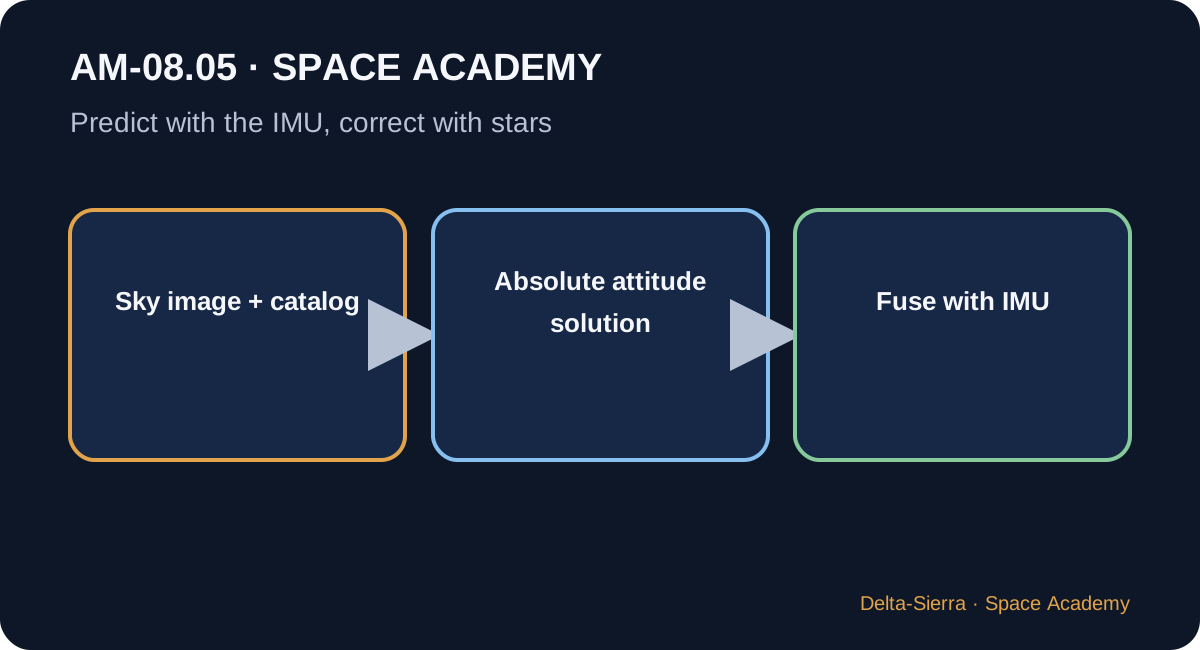
Image a pattern, not a name
The star tracker detects bright points, measures their relative image positions, and searches for a configuration compatible with its catalog. Once several stars are identified, geometry yields sensor attitude.
Lost in space
A capable tracker may have to recover attitude without a reliable initial guess. This “lost in space” acquisition requires enough visible stars and algorithms able to recognize the pattern.
Predict then correct
Between star solutions, the IMU propagates attitude. When a new star image arrives, the estimator compares prediction and observation, then adjusts attitude and often gyro biases.
4 — The formulas, only now
A formula is a compressed sentence. We unpack it before using it.
How to read it : “innovation equals measurement minus prediction.” Innovation here means the residual between observation and expectation.
The difference tells the estimator in which direction the predicted state should be corrected. The actual correction also accounts for uncertainties.
How to read it : “corrected state equals predicted state plus K times innovation.” K is an estimator correction gain.
A reliable measurement receives more weight; an uncertain one receives less. This is a conceptual form, not a full Kalman derivation.
5 — What the units tell us
Attitude can be represented by angles, matrices, or quaternions. Star-tracker accuracy is often expressed in arcseconds: one arcsecond is 1/3600 degree. The key idea is scale: a few arcseconds is a very small angular error.
6 — Three concrete demonstrations
Example 1 — One arcsecond
Convert 18 arcseconds to degrees.
18 ÷ 3600 = 0.005°
Example 2 — Correcting drift
The IMU predicts 20.4° while the star solution gives 20.0°. For a teaching weight K = 0.75:
innovation = 20.0 − 20.4 = −0.4°
correction = 0.75 × (−0.4) = −0.3°
corrected state = 20.4 − 0.3 = 20.1°
Example 3 — Temporary loss
The star tracker is blinded for 8 s while the IMU keeps providing angular rates.
star tracker: no solution
IMU: propagate attitude
stars return: update estimate
7 — Deepening: what the summary hides
Stray light and the Sun
A star tracker can be disturbed by the Sun, a bright planet, reflections, or thruster plumes. Mounting geometry and exclusion zones are studied before flight.
Update rate is finite
The camera exposes, reads out, and computes a solution. The IMU produces data much faster, which is why the two complement each other.
A filter does not create information
Sensor fusion cannot turn bad measurements into truth. It requires a model, realistic uncertainties, and rejection of outliers.
Redundancy and disagreement
Two star trackers can improve availability, but alignment errors or different optical environments can make them disagree. The system needs fault-detection logic.
8 — Why this matters for Mars
Pointing a high-gain antenna, orienting solar arrays, performing a trajectory correction, or making a scientific observation can require much better attitude knowledge than visual intuition.
Autonomous Mars missions must keep knowing their orientation when Earth cannot correct them in real time. Inertial plus stellar sensing is therefore a core navigation-resilience example.
9 — Common traps and bad intuitions
- Thinking a star tracker gives spacecraft position.
- Confusing sensor accuracy with whole-spacecraft accuracy.
- Ignoring glare and field-of-view constraints.
- Treating a Kalman filter as a “magic average”.
- Ignoring timing and alignment between different sensors.
10 — Guided exercises and answers
Question : An error is 36 arcseconds. How many degrees?
Question : Why is the IMU useful if the star tracker is more accurate in absolute attitude?
Question : What does an innovation near zero mean?
11 — What I should be able to explain at the end
- Explain how a star tracker recognizes a star pattern.
- Distinguish attitude from position.
- Explain the predict-correct principle of sensor fusion.
- Convert arcseconds and degrees.
- Name major causes of star-solution loss or degradation.
12 — NASA / JPL sources for further study
Primary institutional sources used to check concepts and orders of magnitude.