Lesson compass
AM-10.01 — Radio waves: frequency, wavelength and why λ = c/f. The lesson starts with a concrete scene, defines every word and symbol, and only then introduces equations and mission decisions.
1 — Start from a concrete scene
A rover antenna does not throw “bits” as tiny material objects through vacuum. Its transmitter maps information onto controlled variations of an electromagnetic wave. The wave propagates at light speed in vacuum and can be detected by another antenna thousands or millions of kilometres away.
To understand a radio link, first separate three ideas: frequency says how many cycles repeat each second; wavelength is the distance between equivalent points of the wave pattern; propagation speed links the two. This foundation leads to antennas, UHF/X/Ka bands, and link budgets.
2 — Essential vocabulary before going further
None of these words should remain mysterious. A short definition is better than unexplained jargon.
- Electromagnetic wave
- Coupled electric and magnetic field variation that can propagate through vacuum.
- Cycle
- One complete wave pattern before it repeats.
- Frequency
- Number of cycles per second. Unit: hertz.
- Hertz
- One hertz means one cycle per second. MHz is a million hertz; GHz a billion hertz.
- Wavelength
- Distance traveled by the wave during one cycle. Common symbol: λ, lambda.
- Frequency band
- A range of frequencies given a name or use, such as UHF or X-band.
3 — See the system before calculating
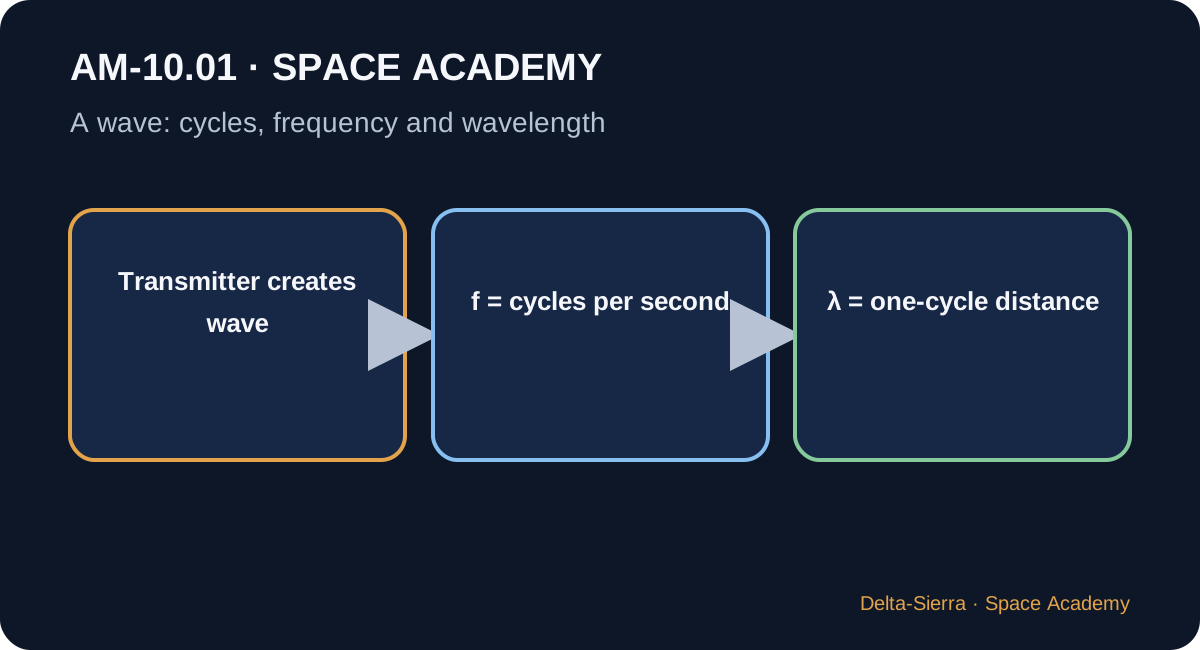
One phenomenon, two views
If a wave repeats very many cycles per second, each cycle occupies less distance: higher frequency means shorter wavelength because propagation speed is nearly constant in vacuum.
Prefixes avoid huge numbers
400 MHz means 400,000,000 Hz. 8.4 GHz means 8,400,000,000 Hz. Correct prefixes avoid long strings of zeros and reduce errors.
A band does not define the whole link
Saying “X-band” specifies a frequency region, not data rate, power, coding, antenna size, or received quality. Those come in later lessons.
4 — The formulas, only now
A formula is a compressed sentence. We unpack it before using it.
How to read it : “lambda equals c divided by f.” λ is wavelength, c is the speed of light in vacuum, and f is frequency.
Speed is distance per time. A wave of frequency f completes f cycles per second, so one cycle occupies the one-second travel distance divided by the number of cycles.
How to read it : “f equals c divided by lambda.”
It is the same relation rearranged: known wavelength gives frequency.
5 — What the units tell us
Frequency uses Hz, kHz, MHz, or GHz. Wavelength uses metres or centimetres. For calculations, convert prefixes first: 400 MHz = 4.00 × 10^8 Hz. Light speed in vacuum is about 2.998 × 10^8 m/s.
6 — Three concrete demonstrations
Example 1 — UHF near 400 MHz
Compute a representative wavelength near UHF rover-to-orbiter links.
f = 400 MHz = 4.00 × 10^8 Hz
λ = 2.998 × 10^8 ÷ 4.00 × 10^8
λ ≈ 0.75 m
Example 2 — X-band near 8.4 GHz
Take a teaching frequency of 8.4 GHz.
f = 8.4 × 10^9 Hz
λ = 2.998 × 10^8 ÷ 8.4 × 10^9
λ ≈ 0.0357 m ≈ 3.57 cm
Example 3 — Find frequency
A wave has λ = 0.10 m.
f = c ÷ λ
f ≈ 2.998 × 10^8 ÷ 0.10
f ≈ 2.998 × 10^9 Hz ≈ 3.0 GHz
7 — Deepening: what the summary hides
Why multiple bands
Different frequencies trade antenna size, beamwidth, path loss, electronics, regulation, and propagation. A mission may therefore use several bands for different functions.
Radio and optical
Optical communication also uses electromagnetic waves, but at vastly higher frequencies with lasers and very precise pointing. NASA SCaN treats radio and optical as complementary domains.
Speed in a medium
The simple equation uses c in vacuum. Propagation is slower in cables or material media. For interplanetary free space, using c is appropriate.
Carrying information
A pure carrier does not yet contain a Mars image. The transmitter changes amplitude, phase, frequency, or other properties through modulation and adds coding and synchronization. That deserves a later lesson.
8 — Why this matters for Mars
Mars rovers use UHF links to orbiters and X-band direct links to Earth. Frequency and wavelength help explain why their antennas differ in shape, size, and directivity.
A future Mars settlement would combine local networks, orbital relays, and interplanetary links. Frequency, band, and wavelength appear throughout even though powers and distances differ radically.
9 — Common traps and bad intuitions
- Confusing frequency with data rate.
- Thinking higher frequency travels faster in vacuum.
- Forgetting to convert MHz or GHz to Hz.
- Saying radio waves need air to travel.
- Treating physical antenna length as always equal to wavelength.
10 — Guided exercises and answers
Question : Approximate wavelength at 1 GHz?
Question : Does 800 MHz have a longer or shorter wavelength than 400 MHz?
Question : Why is “X-band = 8.4 GHz” only an example?
11 — What I should be able to explain at the end
- Define cycle, frequency, hertz, and wavelength.
- Read kHz, MHz, and GHz correctly.
- Use λ = c/f with units.
- Explain why higher frequency means shorter wavelength.
- Distinguish frequency band from data rate.
12 — NASA / JPL sources for further study
Primary institutional sources used to check concepts and orders of magnitude.