Lesson compass
AM-08.07 — Attitude: roll, pitch, yaw and why quaternions exist. The lesson starts with a concrete scene, defines every word and symbol, and only then introduces equations and mission decisions.
1 — Start from a concrete scene
A spacecraft can remain at exactly the same point while pointing in completely different directions. Its position has not changed, but its attitude has. To point an antenna at Earth, a thruster correctly, or a camera at Mars, attitude knowledge is essential.
Roll, pitch, and yaw provide an aviation-like intuition, but 3D rotations do not combine like simple additions. Space systems often use matrices or quaternions to avoid ambiguities associated with some angle sequences.
2 — Essential vocabulary before going further
None of these words should remain mysterious. A short definition is better than unexplained jargon.
- Attitude
- Orientation of a vehicle relative to a reference frame.
- Roll
- Rotation about the vehicle longitudinal axis.
- Pitch
- Rotation that raises or lowers the nose in a common convention.
- Yaw
- Rotation turning the nose left or right in a common convention.
- Rotation matrix
- An array of numbers describing how one frame’s axes are oriented relative to another.
- Quaternion
- A four-component rotation representation that composes attitudes without some Euler-angle singularities.
3 — See the system before calculating
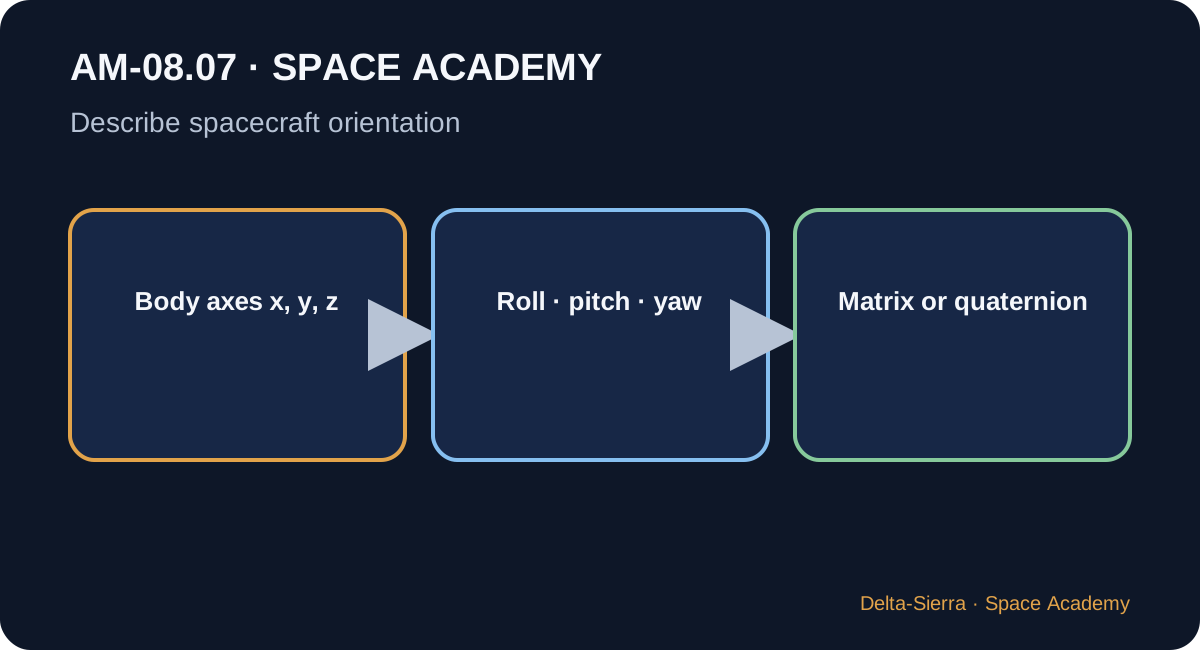
Three body axes
First define a frame attached to the spacecraft. Its x, y, and z axes move with the vehicle. Rotations are then described relative to these directions or an external frame.
Rotation order matters
Rotating 90° about one axis then 90° about another generally differs from reversing the order. Three-dimensional rotations do not commute.
Why change representation
Euler angles are intuitive, but some attitudes produce a representation singularity commonly called gimbal lock. Quaternions provide a compact robust form for onboard computation, though they are less intuitive.
4 — The formulas, only now
A formula is a compressed sentence. We unpack it before using it.
How to read it : “q is a quaternion made of q zero, q one, q two, q three.”
The four values jointly encode one orientation; they are not four independent angles.
How to read it : “q zero squared plus q one squared plus q two squared plus q three squared equals one.”
A rotation quaternion is normally normalized. This constraint keeps its mathematical norm equal to one.
5 — What the units tell us
Angles use degrees or radians. Rotation-quaternion components are dimensionless. Rotation matrices are also dimensionless because their entries describe geometric projections between axes.
6 — Three concrete demonstrations
Example 1 — Pure roll
A spacecraft keeps its nose direction but rotates 30° about its longitudinal axis.
position: unchanged
nose direction: unchanged
roll: +30°
Example 2 — Rotation order
Imagine 90° yaw then 90° pitch; now reverse the two operations.
rotation A: yaw → pitch
rotation B: pitch → yaw
final attitude A ≠ B in general
Example 3 — Check the norm
A teaching quaternion is [0.8, 0.6, 0, 0].
0.8² + 0.6² = 0.64 + 0.36
sum = 1
7 — Deepening: what the summary hides
Euler angles are useful but conventional
Roll, pitch, and yaw words do not fully define the mathematics. The sequence and the frame about which each rotation is applied must also be stated.
Gimbal lock is not a gyro failure
It is a representation singularity for some Euler-angle sequences, not necessarily a physical mechanical lock. Two rotational degrees of freedom become mathematically indistinguishable in that description.
Quaternion double cover
Quaternions q and −q represent the same physical rotation. This is surprising at first but does not mean two different attitudes.
Attitude knowledge versus control
Knowing where you point is an estimation task. Rotating the vehicle to a commanded attitude is a control task. They interact but are distinct.
8 — Why this matters for Mars
A Mars mission must point solar arrays at the Sun, antennas at Earth or a relay, sensors at targets, and engines along commanded axes. Attitude therefore crosses almost every subsystem.
During descent or landing, orientation can change rapidly. Robust nonsingular attitude representations become essential for automatic control.
9 — Common traps and bad intuitions
- Confusing position and attitude.
- Naively adding 3D rotations like ordinary numbers.
- Using roll/pitch/yaw without defining convention.
- Thinking a quaternion contains four angles.
- Forgetting numerical quaternion normalization after some operations.
10 — Guided exercises and answers
Question : A vehicle rotates without translation. Does position change?
Question : Why must the order of two rotations be recorded?
Question : Is quaternion [0.5, 0.5, 0.5, 0.5] normalized?
11 — What I should be able to explain at the end
- Distinguish position from attitude.
- Define roll, pitch, and yaw as an intuitive starting point.
- Explain why rotation order matters.
- Describe a rotation matrix without computing a full one.
- Explain why quaternions are used and check a simple norm.
12 — NASA / JPL sources for further study
Primary institutional sources used to check concepts and orders of magnitude.