1 — The real situation before the formula
Pressure loss can be slow or rapid. Sensors track total pressure, rate of decay and sometimes acoustics or flow. A survival architecture limits volumes, provides isolation hatches and valves, preserves gas reserves and defines a pressurized refuge. Available time depends on volume, pressure, leak size and flow regime; simple calculations are only for reasoning before detailed compressible-flow models.
On Mars, distance prevents treating Earth as an instant repair service. A vital function must be monitored, maintainable, isolatable and recoverable by the crew using equipment already present.
2 — Essential vocabulary
- ECLSS
- Environmental Control and Life Support System: functions that keep the crew environment habitable.
- Loop
- Chain in which a resource or flow is processed and then reused or discharged.
- Boundary
- Precise limit of what a recovery rate or balance counts.
- Margin
- Separation between available capability and requirement, retained for uncertainty and failures.
- Degraded mode
- Configuration where some functions are reduced to preserve vital functions.
- Common cause
- Single event capable of defeating several redundant elements at once.
3 — See the loop and its interfaces
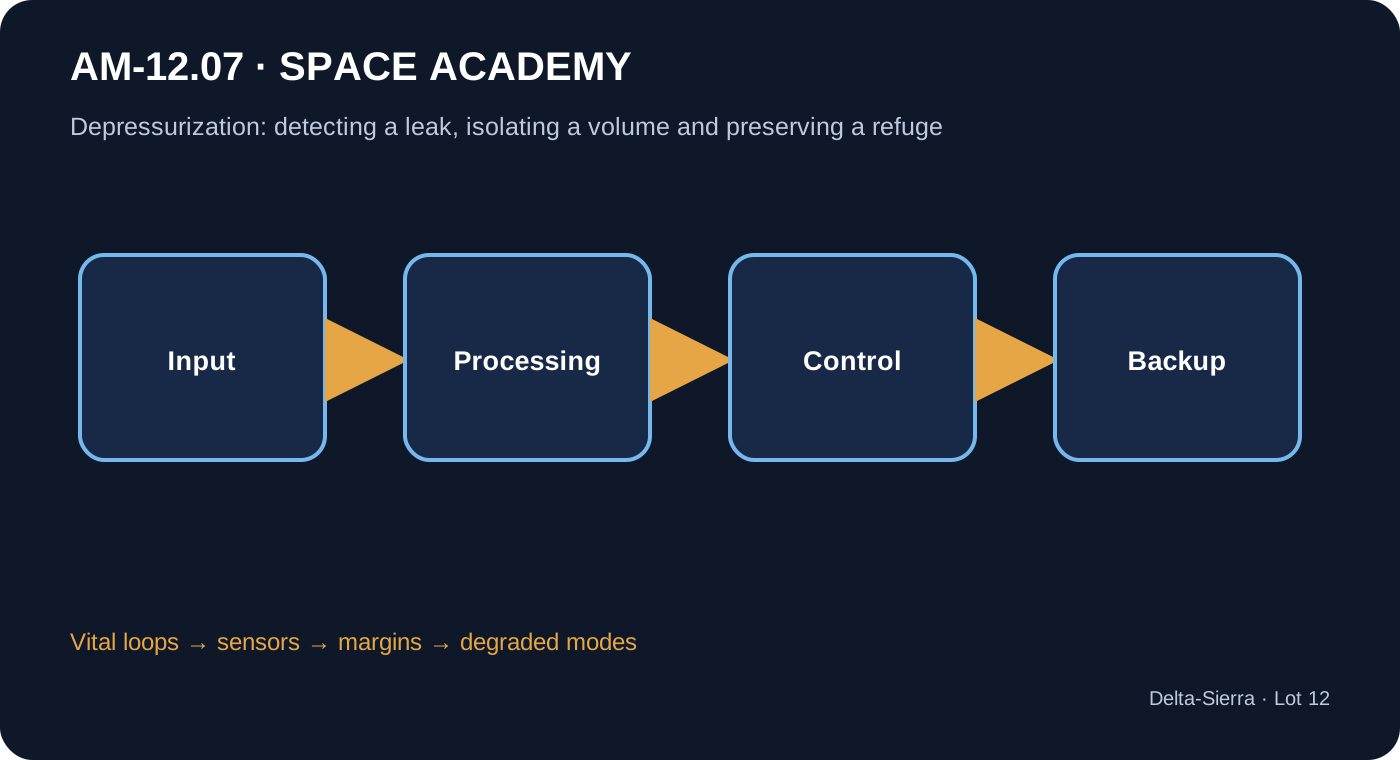
1. leak detection
The point must be connected to other subsystems. Always ask: what quantity is measured, what limit triggers action, what reserve exists, and how does the crew recover after failure?
2. compartmentation and isolation
The point must be connected to other subsystems. Always ask: what quantity is measured, what limit triggers action, what reserve exists, and how does the crew recover after failure?
3. gas reserves and refuge
The point must be connected to other subsystems. Always ask: what quantity is measured, what limit triggers action, what reserve exists, and how does the crew recover after failure?
4. temporary repair then requalification
The point must be connected to other subsystems. Always ask: what quantity is measured, what limit triggers action, what reserve exists, and how does the crew recover after failure?
4 — The mathematical relation and every symbol
Read aloud : for an ideal gas, pressure p times volume V equals amount n times gas constant R times temperature T; a simple rate can be estimated as pressure change divided by time.
Before any operation, write the units and state whether the relation is physical, an approximation, or an operational management indicator.
5 — Three detailed calculations
1. Measured decay
Data → units → substitute symbols → operation → interpretation.
101 − 99 = 2 kPa in 10 min → 0.2 kPa/min in a linear approximation
2. Simplified time
Data → units → substitute symbols → operation → interpretation.
from 99 to 70 kPa at 0.2 kPa/min → 29/0.2 = 145 min, only if rate stayed constant
3. Gas reserve
Data → units → substitute symbols → operation → interpretation.
12 kg + 12 kg = 24 kg; separated bottles reduce single-loss risk
6 — Measurements, sensors and action thresholds
A vital function only exists operationally if the crew can know its state. Define observed variables, sampling cadence, useful independent sensors, alarms, switching thresholds and plausibility checks between sensors.
A single number must not hide a trend: pressure that is still acceptable but falling quickly may be more urgent than a slightly off-nominal but stable value.
7 — Stocks, consumables, losses and make-up
Every real loop has losses, filters to replace, wear parts, cleaning operations and maintenance phases. The balance must translate a recovery rate into kilograms, litres, kilowatt-hours, cartridges, days of endurance and make-up mass.
8 — Credible failures and common causes
- electrical or thermal loss;
- drifting or contradictory sensor;
- saturated filter, bed or membrane;
- contamination or leak;
- human error during maintenance;
- one event defeating multiple redundancies.
Redundancy is therefore not merely “two machines.” Independence of power feeds, sensors, paths, volumes, software and critical spares is sought where justified.
9 — Survival mode and refuge
Survival mode predefines what remains essential: pressure, oxygen, minimum CO₂ removal, potable water, compatible temperature, communications, emergency lighting and medical capability. Non-vital loads are shed and the crew may consolidate if that increases endurance.
10 — How to demonstrate system credibility
Evidence combines analyses, mass and energy balances, component tests, endurance tests, deliberate contamination, injected failures, integrated tests, timed maintenance and crew scenarios. Nominal laboratory performance proves neither repairability nor resilience.
11 — Synthesis exercises
1. Identify one course value that depends on a system boundary.
2. What changes if power and ventilation fail simultaneously?
13 — Turn the function into a verifiable requirement
For leak detection, the requirement must be observable: tracked variable, allowed range, permitted time outside that range, sensor accuracy and expected action. A sentence such as “the system shall work properly” cannot be verified. Prefer an explicit chain: entry condition, minimum capability, alarm criterion, automatic or crew response, then criterion for return to nominal. This also forces the design to state who has decision authority when sensors disagree. On Mars, critical documentation must remain usable without immediate ground response, so every vital requirement needs a local procedure and a safe configuration.
14 — Mass, power, heat and crew-time budgets
The topic compartmentation and isolation is never free. Every kilogram of consumable or redundancy increases transported mass; every pump, heater, fan or lamp uses electricity and eventually adds heat that must be rejected; every maintenance task consumes crew time. At minimum, four coupled budgets are maintained: mass, electrical power, thermal load and human time. A solution that is more energy-efficient may be harder to repair; a lighter one may require more consumables. The objective is not to optimise one spreadsheet column in isolation but to preserve total survival capability in nominal and degraded modes.
15 — Instrumentation, data and diagnosis
For gas reserves and refuge, diagnosis must distinguish real degradation from sensor failure. Where possible, independent measurements, physical balances and time trends are compared. A concentration can be checked with another sensor; a stock loss can be compared with measured flow and mass balance; a filter can be tracked through pressure drop and operating time. Raw data should be timestamped and retained long enough to reconstruct an event. Telemetry to Earth remains valuable for delayed expertise, but local crew and automation must have enough information to make the first decision without waiting.
16 — Maintenance, contamination and configuration
The issue temporary repair then requalification must be designed in from the start. A critical part hidden behind other hardware, a connector that cannot be handled with gloves, or a filter replacement that spreads its contaminant can turn routine maintenance into a major hazard. Replaceable units, tools, torque values, consumables, clean surfaces, decontamination steps and post-maintenance tests are defined. Each replacement also updates configuration records: serial number, date, lot, failure history and operating time. This traceability makes recurring problems visible and improves spare-parts planning.
17 — Degraded scenario: reason before the emergency
A useful exercise asks more than “what if the system fails?” It combines constraints. In a generic scenario, the primary function is unavailable for six hours while another unit is under maintenance and crew consumption cannot stop. Calculate buffer stock, backup power and time to a limit; decide what can be shed; prepare the repair; then verify that restart does not introduce new contamination or configuration error. This turns abstract redundancy into actual time available for action.
18 — What still has to be demonstrated for a Mars base
ISS provides extraordinary heritage, but Mars adds distance, different gravity, dust, surface cycles, no rapid evacuation and very long logistics chains. Before calling a function “Mars-ready,” demonstrate endurance, maintenance with carried tools, behavior after storage, tolerance to relevant contamination, interaction with other loops and crew recovery after failure. Component maturity is not automatically system maturity. A technical Bible must preserve the distinction between measured performance, integrated demonstration and operational mission capability.
12 — NASA sources / further study
These references are used to check state of the art, human requirements and demonstrated performance. They do not validate a particular Delta-Sierra architecture.
- NASA — Environmental Control and Life Support Systems (ECLSS)
- NASA — Water recovery milestone: 98% demonstrated
- NASA NTRS — Life Support Baseline Values and Assumptions Document
- NASA — Human Research Program risks
- NASA — The Human Body in Space
- NASA — Spacesuits, NASA-STD-3001 technical brief
- NASA — EVA Systems
- NASA — Space Crops
- NASA — Exploration Medical Technologies
- NASA — Health and Medical Care, NASA-STD-3001 Vol. 2
- NASA — Combustion Science and spacecraft fire safety
- NASA NTRS — Applying ISS insights to exploration ECLSS