1 — The concrete scene
Trajectory corrections, insertion, station keeping, rendezvous and control use propulsion suited to very different needs.
The key point is never to isolate this subject from the rest of the spacecraft. A local change often moves mass, power, heat, data, software, testing or risk elsewhere in the system.
2 — Essential words, explained before using them
Before calculating, we define every word that will be used next. The goal is for the symbol to come after the idea, never before it.
- Thrust
- Propulsive force in N.
- Delta-v
- Required velocity change.
- Impulse
- Force accumulated over time.
- Isp
- Specific impulse, indicator related to exhaust velocity.
- Chemical
- Propulsion powered by chemical reaction.
- Electric
- Electric power accelerates propellant.
3 — See the architecture before calculating
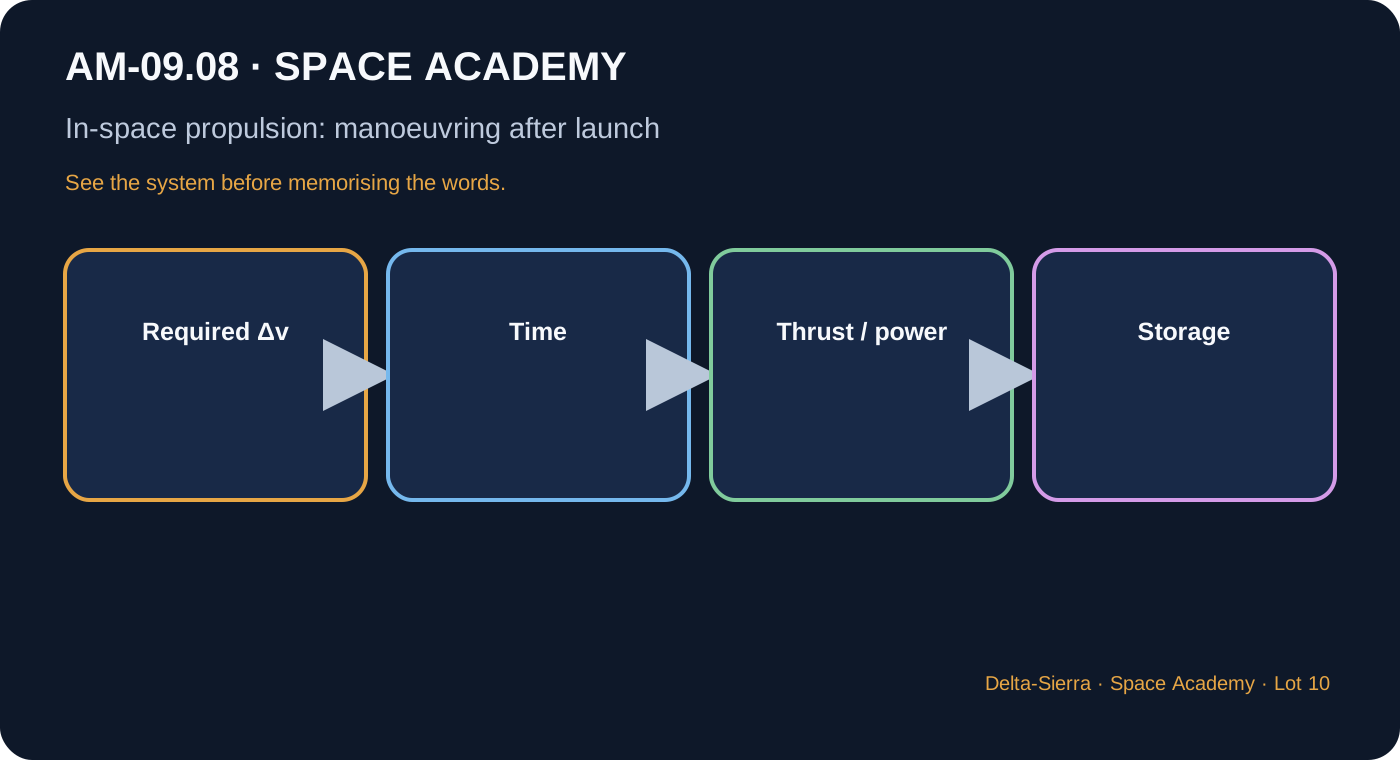
Force
The jet transfers opposite momentum to the vehicle.
Duration
Low thrust over long time can build significant Δv.
Storage
Tanks, valves and thermal control belong to the system.
GNC
Thrust time and direction come from navigation and control.
4 — Formulas, only when they answer a question
A formula is useful only if we know which question it answers, what every symbol means, and which units must be used.
How to read it : impulse equals thrust times duration
For approximately constant thrust.
How to read it : acceleration equals force divided by mass
For equal thrust, a heavier vehicle accelerates less.
5 — What units and margins mean
N, N·s, kg, m/s², m/s and s for Isp. Propellant flow can be kg/s.
6 — Three concrete demonstrations, calculated step by step
Acceleration
200 N on 20,000 kg.
a=200/20,000
=0.01 m/s²
100 s → Δv≈1 m/s
Impulse
4 thrusters of 5 N for 20 s.
F=20 N
J=20×20=400 N·s
For 1,000 kg, Δv≈0.4 m/s
Electric propulsion
2 kW for 10 h.
E=2×10=20 kWh
=72 MJ
That energy must be generated and partly rejected as heat.
7 — Deepening: what the simplified diagram hides
Chemical / electric
Thrust, efficiency and duration optimise differently.
Isp
Higher does not mean better for every mission.
Storage
Cryogenic, pressurised and storable options differ.
Plume
Jet can heat or contaminate nearby surfaces.
Calibration
Thrust or alignment error becomes trajectory error.
8 — Application to an Earth-Mars spacecraft
On an Earth-Mars transit, long duration turns a small weakness into cumulative risk: ageing, drift, consumption, cycles and maintenance become as important as nominal performance.
Communication delay forces the vehicle and possibly the crew to diagnose and reconfigure locally. Design must therefore remain observable, understandable and testable in degraded modes.
9 — Reference dossier: what a real project must still consider
This section deliberately goes beyond the introductory calculation. It connects the concept to interfaces, failures, testing, duration and maintenance so the lesson can serve as a reference chapter rather than a revision card.
Space propulsion serves different missions
Launch engines, cruise thrusters, attitude-control jets and rendezvous propulsion solve very different problems. Thrust, specific impulse, mass, power, storage, restart count, precision and lifetime must therefore be evaluated together. There is no universally 'best engine'.
Thrust and acceleration depend on vehicle mass
The same force produces different acceleration according to mass: a = F/m. This is especially important for electric propulsion, where low thrust applied for weeks or months can accumulate substantial velocity change.
Specific impulse is useful but not sufficient
High specific impulse usually reduces propellant needed for a given delta-v, but it says nothing by itself about manoeuvre time, electrical power, tank volume or whether thrust is high enough for a rapid capture.
Propellant storage is part of propulsion
Cryogenic, storable and pressurised propellants impose different thermal, material and operational constraints. Valves, regulators, sensors and propellant gauging are part of system reliability, especially on long missions.
Thruster plumes interact with the spacecraft
Plumes can heat or contaminate surfaces and create unwanted torque. Thruster placement must account for plume zones and centre-of-mass motion as consumables change.
Thrust errors become navigation errors
Real burns have magnitude, direction and timing errors. Navigation estimates the achieved state after a manoeuvre and may command corrections, coupling propulsion and navigation through models, timing and telemetry.
Local propellant is not full propulsion autonomy
Mars-produced propellant still requires purification, storage, compatible materials, metrology, spare parts and qualified engines. True autonomy must be measured across the complete resource-to-thrust chain.
10 — Common traps and bad intuitions
- Comparing only Isp.
- Ignoring power and time for electric propulsion.
- Treating tanks and valves as details.
11 — Guided exercises
Question : What question comes before choosing hardware?
Question : Why is a nominal result insufficient?
12 — What to remember
- Explain the topic in simple words before symbols.
- Connect at least four interfaces with other subsystems.
- Redo the three numerical examples without reasoning gaps.
- Identify at least three limits or failure modes absent from the ideal calculation.
13 — NASA sources for further study
Primary institutional sources used to check the lesson structure. Teaching-number examples are identified as such.