1 — The concrete scene
In vacuum there is essentially no external air to carry heat by convection. Internal heat must be conducted, transported and radiated.
The key point is never to isolate this subject from the rest of the spacecraft. A local change often moves mass, power, heat, data, software, testing or risk elsewhere in the system.
2 — Essential words, explained before using them
Before calculating, we define every word that will be used next. The goal is for the symbol to come after the idea, never before it.
- Conduction
- Transfer through matter or contact.
- Convection
- Transfer by moving fluid.
- Radiation
- Electromagnetic emission related to temperature.
- Radiator
- Surface rejecting heat by radiation.
- MLI
- Multi-layer insulation limiting radiative exchange.
- Heat pipe
- Device efficiently transporting heat.
3 — See the architecture before calculating
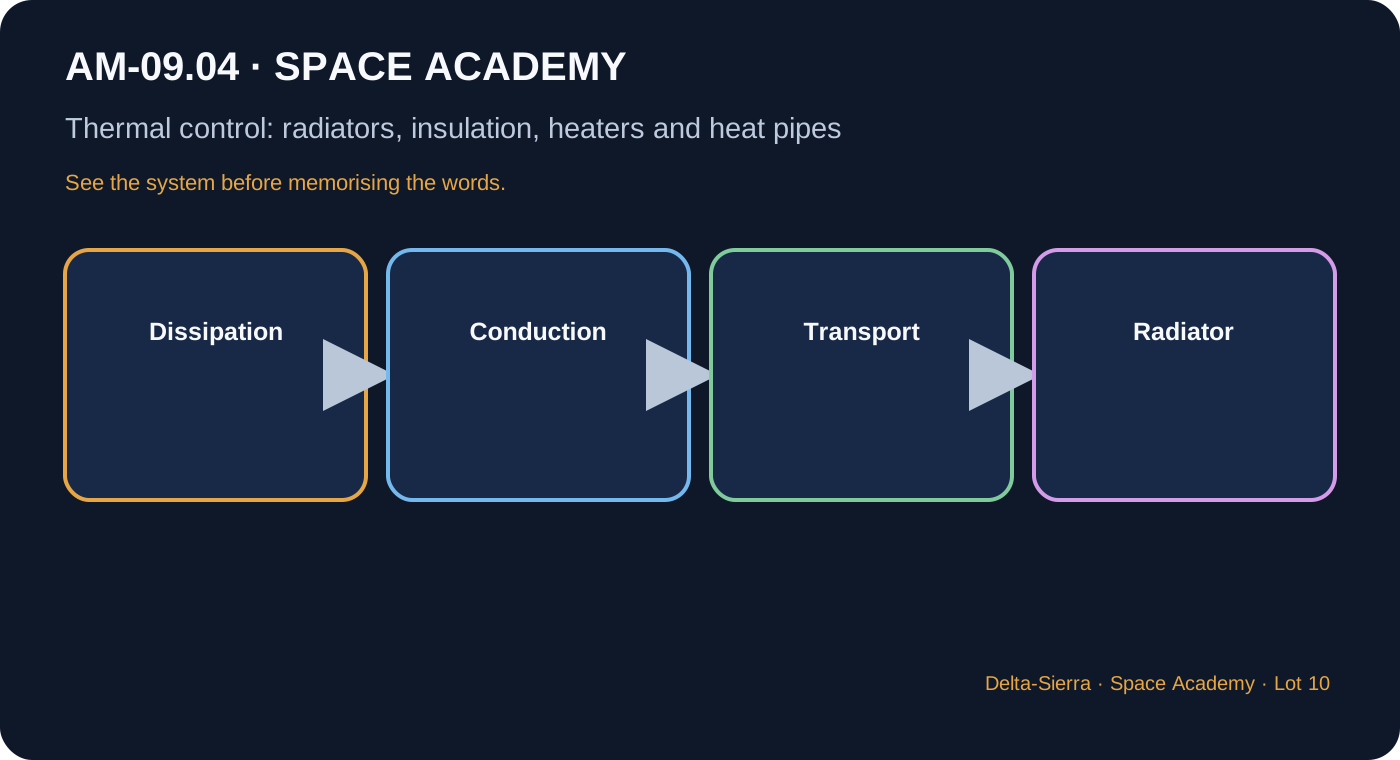
Internal heat
Electronics, batteries and people dissipate heat.
Insulation
Insulating does not mean cooling.
Transport
Straps, heat pipes or fluids move heat.
Rejection
Radiators exchange by radiation with the environment.
4 — Formulas, only when they answer a question
A formula is useful only if we know which question it answers, what every symbol means, and which units must be used.
How to read it : Q equals mass times heat capacity times temperature change
Estimates energy to change a mass temperature.
How to read it : approximate radiated power
T must be in kelvins; a real balance includes absorbed radiation.
5 — What units and margins mean
K for absolute temperature, W for thermal power, J for energy.
6 — Three concrete demonstrations, calculated step by step
Heating
10 kg, c=900 J/kg/K, ΔT=20 K.
Q=10×900×20
=180,000 J
At ideal 200 W: 900 s=15 min
Converter
Input 500 W, output 460 W.
Loss=40 W
η=460/500=92%
40 W to reject.
Kelvin
Surface at 27 °C.
T=27+273.15=300.15 K
≈300 K
300⁴=8.1×10⁹ K⁴
7 — Deepening: what the simplified diagram hides
Passive
Coatings, MLI, straps, heat pipes, radiators.
Active
Heaters, pumps, cryocoolers or thermoelectrics.
Field of view
A radiator can also absorb Sun or planet energy.
Thermostats
Control avoids unnecessary cycling and excursions.
Thermal-vacuum testing
It correlates model, temperatures and interfaces.
8 — Application to an Earth-Mars spacecraft
On an Earth-Mars transit, long duration turns a small weakness into cumulative risk: ageing, drift, consumption, cycles and maintenance become as important as nominal performance.
Communication delay forces the vehicle and possibly the crew to diagnose and reconfigure locally. Design must therefore remain observable, understandable and testable in degraded modes.
9 — Reference dossier: what a real project must still consider
This section deliberately goes beyond the introductory calculation. It connects the concept to interfaces, failures, testing, duration and maintenance so the lesson can serve as a reference chapter rather than a revision card.
In vacuum, heat does not simply disappear
Outside a spacecraft, convection through air is essentially absent. Heat moves internally by conduction and is ultimately radiated to space. Radiator equilibrium therefore depends on rejected power, area, surface properties and what the surface sees: cold space, Sun, Earth, Mars or another warm vehicle surface.
Passive control is valuable but not trivial
Coatings, multilayer insulation, heat pipes, thermal straps, conductive interfaces, sunshields and radiators can manage heat with little continuous control power. Their performance still depends strongly on orientation, ageing, contamination, contact conductance and geometry.
Active control adds capability and dependency
Heaters protect batteries, fluid lines and mechanisms; pumps move coolant; cryocoolers reach very low temperatures. These devices consume power, depend on sensors and control logic, may vibrate and may fail. A survivable passive or degraded state is therefore valuable.
A radiator must see the right environment
A heat-rejection surface can absorb heat if it sees the Sun or a warm planet. View factors and spacecraft attitude therefore matter. A communications pointing change can alter radiator illumination, coupling GNC, communications and thermal design.
Transient thermal behaviour matters
Temperature has inertia. Steady-state analysis asks where temperature eventually settles; transient analysis asks how long it takes to reach a limit. For short manoeuvres or eclipses, time-to-limit can be more useful than final equilibrium.
Why thermal-vacuum testing matters
Thermal models contain conductances, dissipation, radiative properties and geometry. Thermal-vacuum tests measure actual temperatures and response so the model can be correlated. Hot-cold cycling can also expose workmanship and material problems.
Mars adds atmosphere, soil, seasons and dust
Mars surface thermal control is not deep-space thermal control. Thin atmosphere, soil coupling, daily and seasonal temperature cycles and dust modify the environment. Habitats, external equipment, fluid lines and power systems form a distributed thermal infrastructure that must be maintained.
10 — Common traps and bad intuitions
- Thinking vacuum cools like cold air.
- Confusing insulation and cooling.
- Using °C in T⁴.
11 — Guided exercises
Question : What question comes before choosing hardware?
Question : Why is a nominal result insufficient?
12 — What to remember
- Explain the topic in simple words before symbols.
- Connect at least four interfaces with other subsystems.
- Redo the three numerical examples without reasoning gaps.
- Identify at least three limits or failure modes absent from the ideal calculation.
13 — NASA sources for further study
Primary institutional sources used to check the lesson structure. Teaching-number examples are identified as such.